BUDDHISM IN JAPAN

7%

S. D. A. Publishing Association · Battle Creek, Mich. · Oct 24, 1895

FromThe Youth’s Instructor, Vol. 43, No. 43.

Read the full edition

BUDDHISM IN JAPAN.

“Buddhism” is the name of a religion that originated in India almost five hundred years before Christ. It arose from the teachings of Gautama, who was the son of a raja. When Gautama was a young man, he became deeply impressed by the scenes of misery and woe that he saw about him, and resolved to seek for some panacea from the sorrows of life, for suffering humanity. He left his father’s home of wealth and splendor, and his wife and infant son, and went out into the world as a beggar, to seek enlightenment. For six years he gave himself up to fasting and self-torture, without being able to solve the problem, till at last he fell to the ground from weakness. He then ceased his severe penances, and took regular food.
He felt greatly discouraged, and sat down one day under a tree to rest and meditate. He wrestled with doubt all day; but the religious side of his nature predominated, and he came out from the struggle a buddha, or the enlightened one. He then became a teacher, and gathered about him many disciples, who followed him about to listen to his words of wisdom, and find out how to become enlightened like himself. By and by his doctrines spread, and finally became the religion of nearly all Asia. Many of the teachings of Buddha were pure and elevating in their character, and at first his adherents were real benefactors of mankind. But like all other man-made religions, Buddhism has become corrupt, and in consequence has degenerated into a system of superstitious rites and ceremonies.
Buddhism declares that all men are equally sinful and miserable, but that all are capable of being freed from sin and misery through knowledge. It teaches that the souls of all men lived in a previous state of existence, and that all trouble in this life is due to sin committed in a life prior to this, perhaps centuries ago; that after death the soul must be reborn into different conditions of life, at each birth rising higher and higher in the scale of being, until at last it is absorbed into Nirvana, and ceases to be, which is the greatest good that can come to man.
The commandments of Buddha prohibit lying, stealing, adultery, drunkenness, and murder. There are also precepts against hypocrisy, anger, pride, and many other vices. Buddhism spread from India to Ceylon, Siam, Burma, Tibet, China, Korea, and thence to Japan.
The native Japanese historians say that an image of Buddha and some books of Buddhist scriptures were proffered to the mikado Kimmei by the king of one of the Korean provinces, in A. D. 552. The mikado wanted to accept the gifts, but his council, who were Shintoists, insisted upon his rejecting them. He thereupon gave them to one Soga-no-Iname, who turned his own home into a Buddhist temple. Monks and nuns began to flock over from Korea in large numbers. Some of the princes and nobles embraced Buddhism, and it continued to spread until it became the chief religion of Japan. It was not established without a struggle, chiefly with the Shintoists, who sacrificed to the spirits of the dead, and did homage to the mikado as a god; but Buddhism finally became reconciled to all opposing cults through amalgamation, and accepted into its pantheon all Shinto deities, teaching that they were transmigrations of Buddha.
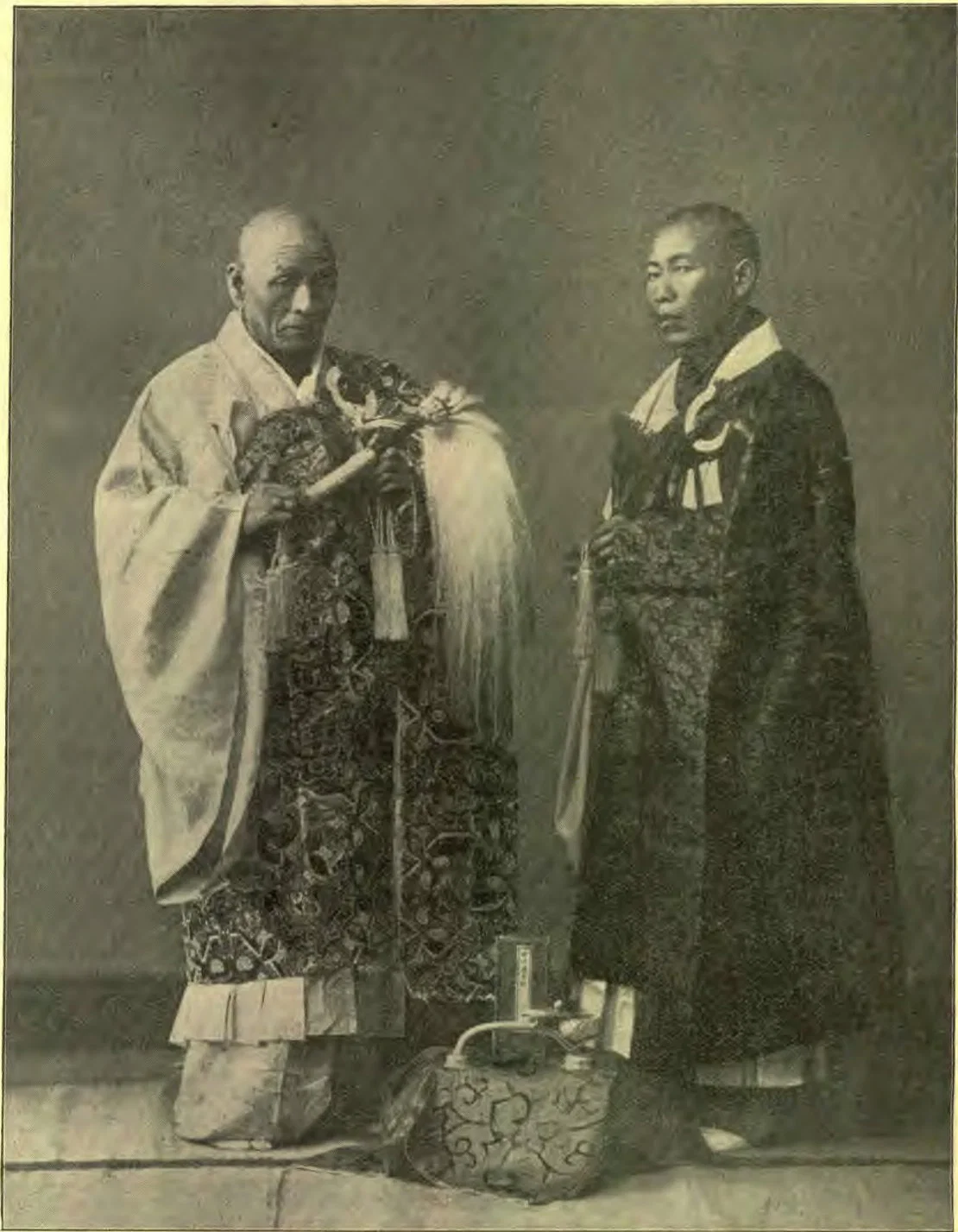
BUDDHIST PRIESTS.
BUDDHIST PRIESTS.
The Buddhists in Japan, as in other countries, are divided into numerous sects, who are greatly at variance with each other, and differ widely in their teachings. The chief sects now existing in Japan are the Tendai, Shingon, Jodo, and Zen, which are of Chinese origin. There are two more, which originated in Japan in about the thirteenth century, called the Nichiren and Shin sects.
The first bears the name of its founder, who was born about 1222 A. D. He spent a busy life in teaching and preaching his doctrines. He was greatly given to controversy, and his disciples have inherited the same spirit, for they are extremely bigoted, and openly abuse all who oppose them. Their meetings are very noisy. They beat drums, and sing out the same prayer over and over again, and shout until they are exhausted. They sometimes work themselves into such a state of excitement that it ends in insanity.
Shinran was the founder of the Shin sect. He taught by precept and example that celibacy was an invention of the priests, and not a part of the original teaching of Buddha. He regarded penances, fasting, pilgrimages, the wearing of chains, etc., as folly, and taught that prayer, purity, and trust in Buddha were the only means of salvation. The Shinshuists are called the Protestants of Japan. They hold a form of doctrine of justification by faith, believing in Buddha instead of Christ. This sect is very strong in Japan. They are among the strongest and most aggressive opponents of Christianity in the empire.
Like the Roman Catholics, most of the Buddhists believe in and practise asceticism, and make celibacy compulsory upon the priesthood. There are a great many monasteries and convents in Japan, well filled with priests, monks, and nuns, many of whom live lives that are far from saintly. In fact, the majority of the Buddhist priests are ignorant and immoral, and the better classes of the people have but little confidence in them.
In reality, Buddhism is losing its hold upon the upper classes; but the ignorant masses are still abject slaves to its superstitions. They buy amulets and charms at the temples, and wear them to ward off danger. They go through forms of conjuring to dispel evil spirits, and burn incense to propitiate the good ones. They live all their lives in abject bondage to fear.
The most enlightened Buddhist priests are waking up to a realization of the fact that Christianity is progressing in the Island Empire, and leaving Buddhism in the rear, as a thing of the past. They are advocating and adopting Christian methods, such as schools for the education of the youth, benevolent societies, and all modern means of reaching and keeping a hold upon the minds and hearts of the people. They teach their followers that Christianity is an evil religion, and that the Japanese who believe in it are disloyal to all the best interests of Japan.
But the pure, honest lives of the missionaries and native Christians are arguments known and read of all men, and such arguments cannot be controverted. They are bringing to the empire a better understanding of what genuine Christianity really is, and a kinder feeling is springing up in Japan toward the Christian and the religion which he professes. But one unconverted missionary will do more harm than a hundred Buddhists. O that all who go to heathen lands as Christ’s ambassadors might be so filled with his spirit that they would represent him in their lives, so that all coming within their influence would be made to feel that there is a power in the Christian religion that can change the sinful heart,—a power which has no place in that of Buddha, or any other religion invented by man!
MRS. J. A. BRUNSON.