During the early months of 1893 the newspapers of the country were full of matter pertaining to the World's Fair; and among the interesting announcements was one to the effect that the sultan of Johore, an Oriental potentate of great wealth and power, would visit the Columbian Exposition. The American consul, who was responsible for this glowing announcement, left the impression upon the public mind that golden coin, and it might be even precious gems, would be sown broadcast by this royal spendthrift, who had more treasure than he knew what to do with, and who was coming to this country to furnish Yankees with a specimen of the Simon pure article in the line of Oriental sovereigns. The whole land was interested; and many were induced to visit the World's Fair in the hope of seeing this Malay sultan.
The sultan of Johore, Aboubaker, when he saw a report of these highly colored representations, was so incensed that he peremptorily canceled all instructions to his ministers of state for the preparations that had been carried on for this contemplated visit to America. The facts in the case are these: His territory includes about nine thousand square miles of the southern point of the Malay Peninsula. He is nominally independent, but pays tribute to the British crown. His kingdom is heavily mortgaged, and is very insignificant when compared with even so feeble a country as Siam.
The sultan himself died some years ago, and was succeeded by his son. Aboubaker was educated in a missionary school at Singapore, which was established by Sir Stamford Raffles, the founder of the colony. In those early days the Raffles Institution, as the school was called, was a mission school, and Aboubaker received a Christian education. His contact with Englishmen, together with the education he received, had the effect of broadening his character. He was intelligent, had a high appreciation of the advantages that exist in Western civilization, and as far as he was able, made use of them when he came to the throne. He constructed thoroughfares, built bridges, and in various ways sought to better the conditions of the state. He encouraged planters and gave concessions to miners; and, after the example of his European preceptors, he also licensed gambling, the sale of opium, etc. The entire population of his kingdom would not reach half a million, the most important part of which, from an economic point of view, were the Chinese; for from them he derived the greater part of his revenue.
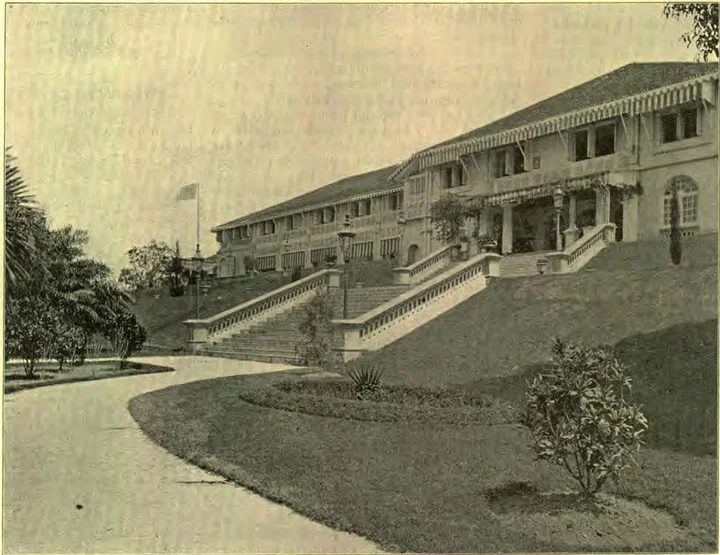
The capital of the kingdom of Johore is situated on the southern shore of the peninsula, opposite the little Island of Singapore, which is separated from the mainland by a narrow strait, less than two miles wide. The capital, Johore Baru, consists of a few hundred Chinese and Malay houses besides the sultan's palace, the harem, the barracks for the state forces, and the government offices. In the picture we have a fine view of the palace, or a portion of it. The right wing does not appear, but can easily be supplied by the imagination. The palace is a two-story bungalow of royal dimensions. There is nothing kingly in its appearance, so far as its exterior is concerned, except its unusual size. Like all Oriental dwellings, a wide veranda extends around the entire building, both above and below. In this building the verandas are enclosed above by Venetian shutters and below by rattan screens. The body of the house is constructed of brick, plastered over with mortar, and is lime-washed. It receives a new coat of calcimine every year, and is thus kept new and attractive in appearance. A tropical luxuriance of vegetation assists the landscape-gardener in harmonizing the surroundings with the appearance of the building itself, and a beautiful and attractive picture is the result.
The interior of the palace is expensively furnished, and is more in keeping with the idea of a royal residence. Priceless rugs cover the floors, and beautiful furniture, tastefully arranged fills all the rooms. I had the pleasure of visiting the palace on several occasions, and found it a very elegant establishment indeed, considering the scanty dimensions and resources of the state. This very elegance partly accounts for the heavy mortgage held by the British government upon the property of the kingdom.
There lived in the town of Johore Baru an enterprising Scotchman, who was engaged in the sawmill and lumber business. At the time of my residence in Singapore, James Meldrum was a man of nearly threescore and ten. He was a trusted counselor of the sultan, and exerted a great influence over him, so much so, indeed, as to excite the jealousy of the ministers of state; but he continued to enjoy the confidence of Aboubaker to the day of hisp. 478 death. By his counsel and advice, many improvements were undertaken, one of the most important of which was the construction of a system of water-works, by which the town is supplied with wholesome drinking-water. The sultan's estimate of the old Scotchman was expressed in his conferring upon him the rank of dato, or prince.
Mr. Meldrum was an earnest Christian, and used his influence and wealth to a considerable extent in helping promote the work of the missions in the state. He kept open house for all missionaries and Christian workers; and no more delightful or quiet retreat could be found than his spacious bungalow, standing on the crest of a cliff that commands a view of the straits for miles in both directions. It was always cool, and an abundance of excellent reading-matter furnished the toiler with the best possible means of rest and quiet recreation. I can never forget the delightful hours spent in this truly Christian nobleman's hospitable home.
The sultan of Johore was abreast of the times in more respects than in having a sumptuous palace. He commanded a small fleet of tiny warships, which were a trifle too large to be called steam launches, and a trifle too small to be dignified with the name of gunboats. They were of modern pattern and construction, and chiefly designed as a means of recreation for his royal highness. He drove fine horses, played billiards well, and enjoyed a hearty repast; but, whatever virtues he lacked, he possessed one that would do credit to a vast number of Americans who consider themselves better men than this petty rajah,—he was a stanch total abstainer, as is every good Mohammedan. While visiting the courts of Europe, he was often rallied on his abstemious habits by different members of the various royal households where he was entertained; but he had sense enough not only to refuse intoxicating beverages, but also to inculcate some homely precepts on the rich rewards of a strictly temperate life. In fact, he regarded himself as superior in character to most of the men that he met, who were not above indulgence to the extent of intoxication. Another of the sultan's favorite pastimes was the bicycle; not that he rode it himself, but he had others ride it in ways that contributed to his amusement. He would organize holiday sports, and offer tempting prizes to the men who could make the fastest or the slowest time, or who could perform strange or novel feats.
The sultan encouraged missionary work among the Chinese; but while he may have been inclined to extend the same privilege to missionaries to the Malays, popular sentiment, together with the influence of the priesthood, rendered such a course impossible. The only missions in the state are those conducted by the English Presbyterian Missionary Society and the Plymouth Baptist body. Thus far the accessions to Christianity from among the Chinese have reached only one or two hundred, but no doubt larger results will be seen in the future. The work is thoroughly and conscientiously conducted, and its good effects are seen in the restraint that it puts upon crime.
The present sultan is on the best of terms with the British government, and spends much of his time in a palace built by his father in the town of Singapore. This is really the residence of the sultan; for but a small part of his time is spent within the boundary of his own state. It was with the old sultan of Johore that Sir Stamford Raffles in 1819 signed a compact securing to the British the Island of Singapore, whereon is now situated the capital of the Straits Settlements.
If any of our readers should ever visit these Eastern lands, and find themselves in Singapore, it will well repay them to engage a carriage or jinrikisha, and enjoy the delightful fifteen-mile ride across the island to visit this little kingdom, which forms the southernmost point of the continent of Asia. R. W. Munson.