Mexico has but two seasons, the rainy and the dry. The rainy season begins in June, and ends with September; so the months from October to June are without rain. During this time everything becomes dry, and the water-supply in some places is almost exhausted. Often water must be carried long distances.
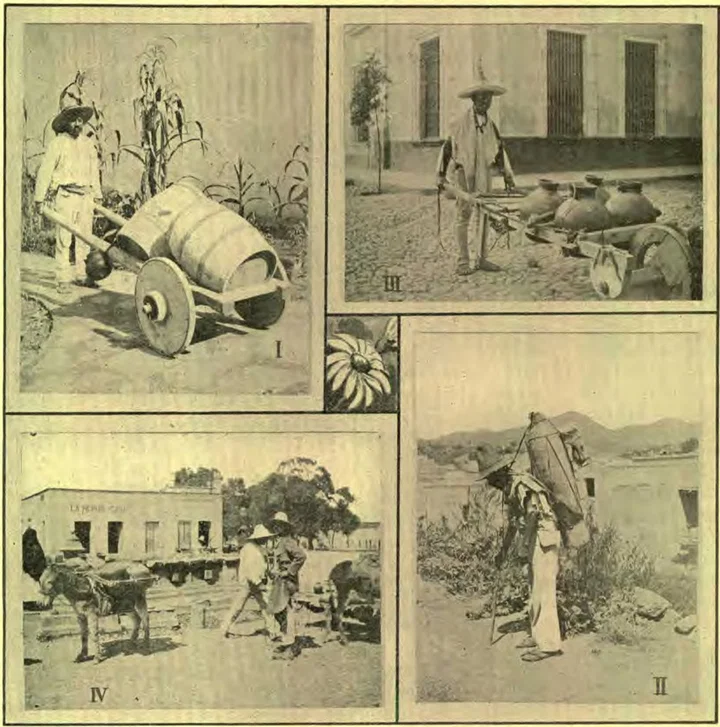
Some of the methods adopted by the Mexicans for carrying water seem very unique to us. In the first picture is shown a water-carrier of northern Mexico. He has utilized some barrels brought over from the “States;” and oddly out of place they look on the rude wheelbarrow, whose wheels are cut out of a solid piece of timber.
The second picture is of a water-carrier of Guanajuato, one of the most picturesque cities of all Mexico. This city has but one main street, which runs up a narrow pass between two mountains. The houses are perched on the sides of these mountains, looking as if one house were built on the back of the one just below it, so steep are the mountain sides. This city has seventy thousand inhabitants, and justly boasts of the most beautiful theater building in Mexico, and one of the most beautiful in the whole world. How strangely out of place with its surroundings appears this beautiful monument of modern architecture, as we see the primitive water-carriers passing in front of it! The first time I saw one of the water-carriers of Guanajuato, I was looking from my door in a hotel. He passed by on the other side of the open court, and emptied the water from the strange bucket of hogskin roped to his back, by bending his body, and letting the water fall over his head.
The water-carrier who brought water to us at the mission in Guadalajara, brought it as you see illustrated in the third picture. The wheelbarrow is rude enough, and the cantaros holding the water are just such jars as we read about in the Bible: they are in common use in Mexico.
Later, when we moved to another street of Guadalajara, water was brought to us by the faithful little burro, with the cantaros fastened to his back.
The peculiar customs and primitive ways of the Mexicans are interesting to us; but when we realize that their lack of knowledge is the result of the oppression they have been subjected to for hundreds of years, we should be anxious to help in some way to reach these poor people with the light of the true gospel.
KATE ROSS MARCHISIO.