Veneering is the art of covering a cheap or inferior grade of wood with a thin leaf, or layer, of a more valuable or ornamental material. It is not a modern invention.
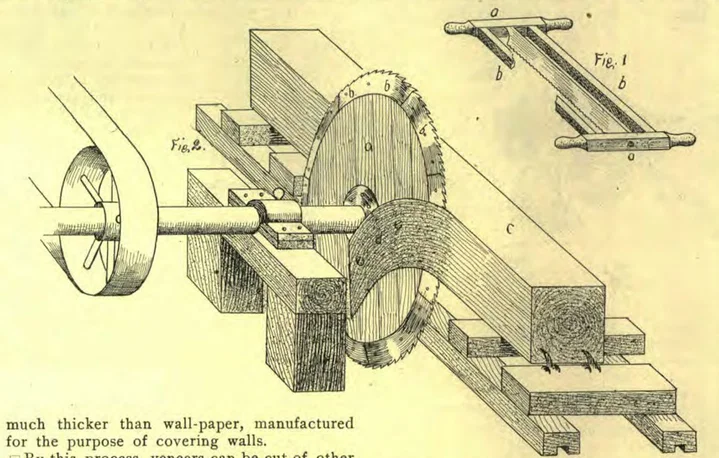
The material of which veneers are made being generally expensive, of course it is desirable to economize as much as possible in cutting it. Formerly veneers were cut at the saw-pit (“a pit over which timber is sawed by two men, one standing below the timber, and the other above”), with very thin plates strained in the common pit-saw frame; or they were cut with a smaller frame-saw, such as is shown in Fig. 1, which represents a saw about four feet long inserted in a frame, to which it is fastened at each end (see a, a), the ends being finished with turned handles. There is also attached at each end of the saw an iron with a nut for the purpose of tightening the saw. You will notice a strip of wood each side of the saw for stretchers (see b, b), the piece on one side being broken off to show the saw. Two men take hold of the saw, and work a board up into veneers about one eighth of an inch thick. My father had one of these saws in his shop. He also used it for resawing one-inch lumber for panels.
When I was a small boy, I visited a mahogany yard in Rochester, N. Y., where there was a saw for sawing logs into veneers. I will try to give some idea of how this was done. The saw differed from saws now used in sawing lumber. There was a large wooden wheel, or what might be called a “face-plate,” made ofp. 336 plank, and fastened together securely with iron clamps. This was turned off perfectly true. See Fig. 2, a. The saw was made in sections, as seen at b, b. The pieces were very thin on the outer edge, but thick where they were screwed to the plate, or wheel. The teeth were fine, with a slight “set.”
In cutting the veneer, the log passed along the side of the saw. See the log, c. As the saw was thick in the center, and upon a flank-wheel, it did not pass through the log like a common buzz-saw; but as the veneer was cut, it was less than one sixteenth of an inch thick. A man stood by the saw, d, and with his hands at e, e, bent the veneer around until it was cut off, thus proceeding until the log was cut up.
You may ask why these saws were put on a wooden wheel. They were large,—sometimes eighteen feet in diameter,—and of course had to be very thin on the edge, to save the timber that would be wasted in sawdust with the ordinary buzz-saw. A few years ago a burl-walnut tree was sold in Indiana for five hundred dollars. When made into veneers, it was worth nearly fourteen thousand dollars. You see, then, that it is important that there be no waste.
□ Within the last few years a machine has been invented for cutting veneers without waste of material. A log is cut the desired length, and boiled or steamed until the wood is soft throughout. It is then placed in this machine, and made to revolve against a knife, which cuts it into very thin strips. I have seen veneers not much thicker than wall-paper, manufactured for the purpose of covering walls.
□ By this process, veneers can be cut of other material than wood. In the United States Department of the great London Exhibition there was an ivory veneer twelve inches wide and forty feet long, cut from a single tusk of an elephant. Some years ago a Mr. Pape, in Paris, veneered a piano with ivory, and advertised to furnish veneering of the same material in sheets thirty by one hundred and fifty inches in size. W. K. Loughborough.