In previous articles we have spoken of the small, temporary garden and the permanent acre-garden. The accompanying diagram shows what can be done for the Master on a quarter of an acre. But whatever the size of your garden, let me insist upon the rotation of crops. Early sweet corn may be followed by late potatoes, cabbage, or string-beans. Early peas may be followed by melons, squashes, or field beans. After strawberries are picked, spinach, lettuce, or late radishes may be planted between the rows. Besides giving an increase of crops, this method of planting will keep the garden free from weeds, and will not exhaust the soil half as much as if they were allowed to grow.
“The amount of ‘green stuff’ that can be grown on a single acre, well tilled, in one summer, is simply incredible,—wagon-loads upon wagon-loads; and there need not be a single meal, from early spring until winter, that is not made more cheerful, more palatable, more wholesome, and altogether more enjoyable, by the presence of some good dishes from the garden, to say nothing about canned tomatoes, sweet corn, berries, crisp stalks of celery, etc., during the winter months. Think,—sixty meals with big plates of strawberries, and sixty more with raspberries and blackberries! Think of the wholesome dishes of asparagus, of the young onions and radishes, the green peas, beans, tomatoes, squashes, melons, etc.” All this can be accomplished in one season.
There will be no trouble in disposing of all you raise; for city people are always glad to get fresh vegetables from the garden. What better method of teaching the principles of health reform could be devised than selling clean, fresh, crisp vegetables, to say nothing of placing in tempting array the large berries and grapes? We are told that we should not teach people to discard certain articles of diet unless we have something better to give them.
Let me again insist upon never using fresh stable manure, unless you can keep the ground well watered. Five loads of decomposed manure is not too much for a garden of this size. Wood ashes are excellent for fertilizing all kinds of soil. If you have been in the habit of throwing ashes in the road, or making a heap somewhere, do so no more, but scatter them over your garden. Market-gardeners living near New York City pay from twenty-five to thirty cents a bushel for wood ashes. Slaked lime and plaster are excellent for some kinds of soil. The manure from the hen-house is also an excellent fertilizer. Like stable manure, it is best when well decomposed. If not fully rotted, mix thoroughly, in small quantities, with soil.
Will it pay to buy commercial fertilizers?—Yes; but let me give a word of caution: There are fertilizers advertised particularly for onions, or beets, or turnips, etc., etc. These special fertilizers are sold at high prices. A fertilizer that will raise onions will also raise beets. The best all-round commercial fertilizers are ground bone-dust, nitrate of soda, and salt. If nitrate of soda and coarse salt are sprinkled over the ground, twenty-five pounds of the former and fifty pounds of the latter, for each quarter-acre, or city lot about four by eight rods, just as the early vegetables begin to peep through the ground, they will grow like mushrooms. This fertilizer should be applied during or just before rain, so it will be dissolved and carried into the ground. It may also be used after the garden is well up; but the sooner, the better, after roots have formed so that it will be used by the plants. A smaller quantity may be sprinkled on every two weeks.
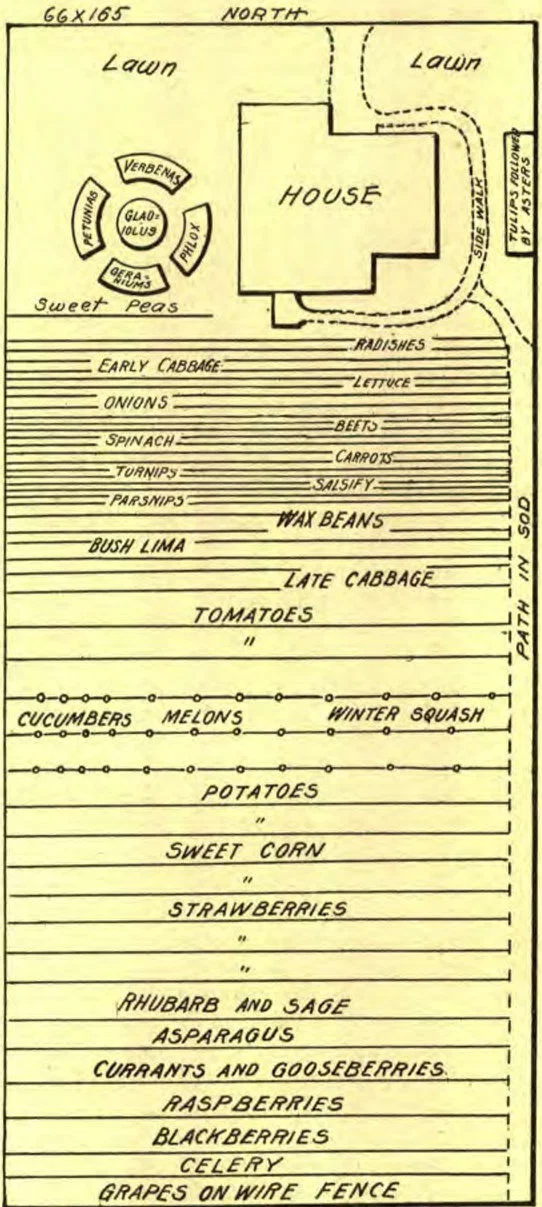
As to the quarter-acre garden, but little need be said as to its location; for the necessities of the situation will often require it to be placed back of the house. The arrangement of the beds may be followed as indicated in the accompanying diagram, or it may be changed to suit the taste of the gardener. To plant radishes, lettuce, etc., in long rows, rather than in small beds, will assist in the cultivation with the wheel-hoe; and if the small and more frequently needed vegetables are planted near the house, much tramping of the soil will be avoided.
To set out cabbage and tomato plants, have the soil mellow and in good condition. Be sure to use a rope or strong cord to keep the rows straight. Crooked rows show careless and slovenly work. They are not like some little sins, that can be covered from mortal eyes as soon as they are committed, but are a constant witness the whole season. Never set out plants of any kind until afternoon, unless it is cloudy, or there is an approaching rain, in which case make all haste possible. Always press the soil firmly about the roots of plants, with the fingers. If the soil is dry, leave a small pit by the side of the plant. Into this pit pour about a pint of water; after the water has disappeared, fill up the trench with soil. This should be repeated once each day in dry weather, until the plants have a good start.
Muskmelons do well in any rich soil. It must be mellow and in good condition, and plenty of good fertilizer will not be amiss. Three or four shovelfuls of well-decomposed manure should be mixed with the soil at each hill. With a hoe make hills five feet apart, scatter ten or more seeds in each, cover with an inch and a half of soil, and firm with the back of the hoe.
Watermelons require the same care as do muskmelons, except that the hills should be made from six to eight feet apart, according to the variety planted.
Squashes will do well under the same care. Summer varieties may be planted four feet apart, but the later winter varieties should be planted eight feet apart in the rows.
The same treatment will give an excellent crop of cucumbers. They should be planted four feet apart. ARTHUR F. HUGHES.