It is a somewhat novel experience to stand on the highest point in the United States,—the very topmost peak of our country,—and look down upon great mountain ranges that lie so far beneath that they appear like great rolling plains.
Hundreds of persons have undertaken the ascent of Mt. Rainier simply for the sake of this novelty, and have struggled up the mountain's rugged sides, buoyed up by the hope that they might afterward boast of having “been to the top.” Many of these have given up the ascent before it was half finished. Others have persevered to the end; and after a few minutes' rest on the warm rocks at the rim of the crater, have begun to drag their weary bodies down the inhospitable sides of the mountain, vowing never again to attempt so foolhardy a trip. Not many who have attempted to ascend Mt. Rainier without previous experience in mountain climbing, have carried to the summit sufficient strength and enthusiasm to appreciate and enjoy the grandeur of their surroundings.
But whether or not the would-be mountaineers are successful, they find themselves imbued, when the fatigue of the journey has worn away, with a love for the mountains that nothing can take away. With many, mountain climbing becomes a mania, which can be satisfied only by two or three tedious ascents each year. The writer can never look at a snow-capped mountain peak without feeling a homesick longing that can not be described, but must be felt to be understood.
The ascent of Mt. Rainier is fraught with difficulty and danger, even to the most hardy climbers. To one not endowed with sound heart and lungs, strong muscles, and steady nerves, it is practically impossible. And yet, with all the danger, there has been but one fatal, and few serious, accidents among the scores who have ascended, and the hundreds who have attempted to ascend, the grim old King of the Cascades.
A few years ago it was the good fortune of the writer to be one of a party of sixty-six who attempted the ascent, and one of the fifty-nine who accomplished it. That was an unusually large party; and the success that attended the effort was a surprise to all who understood the difficulties that must be overcome.
About nine o'clock the party left their comfortable camp in Paradise Park, and began their long tramp over the smooth ice-fields to the head of the Cowlitz glacier. It was a motley crowd that slowly followed the trail of the pack-horses that morning. We all wondered that our appearance did not provoke a smile from the frowning countenance of grim old King Rainier. A few of the party wore veils; but veils were troublesome, and not in general favor. Some had covered their faces with red or pink grease-paint, such as actors use. The less fastidious were content to besmear their countenances with vaseline and burned cork. The object of this decoration was to prevent sunburn; but whether or not it accomplishes this result, in even a small degree, is disputed. “In the interest of science,” one young woman blackened half her face, and left the other half unprotected. But the sun was hot; and that glittering mass of ice reflected its glare like the burning sands of a desert. In wiping the perspiration from her face, she tried to use a different hand for each side, but sometimes she forgot. In a short time both sides looked alike, and science was not benefited by the experiment.
About four o'clock we reached the head of the Cowlitz glacier, and began to prepare our camp. Of course we had no tents. In fact, we considered ourselves fortunate to get our blankets. It is no easy matter for pack-horses to reach that place, and quite impossible for them to go farther.
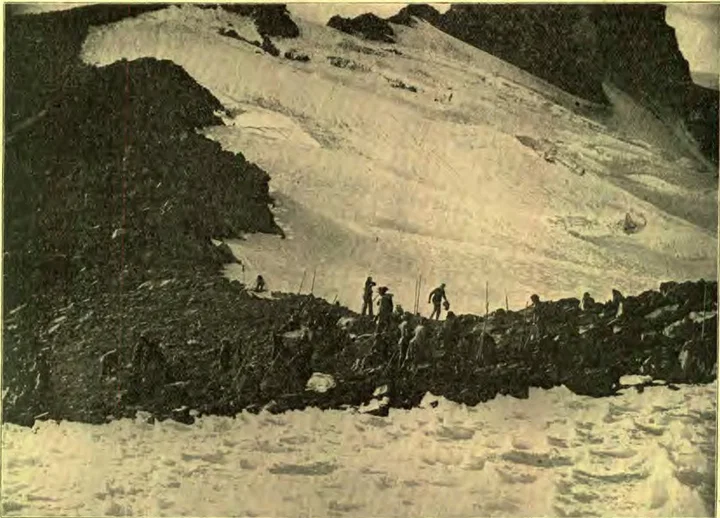
Near the head of the glacier is a pile of rocks embedded in sand and gravel. By displacing some of these rocks, most of the party were able to make fairly comfortable “gravel beds,” on which to spread their blankets. While they were thus engaged, a bitterly cold wind sprang up, and drove nearly the entire company to bed before sunset. But the wind went down with the sun, and many left the protection of their blankets to take a peep into the cold, emerald-tinted crevasses of the glacier, or to watch for signal-fires from the surrounding country.
Next day about half the ascent was over loose rocks, and the remainder over steep fields of ice. On the rocks it was often necessary to use the utmost caution in stepping from one to another to keep from starting an avalanche. At one point the entire party were compelled to pass, one by one, along a narrow ledge of rock, that scarcely afforded a foothold. Above rose a perpendicular wall of rock a thousand feet high. A thousand feet below lay the Nisqualli glacier, ready to receive in its icy embrace the daring adventurer who should make a misstep on that narrow ledge. It was decided to stretch a life line along this dangerous place. Strong hands held one end of the life line, and let it out only as needed, but the position of the man who carried the other end was an unenviable one.
The ice-fields were so steep that the life line was in constant use. Below, on every side, were crevasses and glaciers; and so great was the danger of an involuntary glissade to instant death in one of these, that all in the party were cautioned to neither let go the life line nor sit down to rest when we halted.
It was four o'clock when we reached the summit. Because of the lateness of the hour, it was thought best to halt but a short time before beginning to descend. Though this gave little opportunity for sight-seeing, it was no matter ofp. 590 regret to most of the party. Some were suffering from mountain-sickness,—a nausea caused by the high altitude. Others were so nearly exhausted that they were glad to find a sheltered place among the rocks, where they could lie down, and get a few minutes' rest.
To those who were able to appreciate it, the panorama spread before them was indescribably grand. Northward and southward lay the Cascade Range, with here and there a snow-capped mountain peak, that spoke of long-inactive volcanoes. Eastward stretched the great plains of Washington and Oregon, with the Blue Mountains in the background. To the west one could look over sixty miles of forest-covered mountain and valley, to the placid waters of Puget Sound, lying more than fourteen thousand five hundred feet below. Beyond Puget Sound the rugged Olympic Mountains hid the Pacific from view.
The crater is shaped like a mammoth old-fashioned butter-bowl. The center, once a spring of molten lava, is filled with ice, but around the rim the steam still issues from every crack and crevice, and keeps the rocks so warm that snow melts as fast as it falls upon them.
No time was lost in the descent; and by dark the entire party had passed the dangerous places, and reached the temporary camp at the head of the Cowlitz glacier, without serious mishap. Here many chose to spend the night; but others shouldered their blankets, and trudged across the ice-fields to the more comfortable camp in Paradise Park.
J. EDGAR ROSS.