It is a common error to suppose that the two pictures that make a stereoscopic slide are duplicates, and that their enhanced beauty, when seen in the instrument, is caused by the slight magnifying power of the lenses.
I once attempted to make a stereoscopic slide by mounting, side by side, two prints from the same negative. The pictures combined beautifully in the stereoscope; and though I could see that they were in some way inferior to my other slides, it was some time before I knew that they were not stereoscopic.
The principle upon which the stereoscope is constructed may be illustrated by a few simple experiments.
Look out of the window, and with one eye closed notice the relative positions of the sash and some object outside. Then without moving the head, close the open eye, and open the other. You will observe that the relative positions of the objects have changed considerably. The reason is that the objects are seen from two different points. When both eyes are open, a different image is formed on the retina of each eye, and these images are combined in the brain to form a third.
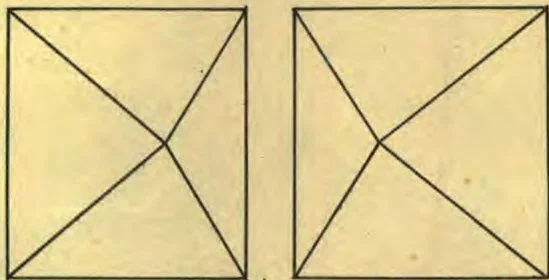
This principle holds true in stereoscopic photography. Two pictures are taken from different points of view. By the aid of the stereoscope an image of each is formed on the retina of the corresponding eye; and when the brain combines these to form a third, which is unlike either, we have the true “stereoscopic effect.” The drawing will help make this plain.
You may not be able to tell what this drawing represents. But separate the two figures by holding a piece of cardboard or paper between them so that each eye will see but one, and they will gradually melt into one figure. If you are successful with this experiment, you will not need to be told that you are looking down on a pyramid. If the figures will not combine, there is strong probability that you need glasses.
Stereoscopic photographs are usually taken with a camera having twin lenses and a partition. It is really a double camera, with which two exposures are made simultaneously. Such an instrument is necessary if the picture includes moving objects; but many beautiful views may be secured with an ordinary camera and one lens.
The size of the camera used will make no particular difference. If it is larger than four by five inches, it will be well, for the sake of economy, to provide kits, and use smaller plates. If it is smaller than three by three inches, the prints will be smaller than the usual size, but that will not matter if they are mounted the proper distance apart.
Two negatives will be required; and they must be taken from points about three inches apart, measured at right angles with the direction of the object photographed.
The most simple way to accomplish this is to set up your tripod, and make one exposure, in the ordinary manner. Then move each tripod leg about three inches to one side. If the object is near, it may be necessary to loosen the tripod screw, and slightly rotate the camera, in order to include in the second negative the same field that the first had.
If you take many stereographs, it will be advisable to fix a short board on your tripod head, so arranged that the camera may be moved the necessary distance without moving the tripod. There are several methods of accomplishing this, so simple that they need not be described: I will leave you to study out one.
Strong contrast does not give a pleasing effect in the stereoscope; so if your subject is “contrasty,” it is well to overtime the negatives.
The developing, printing, and toning are carried on in the usual manner; but when it comes to mounting, you must be careful not to transpose the pictures, or you will have a “suedoscopic,” instead of a stereoscopic, slide.
If the prints are made on paper a little larger than required, they may be matched more accurately when they are trimmed than if paper of the exact size is used.
Trim the bottom first. Then place the prints in the position they should occupy on the mount, and bring them together until some object in one is two and three-fourths inches from the same object in the other. The prints will overlap in the middle, and they may be trimmed simultaneously by making one cut with the trimming-knife straight down through both. The outside and top may then be trimmed to any size preferred. The usual size of a stereoscopic slide is three by six inches; that would make each print three by three inches. J. EDGAR ROSS.