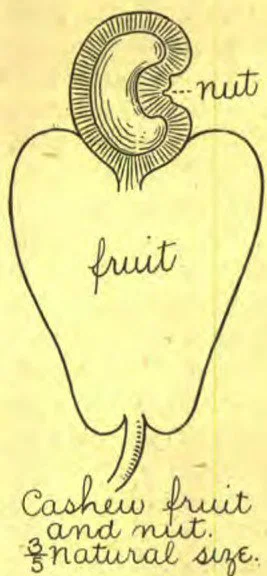
WHEN spring is giving us its parting days, the air is often filled with a savory odor that comes from groups around the common open cooking fires of our island homes. As one passes these fires, he smells burning oil, and sees a great smudge, ending in a sudden fierce blaze. When this burns down, as it soon does, there will be a rapid poking among the embers, and a pulling out of blackened, kidney-shaped nuts, which are cracked, and the white kernels taken out, and eagerly eaten. These are the cashew nuts, which grow at the lower end of the fruit, instead of inside it, as you can see by the illustration. The fruit smells like strawberries, is pear-shaped, spongy, and tough, and its juice, which is somewhat acid, is the only portion used. The skin of the fruit is smooth and glossy, mottled with red and yellow.
The nut has an outer and an inner covering, and between the two is a thick black oil, which oozes out when the nut is roasting. It is this that burns, and gives off such an odor. This oil will blister the skin, and indeed it is sometimes used in the treatment of corns, warts, and sores. The nut meat tastes not unlike almonds. Before it is fully matured, the kernel is filled with a sweet, milky juice.
The tree itself is a sprangly affair, having medium-sized, egg-shaped, reversed leaves growing near the end of the branches. The flowers grow in clusters on the end of the branch, and are small and inconspicuous. The bark produces a milky juice, which is sometimes used for marking linen. The wood is red and rather hard.
The star-apple is another fruit peculiar to the tropics. It is about the size of an apple, quite round, with a smooth green or purple skin. Usually it has ten parts, though each part is not always supplied with a seed. In shape and size the seeds are like a butter-bean,—black, with a white eye. The pulp is purplish-white, very sweet, with a sticky, milky juice, which sends a woe upon the man with a mustache, as it will not wash off, but must wear off. The trees are tall and graceful, with long, slender branches. The pretty, pointed leaves are dark-green above, and of a beautiful, glossy, golden or copper color beneath. Some very young leaves are silver-lined instead. You can easily imagine that one of these trees on a sunny slope presents a beautiful sight when fanned by the breeze.
Driving along, one often sees tall, sturdy, pear-like trees hanging full of fruit that grows straight out from the trunk or limb, and often as large as a gallon pail. The fruit is green in color, and is rough outside, like an osage orange. The flesh of the fruit is white and sweet, the seeds are large and black, and the kernel is often eaten roasted or boiled. This is the “jack-fruit.”
A fruit similar in appearance and size is the “sour-sop,” which, however, grows in the ordinary way; it is sour, and is full of melon-like, brown seeds. This fruit is covered with soft, thorn-like projections. The juice is often used to make a drink similar to lemonade.
The “sweet-sop” and the “custard apple” are two sweet fruits, the flesh of which is soft228and custard-like. The seeds, of which there are many, are small. The fruit of both is about the size of a large orange.
The finest of all tropical fruits, in the opinion of many, is the naseberry. This is round, or egg-shaped, ranging in size from an egg to an apple, and having a thin, rough, brown skin. The flesh is somewhat pinkish, and the few seeds are quite similar in size and shape to those of the star-apple. When well matured and thoroughly ripened, the fruit has a delicious flavor, and is very sweet and rich.
I must not leave from my list, which might be made of almost indefinite length, the tamarind and the genisaro, or guango, as it is commonly called. Both fruits are leguminous in character, as are many of the trees here.
The tamarind is a large tree, pinnate-leaved, with fine leaflets. When hanging full of pods, it is very beautiful. The pods are golden-brown, thin, and brittle-shelled, the seeds covered thickly with a very sour brown pulp. This is used to make a beverage, and is sometimes packed in sugar, and sold for this use. A sauce is also made from it. The wood is very tough. The schoolboy dreads a tamarind switch; and criminals are sometimes sentenced to be flogged with tamarind rods.
Genisaro pods are long and black, the seeds covered with a sweet pulp. Horses and cattle feed upon them, the trees being often planted in pastures for both food and shade. The leaves are similar to those of the tamarind, though not so small. The leaves of this tree go to sleep at night. This makes it look, in the early evening, as if it were dying.
The divi-divi is another leguminous tree, which in appearance resembles the tamarind, though it is not so tall, and is more spreading. The leaves are smaller, and slightly sensitive to the touch. The pods are small, brown, and curled up almost like a snail’s shell. The tree is cultivated for tanning purposes.