BEFORE instructing you in the art of laying veneers, I will mention some of the choicest woods used for this purpose. Let us notice, first, some of our native forest woods. A fine veneer is made from white maple, also from bird’s-eye maple. The last-named is difficult to work because the eyes in the wood are liable to work out in dressing, but some of it is very beautiful. Birch, both red and white, is now being much used in veneering furniture. White oak, also red oak, when cut quarter-sawed, make a rich veneer. Black walnut, both the crotch of the log and the burl, makes a fine finish. There is a veneer cut from ash, called Hungarian ash, but without doubt the wood from which it is made grows in this country. Then there is what is called “corrugated veneer.” The wood is cut with a crooked knife, across the grain; when pressed down, the work looks wavy, although cut from straight-grained wood.
The tropical regions produce a variety of woods used in veneering. Of these, mahogany, a rich timber, dark-red and clouded, takes a high polish. Different soils give this wood different shades. A beautiful dark veneer is made from rosewood, used largely in overlaying pianos. This wood is so oily that varnish will not dry on it unless it is either baked or shellaced before the veneers are laid. Baking gives it a darker color. Brazilwood is dark, and looks something like rosewood, but has large light streaks in it. It makes a coarser veneer. Olivewood is also made into veneers. The root is very beautiful, being mottled. Ebony comes from Madagascar and Ceylon. The usual color is black, but it sometimes comes in both red and green. Many different materials are cut into veneers.
The object of veneering is to make a nice piece of work at much less expense than would be involved in using the solid wood. The softest woods should be chosen for the foundation upon which to lay the veneers; perhaps the best for the purpose are those having a straight grain, free from knots, as a veneer will soon loosen from a knot.
A person who intends to do much veneering should have a plane about the size of a common smooth-plane, with the iron standing nearly perpendicular, and the edge of the iron full of fine notches. Such a tool is called a tooth-plane. With this plane scratch over the surface upon which you lay the veneer, also the veneer itself, if it is a sawed one. Should a veneer get broken, glue a piece of stiff paper on the outside, which may be scraped off in finishing.
Always cut veneers a little larger than the work to be covered. They can be trimmed to the proper size after the glue has hardened. You will need a board a little larger than the piece of work to be veneered. Dress both sides smooth, after which rub the surface thoroughly with soap or beeswax, and heat it in, to prevent its sticking to the work, should a little glue work through the veneer. (Be careful that no soap gets into the glue, as it would prevent its sticking.) This board is called a caul.
When you are ready to put on the veneers, have your glue thin and hot; and while you are gluing, have your caul heating by the fire, so that when the veneer is laid on, the caul, being hot, will keep the glue liquid until you can get your work clamped up.
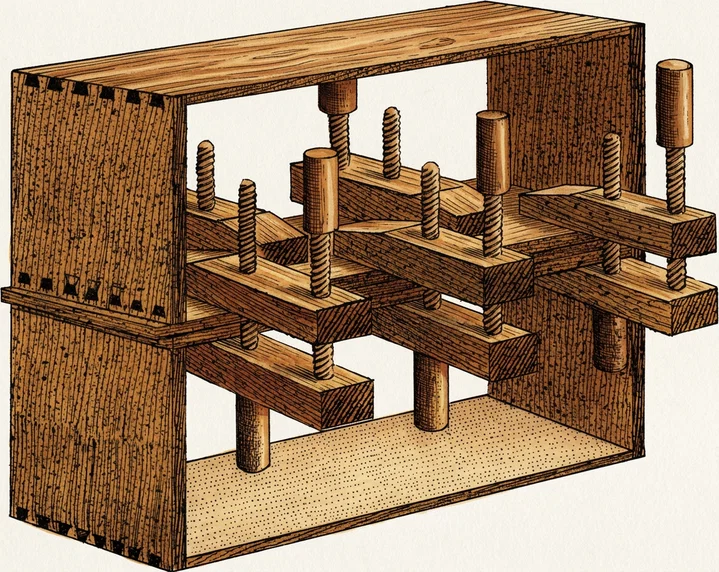
The illustration represents two drawers, without the bottoms, showing the front sides of the two turned together after the veneers are glued on. The caul-board, a, is placed between the drawers, b, b, after which the hand-screws, c, c, are put on. In putting on the hand-screws, keep the jaws, c, c, as nearly parallel as you can, to press the work together as tightly as possible. Turn the screw next to the work up tight; then turn up the outer screw. In this way you get a greater pressure.
Other kinds of cauls are used for different kinds of work. Should the work be crooked or irregular in shape, it often requires a caul fitted to it. Sometimes, in veneering round work, a bag of coarse burlaps is filled with hot sand, and placed on the veneer, as it can then be pressed down to any shape required to fit the wood. Should your veneer be bulged out or crooked, dip a sponge in hot water, and rub over the veneer before using, and it will press down straight when the caul is laid on.
W. K. LOUGHBOROUGH.