The following article is made up of extracts from a letter written by Mrs. F. E. Braucht, of Samoa, to her sister at Battle Creek College, who kindly allows the INSTRUCTOR thus to give its readers a vivid picture of life on these islands during the political troubles through which they are now passing.
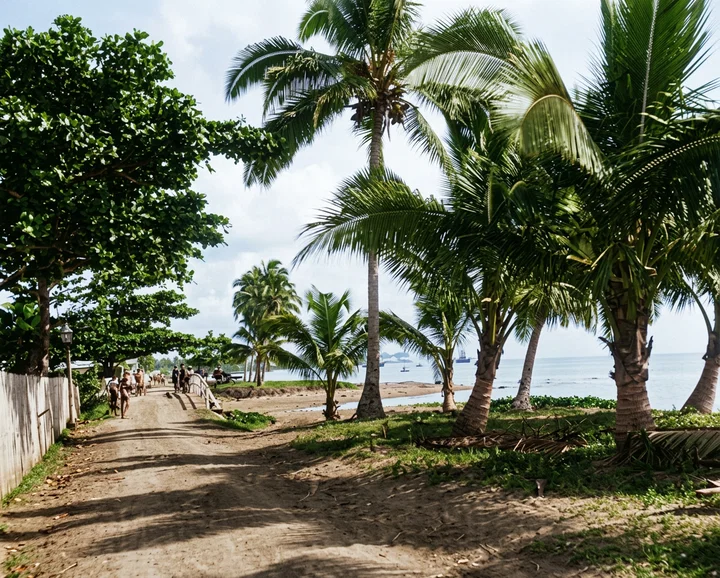
In the letter, Mrs. Braucht speaks of the Doctor, her husband; Marjorie and Alden, their children, aged three years and one year, respectively; “Grandpa,” her father, Mr. Owen; Mattie, a little German girl who lives with them; Professor Lake and his wife, formerly of Battle Creek; Sybil, Emily, and Willie, nurses and helpers; and Mr. and Mrs. Osborn, the American consul and his wife.
“APIA, SAMOA, March 6, 1899.
“MY DEAR SISTER:
The American man-of-war came in this morning, and I tell you, it was heralded with joy by the Americans here. The British have two war-ships in the harbor; and we have been looking for one ever since news of the Samoan troubles reached home, but lately we had almost given up hope. This morning, however, while at worship, we heard the booming of the cannon. At first we thought the war-ships were only saluting, as they sometimes do; but from the way the booming continued, Doctor said he thought they must be saluting an American war-vessel. Professor Lake climbed up the vii-tree (by the way, we now have a ladder running clear to the top of the vii-tree at the corner of the house, with a platform at the top. It is fine, they say; I have not ventured up there yet), and pretty soon he came rushing down, with his face all aglow, shouting, ‘It’s come! it’s come! the “Philadelphia” has come!’ Then Doctor and Grandpa went up, and, sure enough, the ‘Philadelphia’ was coming into the harbor. Then what a scampering there was to get ready to go down to the harbor to see her come in! Sybil hitched up the horse, so she and Marjorie and I could ride. We found Doctor, Grandpa, Professor and Mrs. Lake, and Emily there, with a field-glass; so we all took a look at the old ship. She is painted a dead-gray, the war color. She did not have time to repaint before coming.
“These are exciting times for Samoa. The natives are preparing for war again, and some say they will surely attack the white residents next time, but I don’t know. The coming of the American war-ship may make a change in their plans. One party say they will kill the Germans, and the other say they will put the English and Americans out of the way. Sometimes I feel as if I would like to flee from it all; but if the Lord wants us to remain, we do not wish to go. I am sure he will protect us. We learned lessons of faith and trust during the week of anxiety through which we passed a short time ago. Perhaps we have still further lessons to learn. If it becomes necessary to shell the place, or if there are any signs of danger to the whites from the natives, we shall all go on board the ship. Of course we can not tell what togafiti [treatment] the Samoans may use, but I am sure we shall be cared for, and that the Lord is overruling.
MULINU’U POINT, APIA, SAMOA, March 20, 1899.
“Since I wrote the first part of this letter, we have had a varied experience. We have had to flee for our lives, here and there, and are now staying in a native house at Mulinu’u Point.
“One week ago yesterday a proclamation was issued, ordering all the Mataafa natives—rebels, you know—to go quietly to their homes; if they did not obey, they were to be fired upon. Well, instead of going home, they left Mulinu’u Point, and gathered all around Apia. We were completely surrounded by thousands of hostile Samoans. When they left the Point, the loyal party, or Malietoas, went there, and are now guarded on all sides by English and American soldiers. Monday the troops were landed, and stationed around Apia. Tuesday they were still there. Nobody knew what would happen next. Wednesday morning Doctor went down town, and soon came back, saying that in two hours the ships would begin to shell the town, or rather, the surrounding country, and that we must all go down to the beach as quickly as possible. Emily was getting dinner, and I was just beginning some baking. We left the dinner on the stove and in the oven. I hurriedly put a few things into a bundle for the children, and jumped into the buggy. Doctor had gone down the road to see about a patient. Emily drove me down; on the way we met Doctor, and he said we had better go to the American consul’s; so away we went, as fast as the horse could carry us.
“The soldiers were already at the consulate, barricading the place as quickly as they could. Lieutenant Brown told me to get in behind the large iron safe, and keep still; so I curled down there with the children until Mrs. Osborn came in. She said she thought we would all be safe, for a while at least, at the consulate; but Mr. Osborn thought we had better all go on board the ‘Philadelphia.’
“The shelling soon began. The booming of the guns and the noise and bursting of the shells were awful. We went out to the ship. The tide was low, and they carried us out to the small boats. Amid the noise and excitement we got on board the American war-ship; and when we were on board, I found none of the rest of the family there. Emily had driven back from the consulate with the horse. You can imagine my anxiety. The great ship shook terribly, and the noise was deafening. We put cotton in our ears, and stayed down below. In the evening all the other members of the family, except Doctor, who remained at the consulate to look after the wounded, came on board, safe and sound. The bombarding continued all night. We were supposed to sleep on the floor in the admiral’s cabin; but mostp. 342 of the time we were looking out the port-hole, watching the search-lights and the bursting of the shells. One can never realize what an awful thing war is until he has been in the midst of it. Morning came at last, and with it quiet. Doctor sent a note on board to say that he was safe, and that I must not worry. The shelling continued nearly all day Thursday. That evening I sent a note to Doctor, asking him to come on board, and the next morning he came.
“We had a talk with the admiral, and he assured us that they would not shell our place, and said he thought we would be safe at home, if we raised the hospital flag, as all nations respect that. So we all went on shore, but the officers there would not allow us to go home, except the men,—Doctor, Willie, and Brother Lake,—just to see how things were getting on, and then only under promise to return immediately. They found everything all right. Even the natives had not molested anything. The officers said we must go back to the ship, and told us to get into the ‘Royalist’ boat, which was just pushing off, and they would take us to the ‘Philadelphia.’ Grandpa, Sybil, the children, and I got in, therefore, and started off.
“The ‘Philadelphia’ was rocking badly; and as our little boat came up, the ship rolled over on one end of it. It was instantly filled with water, and went out from under us,—and there we were, babies and all, in the briny sea, in great danger of being sucked right under the war-ship, in addition to all the other dangers. But the angels were there to take care of us. I held Alden up above water with my right hand, and swam with my left. Sybil had Marjorie. Sister Lake’s little girl was with us; one of the men had her. We were under the ladder, and there were some ropes near by, which we caught as soon as we could. Officers and sailors immediately jumped overboard to our rescue. They caught hold of the children’s clothes, and drew them up first; then they dragged us up some way, I hardly know how; anyway, we were all saved, and are indeed thankful that our lives are spared.
“Sabbath the admiral assured us we would be perfectly safe on shore, as they would not shell our place, and he did not think the natives would harm us; so we went ashore again, and again all the other officers were opposed to our going home, and said if we did, it would be at our own risk. The place where our house stands is regarded as the most dangerous point, because there are so many trees around for the natives to hide behind. The officers said that if we went home and raised the hospital flag, they feared the Samoans would take advantage of it, and would flock there for refuge from the shells. After praying over the matter, we decided to come to Mulinu’u Point, which is well protected; the officers are willing we should stay here. We are living, for Samoa, in a native house. Doctor has a pass, and can go anywhere. He goes up home every day, and brings down what we need.
“The court-house has been turned into a receiving hospital, and Emily stays there to help care for the wounded. You would hardly think you were in Samoa, if you could step on shore now. You could not even cross the street without a pass. The streets are full of soldiers; for Apia is under martial law. How much longer this state of things will last, none of us can tell. It is feared that a much larger force will have to be called here before the natives can be subdued. The Germans are all the time urging them on and helping them.
“APIA, SAMOA, March 25, 1899.
“We are at home now, though ours is the only family that stays at home at night, except those that live right on the beach. We feel safe, as the admiral has assured us that they will not shell our place, and we do not fear the natives. Our place has not been touched; while nearly all the other white people living back from the beach have had their houses looted, and everything destroyed that was not carried away. The Lord has cared for us and his property here in a remarkable manner.
“Young Malietoa was made king this afternoon, and established at Mulinu’u Point. We attended the coronation. We don’t know where Mataafa and his people are, or what they intend to do. Some think they will yet try to make a rush on Apia, but we hardly think so. They would never try it again if they did. The streets are still full of soldiers, and the question is yet unsettled. They are waiting now to see what Mataafa is going to do. If he is caught, he will probably be shot, or banished for life.
“With all the shelling the men-of-war have done here in Samoa, we do not know that many natives have actually been killed. One American and three or four British soldiers have been killed, and several wounded. From all the banging and booming and shelling that have been going on, you would think thousands had been killed.”