It has been well said that India, of itself, is a world. The question is often asked, What kind of people are the natives of India? It might as well be asked, What kind of people are the natives of Europe? for India contains more distinct and separate nationalities than Europe does. Nevertheless, there are many points of resemblance, which naturally lead to the conclusion that the people of India are of one common nationality.
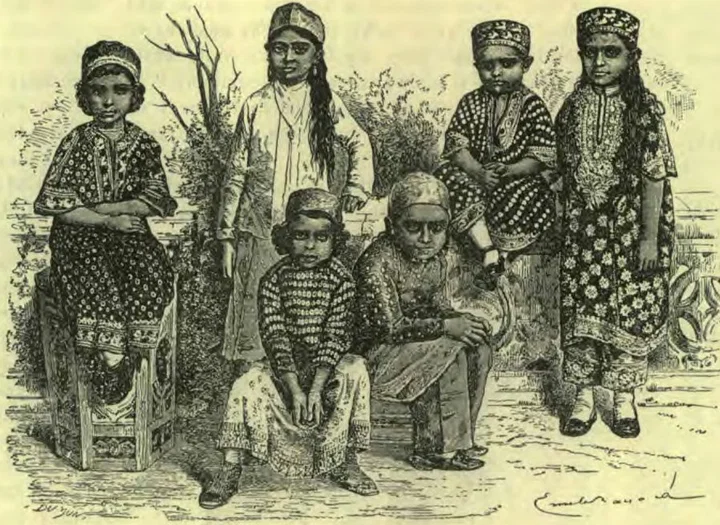
The family system is the same in all parts of the country, and in many respects resembles the condition which existed in the days of Abraham, the sons with their families remaining under the father’s roof throughout his lifetime, while all the family is supported from a common fund. Child marriage is also common in all parts of India, and widowhood is not only looked upon as the greatest misfortune, but the unhappy widow is regarded as the cause of her husband’s death, and is obliged to suffer all sorts of cruel penances for her supposed sin. A little girl may be left a widow before she is six years of age; but there is no exception made in her case. She is treated almost as an outcast all the rest of her days, and is never allowed to marry again.
As a class, the people of India are very poor. Millions belonging to the lower classes live in a state of wretchedness and poverty which it is impossible to describe. In most parts of the country a laboring man will work all day for a sum not exceeding five or six cents, and on this he has to support a wife and from two to six children. It is said that one half the people of India never know what it is to have enough to eat. They spend very little on clothing, and literally live from hand to mouth, so that their life from one year’s end to another is one hard struggle against absolute starvation.
Politeness is a characteristic of the Hindu. The East Indians are strongly attached to form. Some one has said that “manner is something with everybody, and everything with some.” Few attach more importance to it than the Hindus, and as they are often treated unkindly by the English, courtesy on the part of the missionary is the more appreciated. It produces a favorable impression at the start, and causes the gospel message to be listened to with more attention.
It is considered highly disrespectful to use the left hand in salutation or in eating—or, in fact, on any other occasion where it can be avoided. To remove the turban is disrespectful, and it is still more so not to put off the shoes on entering a strange house. Natives, when they make calls, never rise to go until they are dismissed. The best way to do this is to say, “Come to see me again soon,” or, “Always make a practise of visiting at my house,” which will be readily understood.
GEORGIA A. BURRUS.