No trial, either civil or military, of modern times has so attracted the united attention of the world, and been weighted with a series of national crises so far-reaching, as has the case of the unfortunate Alsatian artilleryman whose condemnation has just been reaffirmed by the court-martial at Rennes, France. So much has been said and written about the affair, and it has extended over so many years, that many have almost lost sight of the original charge, and have forgotten when the proceedings began. We will therefore review the case from the first.
Early in 1894 it came to the notice of the French government that some army officer was selling or giving secret information to a foreign power concerning the army and its plans. A document, since known as the famous “bordereau,” was found in bits among the waste paper at the German embassy’s apartments. It was pieced together successfully, and a careful reading showed that information of the kind mentioned had been offered in it. This crime is treason, and in military circles is one of the gravest that can be committed. Then it was that the bitter hatred for the Jews, which has been especially rabid over almost all Continental Europe during the last decade, showed itself in France. Dreyfus is a wealthy Jew. This was enough. The Jews are a frugal people, and much of the wealth of Europe is in their hands. Catholic France and Greek Russia hate the Jews on account of their religion; but all nations are envious of them because of their wealth.
So Dreyfus was suggested as the criminal; and Lieutenant du Paty de Clam, under some pretense, had Dreyfus write for him, dictating for this purpose from the bordereau. As he wrote, Paty de Clam exclaimed, “Ah, your hand trembles! you are guilty!” and immediately had the captain imprisoned on suspicion. For some time the innocent man did not know what was charged to him. He was arrested Oct. 15, 1894. Two months later his trial by court-martial began. By means of much forged evidence, and terrible prejudice against him by the court, he was found guilty, and was publicly degraded Jan. 5, 1895. This degradation consisted of cutting from his uniform, as he stood facing his fellow soldiers, all the emblems of his rank, and breaking his sword and casting it to the ground. This treatment might not mean much to some men; but to a sensitive man like Dreyfus, who had been educated to regard the honor of the army and the respect of his fellow officers above all else, the humiliation was almost unbearable.
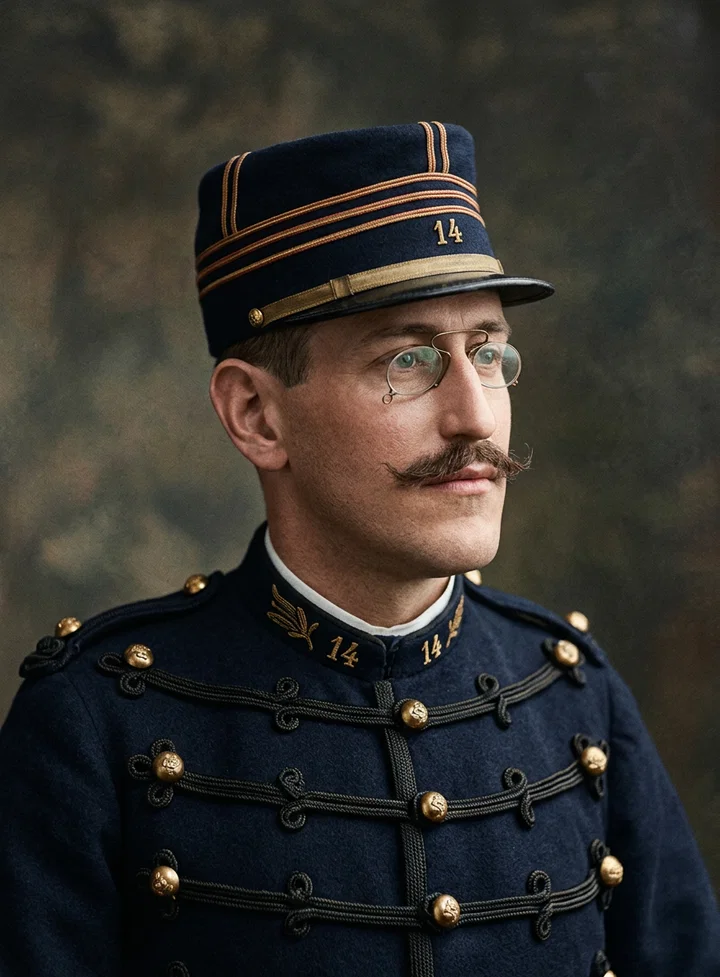
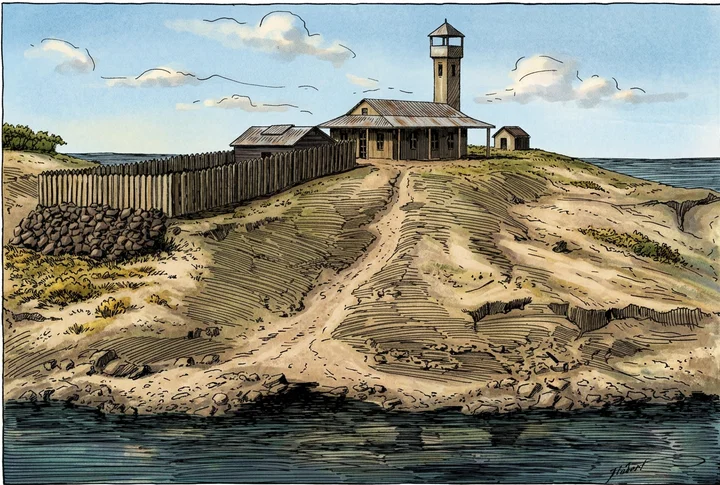
He was then transported to the Ile du Diable, or Devil’s Island, a penal colony off the French Guiana coast, in South America. In his trial one after another of his accusers became involved in deceit and forgery till, in their own interests, it became necessary for them to band themselves together for mutual protection. When Dreyfus was at last degraded and sent away, his enemies hoped the case would end, but the truth would come out. Like those who tell lies to shield themselves, and then have to tell other lies to try to prove the truthfulness of their first statements, these French army officers became more and more involved.
In 1896 postal-card and telegraphic communications were discovered between Colonel von Schwarzkoppen, the German military attaché, and Count Walsin-Esterhazy, a French soldier whose subsequent career, as well as his connection with this case, proves him to be a most unscrupulous villain.
Lieutenant-Colonel Picquart, head of the Intelligence Department, on learning that Dreyfus had been unjustly condemned, made public the relations that he, in his official capacity, had discovered between Esterhazy and the German spy, showing that Esterhazy, and not Dreyfus, was the guilty man. For this act of justice he was removed from the army and imprisoned, but was later released.
In 1897, Oct. 28, Esterhazy’s broker recognized the handwriting of the bordereau as that of his client. So many suspicions had now arisen concerning this man Esterhazy, that he was brought to a court-martial trial, Jan. 2, 1898, but in a very few days he was acquitted. The trial, however, only showed more plainly the underhanded methods employed by the army officers to shield themselves from exposure. At this point in the case M. Zola, the novelist, unable longer to restrain himself, published his letter of accusation against the entire French General Staff, accusing them of a gigantic conspiracy to convict Dreyfus. He was tried, convicted, fined, and sentenced to imprisonment. He appealed, and his sentence was quashed; but he was retired on a sentence in his accusation that barred any reference to the Dreyfus case, and was again condemned. As Dreyfus was not concerned in this second condemnation, he permitted judgment to go by default, and left the country, living in England until recent events permitted his return. The court ordered the sale of his furniture to pay his fines; but his friends united, and ran the bidding so high that the whole amount was raised with the sale of two or three articles.
Aug. 30, 1898, Colonel Henry, who had succeeded Picquart as head of the Intelligence Department, confessed his forgeries of anti-Dreyfus evidence, and was placed in prison. That night he either committed suicide or was murdered to prevent further disclosures. At one time during the first trial of Dreyfus, a revolver was purposely left in his cell, in the hope that he would take his own life; but he, declaring his innocence, said he would not kill himself to relieve the army of its dilemma.
After many attempts on the part of Mme. Dreyfus, the prisoner’s wife, and M. Mattheu Dreyfus, his brother, to obtain a new trial, in March of this year a bill passed the senate, having already passed the house, to refer the case to the Court of Cassation, the highest court of appeals in France. June 3 this court ordered a new trial, and Dreyfus was at once sent for, arriving in France on the last of the month. August 7 the second court-martial began, and continued till September 9. Throughout the trial much prejudice was shown against the prisoner, the presiding officer, Colonel Jouaust, refusing to put leading questions raised by the prisoner’s counsel. The second week of the trial, Maitre Labori, leading counsel for the defense, was shot while on his way to the court, by one who was evidently an anti-Dreyfusard, as he was allowed to escape. Although severely wounded, Labori resumed his position in the trial the following week, an appeal for adjournment on account of his condition being refused. When the verdict was rendered, September 9, a vote of five to two declared Dreyfus guilty of treason; but on account of “extenuating circumstances,” he was condemned to only ten years’ detention. What extenuating circumstances can be made out in connection with treason one can not imagine.
The whole affair is, in the minds of nearly every one outside of France, a terrible miscarriagep. 486 of justice. As the man has already suffered untold tortures for five years in solitary confinement, it is thought he will now be pardoned, but his friends insist on an acquittal.
We have alluded to the tortures endured by the unfortunate captain while on Devil’s Island. These can never be told so that one who has not undergone them can really appreciate what he endured. We will quote a few paragraphs from a Paris paper, which give some idea of that awful place, which Dreyfus can never forget:—
“Life in the climate to which he was sent is in itself damnable. The French officials never stay there more than two years at a time. It was hoped that Dreyfus would die in two or three years at the most. When the atmosphere in his hut became intolerable, he would go into the narrow space between the hut and the stockade. The heat was here still worse, and often he fainted. Then his jailers hoped that he had died. They threw him upon his pallet, ready for the inquest. But he always revived, though his continual fever, the excessive use of quinine, and his many fainting fits caused excessive weakness in an otherwise robust body. To reduce his chances of life, the preserves he ordered from Cayenne were taken from him, and his rations of milk were denied him. Food that he could not eat was given him instead. But he would not die.
“To all this must be added the tortures of the mind. The letters his relatives wrote were never given to him in the original. He was not even permitted to see the handwriting. Copies, mutilated and altered, alone were given to him. At last the entire correspondence was withheld, and he was told that his family had abandoned him. A few books were left to him; but if he wrote down ever so trivial a thought, the paper was torn to shreds before his eyes. At last he copied chapter after chapter as the minimum of brain work necessary to keep him from becoming insane.”
Another Paris paper describes as follows the place where he was confined:—
“Between the box that served as his hut and the stockade, the distance was only forty centimeters [13⅓ feet]. I beg every reader to note this carefully. Fancy yourself walking in a narrow groove, touching the wall on each side, in a climate like that of Guiana. This lasted a year. At last, when the prisoner was too frequently in danger of asphyxiation, the doctor demanded a change. Then only the box was raised a little, to enable the hot, tropical air to reach the prisoner. No wonder that Mme. Dreyfus was not allowed to visit her husband. She would have described these things. Somebody would have been found to ask questions in Parliament.”
The authorities provided a coffin and material for embalming the prisoner, so confident were they that he could not outlive the hardships imposed upon him. His poor wife wrote to him continually, but he was not allowed to see her letters, being told that she had forgotten him. Even while they were making the most strenuous efforts to obtain a revision of his case, he was told that all his friends now believed him guilty. His children remember him, but are not allowed to know why he does not see them. They are told that he will return to them sometime, but they know not when. Let us hope that even if he can not secure the justice that will acquit him, he may at least be pardoned, as is now proposed, on account of the time he has already been imprisoned.
H. E. SIMKIN.