WOMEN OF INDIA

8%

S. D. A. Publishing Association · Battle Creek, Mich. · Dec 26, 1895

FromThe Youth’s Instructor, Vol. 43, No. 52.

Read the full edition

WOMEN OF INDIA.

A HINDU WIDOW.Restored with AI
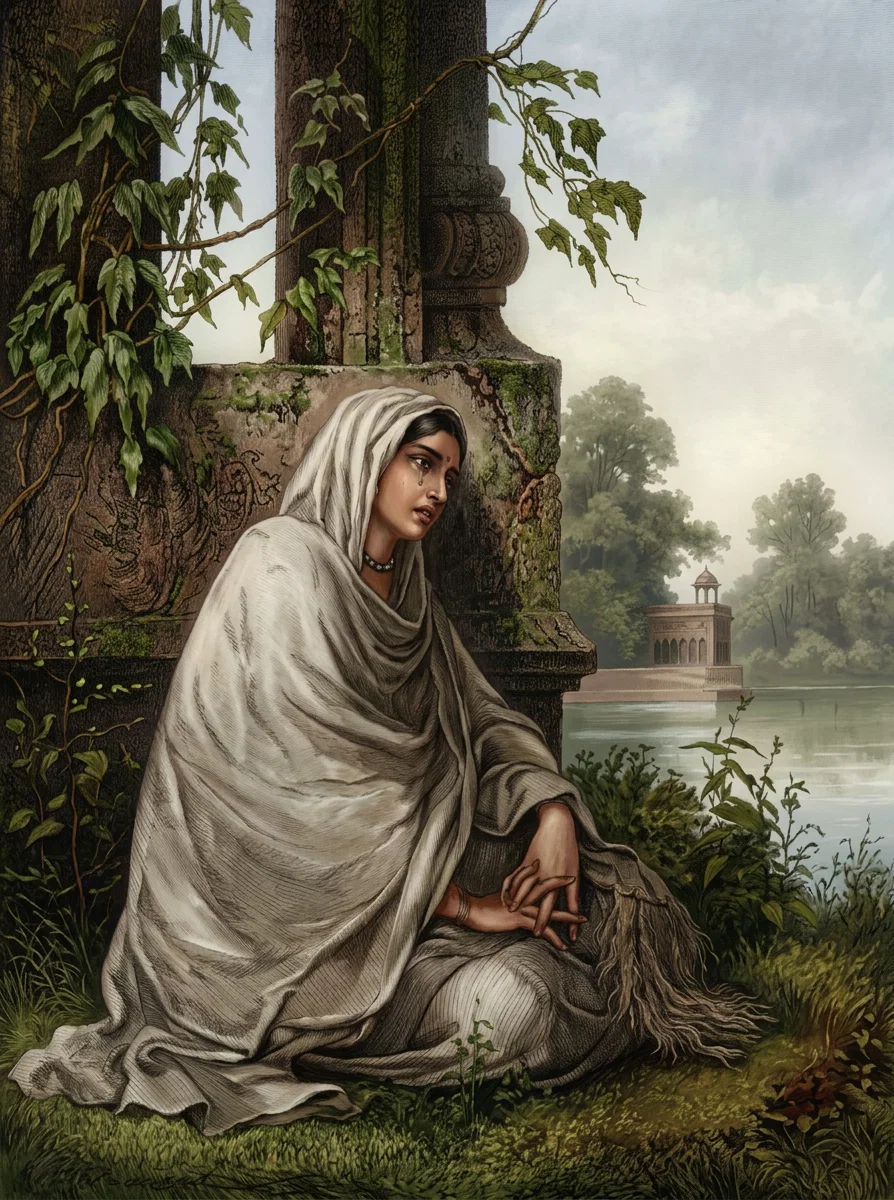
A HINDU WIDOW.
In no country is the freedom of woman more restricted than in India. Why, one may not ask a man how his wife is; the nearest he may come to it is to say, “Is your house well?” Except among the lowest classes, women are never allowed to be seen in public.
The wife in India occupies a position in the household very similar to that of one of her children. She lives in absolute obedience to the law of her husband, and if the rod is used to enforce discipline, it is applied to her as readily as to one of her daughters. The right of a husband to punish his wife is never questioned.
The Hindu wife is not allowed to eat with her husband. The food is prepared and set before the master of the house; and it is the wife’s duty to wait upon him while he eats, and her privilege to eat what he has left. If there are children, the boys eat with the father and the girls with the mother.
The condition of Hindu women is thus described by one of their own writers: “The daughters of India are unwelcomed at their birth, untaught in childhood, enslaved when married, accursed as widows, and unlamented when they die.”
The dress of the women is very simple, consisting of a single piece of cloth about one yard in width and five or six yards long, so arranged as to cover the whole person gracefully, and requiring neither buttons nor pins. The right arm is left free, and the right shoulder is partially exposed. This costume is very pretty. It is generally white, often with a narrow border of blue, red, or yellow.
The women of all classes are very fond of jewelry. They wear bangles on their arms, great massive rings on their ankles, and necklaces, earrings, nose-rings, toe-rings, and the like. Some of the toe-rings have little bells attached, so that the wearer literally “makes music wherever she goes,” or at least makes a jingle.
The poorer classes, who cannot afford the precious metals, array themselves in heavy pewter or earthen-ware ornaments. The poor man’s bank is his wife. If he is able to save any money, he invariably buys ornaments for her. He is thus able to keep his money safe, and please his wife at the same time! These he can sell again, if necessary, for almost the same price he gave for them.
Formerly it was not the custom in India to teach girls anything; and even in the richest families a woman could hardly be found who could read or sew. Women and girls of all classes are despised; and although those belonging to the upper class have more money, they are all equally ignorant.
When missionaries first came to India, they could not reach the women, because of these sad customs. It was necessary that there should be Christian ladies to go into these homes and teach the women. The part of the house where Hindu women and girls live is called the zenana, and the ladies who visit them and teach them in their homes are called zenana missionaries.
The children are taught in the mission school to sing hymns, and repeat verses from the Bible in their own language; and then they talk to their mothers and sisters of what they have learned. One poor heathen woman had a little girl who was taught the “Old, Old Story” at school; and the child repeated it so often that her mother, who could not read, learned it. One day this woman was on a visit to some friends, and there heard a girl repeating the same hymn; and she said, “I can say that, too; my little girl, who is now dead, taught it to me.” So in this way, by the children’s singing at home the Christian songs and telling the stories of Christ, the mothers learn of the Saviour, too.
GEORGIA A. BURRUS.