ROUND THE WORLD.—41.
By P. T. M.
IN THE HEART OF JAPAN.
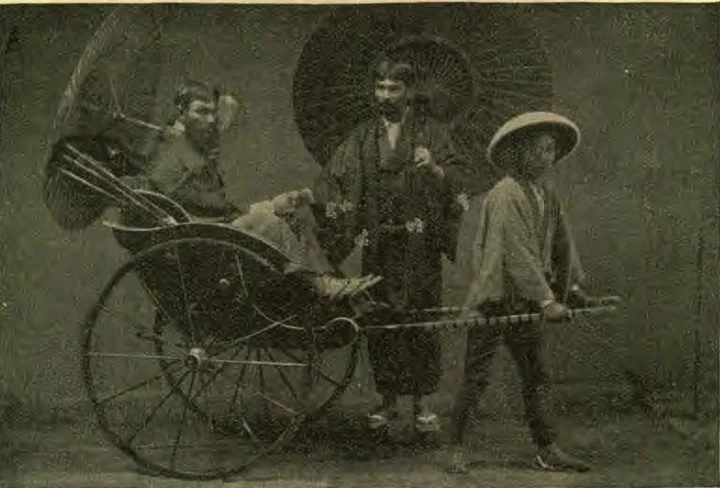
There is yet one more of the “Things Japanese” which we must mention, before we proceed on our journey into the heart of Japan. It is the pride of Japan, the jin-rika-sha. It is the conveyance of the country, and is pulled by a sturdy little Jap. The engraving shows what it is like, so there is no need to describe it further. Most of them are built to hold only one, but some are large enough to carry two. A good jin-rika-sha man will travel as fast as an ordinary pony, and keep it up for several hours. It is reported that one can go over forty miles in a day. But this we doubt, as we had a good chance to try them up-country, and did not find that their staying powers were nearly so good as that. They will run well on a stretch for two or three hours, but after that their speed is very light. They have adopted a European form of dress instead of the long, flowing kimono, which would not make a very good racing costume. No whip or reins are needed, but a walking stick is a very helpful thing to steer them with, when you cannot talk a word of the language. A touch on one side or the other indicates the way to turn, while a poke means to stop. Sometimes they run tandem, and often there is one to push behind. At night they carry paper lanterns with their numbers printed thereon. Often a name is also affixed, such as “Tame,” “Frisky,” and many other such epithets.
Yokohama, the metropolis of foreigners in the Island Empire, has been getting very hot, and the inhabitants are growing very lazy. Sights and sounds at first novel are becoming monotonous, and so for variety’s sake, and to learn a little more about the people and their country, a trip has been planned to the mountains.
At ten A. M., one fine morning in the month of June, we start off on the cars for a place bearing the unpronounceable name of Utsomomiya. For awhile we skirt the edge of Yeddo Bay at the rate of eighteen miles to the hour. It is not very fast, but considering that rika-sha exercise is the fastest kind of locomotion we have been used to for some time in the past, we will not complain. Then we turn inland, leaving behind all men of our color and blood, and coming among those who are Japs pure and simple.
It is not a very pleasant thing to realize that you are the only white man for miles and miles around, that you cannot speak a word of the current language, and that those whom you meet are ignorant of your tongue. Such was my lot.
The country is level for most of the way. There is nothing much to be seen. Rice-fields and tea-gardens seem to occupy most of the space, but a description of them must be left for some other time. At last the end of the main line is reached, and we change onto a new branch, which will take us part way up the mountains. At thirty minutes past four, we are deposited in a pouring rain at Imaichi. This little village is five miles from Nikko, our destination. There is nothing for it but jin-rika-sha, so with two coolies we start. After awhile it clears off a little, and we let the top down so as to the better take in the scene; for a Japanese proverb has it, “Use not the word ‘beautiful’ till Nikko thou hast seen.” The rain is still falling, but it does not seem to wet us; perhaps, like the Irishman, we are going between the drops.
Soon we enter the Empress Avenue. It is some twenty-one miles long, and we have seen it stated by some authors much longer than this. At Nikko is the shrine of the great Iyeyasu, and once, long ago, the daimios (princes) were bringing their gifts. One was poor, and had no rich lacquer to offer, like his fellows, so he planted the beautiful avenue instead. His gift has lived, and theirs have long since moldered in the dust.
Entering this avenue, we see above us the heights of Nikko, “like sleeping kings,” and at their feet rest the great shoguns Iyeyasu and Iyemitsu. The flat-crested giant which overtops the rest is Nantai-zan, 8,196 feet above the level of the sea.
In the wide world there can hardly be a region of more solemn grandeur than Nikko. Nature here seems ever to sing a Gregorian chant, to which the many waters around and above contribute their various parts, from the thundering cataract to the silvery rill; and the great, somber forests send forth their incense of pine; while the great mountain gods above sit from age to age unchanged, their rugged heads clear against the blue vault of heaven, or hidden beneath the folds of enswathing clouds.
Each side of the spacious highway is lined with majestic cryptomerias, varying from 100 to 150 feet in height. The rows of massive perpendicular trunks, with their branches converging above, produce at many points the effect of a vast cathedral aisle. Through these glorious vistas, between the over-arching boughs and the shadow-dappled road, we get glimpses of the shingled roofs of villages, and as we near the sacred region, of the blue, wrinkled summit of Nantai-zan, or of the more gently-sloping foot-hills. And this superb avenue is in honor of the great chief whose remains were interred fully two and a half centuries ago. At the village of Nikko we alight, and commence to tramp, as the road is heavy after the rain, and the coolies are tired. Above us are the mountains, where nature seems to have glorified herself with these mighty ranges, of which glorious Nantai-zan is king, his feet laved by the blue splendors of Lake Chiuzenji, in which his mighty form is mirrored. Nikko means “Sunny Splendor;” and through Japanese poetry and impassioned rhetoric ever sparkle the glories of the morning’s mirror in Chiuzenji, and the golden floods of light which bathe Nantai-zan.
Having passed up the long street of the village, we come upon a little ravine, through which rushes an impetuous river. It bears the name of Daiya-gawa. On the opposite side is an immense grove of aged cryptomerias; and it is in the eternal twilight of this that the shrines are situated. Two bridges cross the stream, one coterminous with the road, and the other a few yards further up. The second is like the other, of wood, but it is a more artistic structure, and is colored a deep red; both ends are closed, for none save the emperor himself may cross it. The legend has it that many years ago a noted worthy came to the river. It was greatly swollen, and there was no bridge for him to cross on. He prayed to the gods, and in response there appeared this red lacquer bridge, which is now looked upon as very sacred.
We enter the sacred grove. After ascending a broad avenue with occasional steps, and bordered by stone embankments, we pass under a granite torii twenty-seven feet six inches high, with columns three feet six inches in diameter, beyond which are one hundred and eighteen magnificent bronze lanterns on stone pedestals, and with a richly carved and painted pagoda of five stories, rising one hundredp. 206 and four feet on the left.
Here we find ourselves at the foot of the steps leading up to the entrance of the great temple of Toshogu, dedicated to Iyeyasu, and unequaled in Japan for gorgeousness.
It would be vain to enter into anything like a detailed description of this masterpiece of Japanese architecture. At the first visit the mind is simply dazzled with the splendor, and retains little beyond a general impression of black, fluted, curving roofs, heavily bordered with gold, and overshadowing gables, carved with hundreds of quaint designs, in high relief, and of every shade and color; elephants, pheasants, doves, dragons, trees, and flowers innumerable; of gateways one mass of decoration, leading to neatly paved courts, with massive stone steps and pavements; of gates of solid, cunningly wrought bronzes; of palisades, almost outvying in their carvings the gilding which they surround; of interiors with lacquered floors, and beautifully lacquered ceiling, and marvellously gilt and colored screens,—an utter lavishness of color, and yet nothing but perfect harmony in the blending of it; and of all this within the folds of a grove whose solemn trees add the finishing touch to the triumphs of art which they imbed.
Such is a meager sketch of the temple reared to Iyeyasu. But it is not within this shrine that the bones of the hero are laid. A staircase of solid stone ascends, with two hundred and forty steps, behind the Toshogu temple. An impressive stairway it is, moss-covered, and flecked with the shadows of the stately cryptomerias amid which it winds. Its goal is a bronze urn, surmounting a plain but massive tomb of stone and bronze, and it is here that the dust of Iyeyasu lies.
It would take too long to tell how we ascended the gorge of the Daiya-gawa, beneath the frowning precipices of basaltic rock, and climbed the winding road to the pass of Chiuzenji, getting wonderful views of rocks and peaks and forests and waterfalls. At the top of the pass lies the lake Chiuzenji, with the steep, forest-clad slopes of Nantai-zan immediately above it. There it lies, so calm, so peaceful, and so pure. Surrounded on all sides by mountains, it looks like a mirror of silver in which their sentinel forms are reflected. It reminds one of a loch in the Scottish highlands; but few of them, however, can compare with it for beauty.
But time is waning fast, and although we would fain spend many days more in this lovely spot, we become painfully convinced that it is best for us to go. Soon we bid it farewell, bound once more for the seaport and the leviathans of the deep, to return to China.
At present the weird, mystic bells of Buddhism are heard on in the mountains and plains of Japan, but God speed the day when the Christian bells of “Glory to God in the highest, and on earth peace, good will toward men” will take their place. P. T. M.