God is a God of mercy, and ever works with fallen man to save him. When man through sin had his mind darkened so that he could not comprehend the plan of salvation, God taught him through various object-lessons. Among these were the sanctuary and the offerings connected with it. Through this structure and its services, men could learn what Jesus Christ was to them.
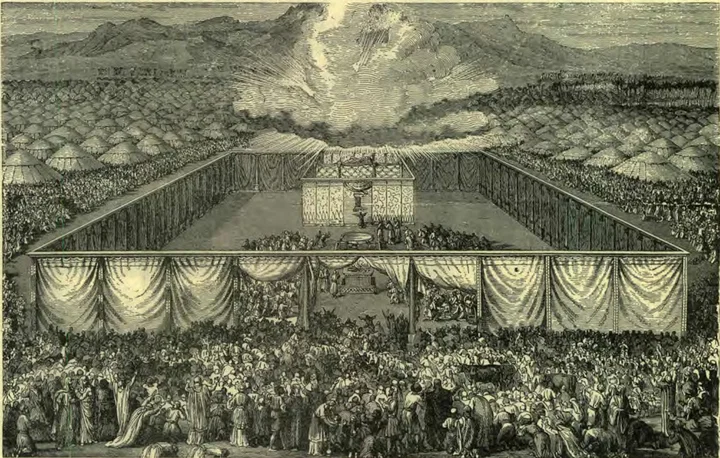
The great plan of salvation was here taught them. In the services imposed upon them, they could learn the nature of forgiveness of sin, the judgment, and the final disposition of sin.
The tabernacle, with its golden furniture and sumptuous drapery, must have been a sight that was lovely to behold. Even the angels might have studied the outlines of thought, contained in its markings, with profit. Its cherubim, its curtains with figures of angels, all told of the glory and power of God. But it was “made with hands.” It was destined to grow old, and finally perish. It was a figure for the time being. Heb. 9 : 9. The greater and more perfect tabernacle was in heaven.
The service of the earthly tabernacle was interesting and instructive in all its parts. Each day the great sacrifice of God in giving his Son to die for the world (John 3 : 16) was impressed upon the people in the animal that was slain. But one day of the year was especially interesting. The tenth day of the seventh month was the climax of the sanctuary work each year. It was a day of great solemnity; for it represented the awful judgment to which all mankind must be called. 2 Cor. 5 : 10. This was the day when the high priest would go within the inner vail before the mercy-seat, and stand in the presence of the shekinah of the God of the heavens and the earth. Lev. 16 : 2; Heb. 9 : 7.
As we let the mind go back to the plain of Shinar, and see the priest entering the tabernacle court with his bullocks and goats, and the thousands of the children of Israel crowding around the tabernacle of the congregation, we cannot help feeling solemn. Everything is in exact order. The priests in their clean linen (Lev. 16 : 4, 5), the censer with the incense (verses 12, 13), the people bowing without the tabernacle, before the Lord, and afflicting their souls (Lev. 23 : 27), all denote that this is more than an ordinary occasion. We watch the great throng, and soon we see the work begin. The high priest offers his bullock for himself to make an atonement for his house. Then the two goats are brought before the door, and after casting lots, the one chosen for the Lord is slain. As the blood flows from the innocent animal, the people that have faith, see the blood of the Son of God offered for them. The formalist sees nothing but a formal service that keeps him from being cut off from Israel that year.
The blood is carried in before the mercy-seat, where God had promised to meet with his people. By this service, God had vouchsafed to remove the sins accumulated there during the year. As the high priest comes forth, the sound of affliction may be heard throughout the great multitude. The scapegoat stands at the door ready to receive the sentence of condemnation, when Israel’s sins are laid upon his head. By a man appointed, he is taken away into the wilderness, where he meets the destruction that guilty Israel merited.
But in all this figure a real work is typified. The heavenly sanctuary is to be purified with better sacrifices than that of animals. Heb. 9 : 23. That purifying work is the real day of atonement, of which the earthly service, year after year, was only a shadow, or type. It began at the end of the twenty-three hundred days of Dan. 8 : 14, which was the tenth day of the seventh month (Jewish sacred time, corresponding to our twenty-second of October) of 1844. For now more than half a century our High Priest has thus been officiating before God’s great mercy-seat in heaven. The blood of the Lord’s offering (Jesus Christ) that was shed on Calvary nearly nineteen hundred years ago for us, has now, in the end of the world (Heb. 9 : 26), been carried once for all within the vail. The great scapegoat (Satan) stands without, awaiting his final sentence, and the reception of the sins of all who have confessed their guilt. When our High Priest comes forth, Satan will go to the very destruction to which our sins would take us if we did not confess and forsake them, and where all go with Satan who do not accept Christ as their Saviour. (See Rom. 6 : 23.)
Like Israel of old, there are at the present day also two classes who profess to believe this. With one class it is a theory. They hope to be saved, but they fail to afflict their souls now. They look forward to the future to do this work. The other class are earnestly seeking God, and have put away their sins, looking for the return of their High Priest to cleanse sin from the universe of God, and give them an eternal rest. Reader, to which class do you belong? May the Lord help us to be among those who are making ready and looking for the return of our blessed Lord. Heb. 9 : 28. We are in the great day of atonement. This is not a work that will be repeated every year. It is once for all. Let every child, and every youth, and every maiden, as well as every young man and every young woman, and those that are older still, whoever read these lines,—let them seek the Lord, and be at one with him. This is the at-one-ment.
J. H. DURLAND.