THE PRINCE OF GLACIERS

5%

S. D. A. Publishing Association · Battle Creek, Mich. · Aug 8, 1895

FromThe Youth’s Instructor, Vol. 43, No. 32.

Read the full edition

THE PRINCE OF GLACIERS.

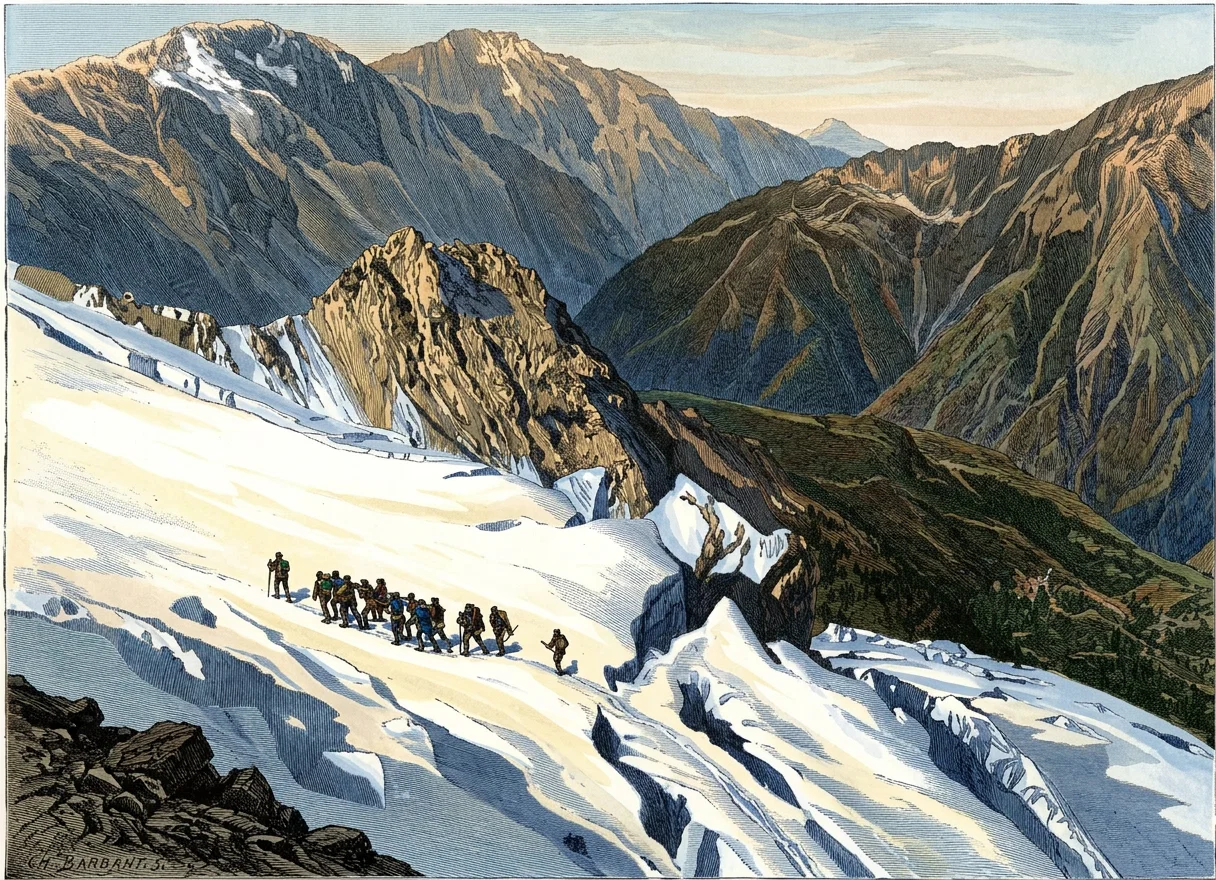
Mont Blanc, which deservedly bears the name of “Monarch of the Alps,” is situated in the midst of a mountain complex. There is no greater attraction in all Switzerland, or in all Europe, as far as that goes, for the lover of mountain climbing, than Mont Blanc and its adjuncts; and this is deservedly so, for it is the highest of all European mountains, towering, as it does, fifteen thousand seven hundred and eighty feet above Lake Geneva, and twelve thousand three hundred and thirty-five feet above the valley of Chamouni. Viewed from the latter place, the mountain and its environments present a very pleasing aspect. The enormous glaciers which clothe the flanks of this colossus of the valley descend now in gentle curves, now in broken and rugged lines; and their splendor illumines the flowery meadows, and penetrates to the very verge of the forests.
THE PRINCE OF GLACIERS.Restored with AI
THE PRINCE OF GLACIERS.
The entire chain of the group in which Mont Blanc is the most conspicuous member has a length of about thirty-six miles by from three to six miles in breadth. The northern part belongs to Switzerland, but the southern part to Italy, while France claims the remainder. At first sight it does not appear to be an easy matter to find the clue to this labyrinthine group of peaks and ravines with contours crossing one another in all directions. From the central range lateral chains of various length extend northeast and southwest, their heights varying from ten thousand to thirteen thousand feet. In the more northern part enormous glaciers are embedded; but toward the east and south the volume of the ice masses is much reduced.
This immense group may be divided into three parts: The northern part extends from the Pointe d’Orny and the Glacier du Trient to the boundary wall of Les Courtes and Les Droites, which meets it at almost a right angle. This natural rampart extends from east to west, from Mt. Dolent to the Aiguille Verte. To this district belong the beautiful Glacier d’Argentière, inclosed between the ridge just mentioned and the central chain,—the glaciers du Tour, d’Orny, de Saleinoz, and de Lanenvaz,—dominated in the center by the Aiguille de Chardonnet; in the southeast by the Aiguille d’Argentière, the Tour Noir, and the Dolent; in the west by the Aiguille de Dru; and in the north by the Grande Fourche and the Aiguille du Tour, flanked by the beautiful mountains of Ecandies, Orny, and Postalet, in Canton Valais.
The central part of the group, with its glaciers, presents, when viewed from above, the form of a trefoil, the stalk of which is represented by the Glacier des Bois, and the right-hand leaflet by the glaciers du Géant and du Tacul, in the south; the middle one by the glaciers de Léchaud and de Mont Malet, and the third leaflet by the Glacier de Talèfre, in the north. Five summits of this group command the valley of the Arve, and are all visible from Chamouni.
The southern part of the group is the loftiest. Its center is Mont Blanc, whose rounded summit dominates this array of peaks rising toward heaven like an ocean of motionless waves. The principal summits in immediate proximity to the culminating point of the European continent are the Dôme and Aiguille du Goûter, the Dôme and Aiguille de Miage, and the Pointe de Trélatête, with a magnificent assemblage of glaciers, of which the following are the chief: Toward the north, the glaciers of Bossons and Taconnaz; in the west, those of Bionassey and Trélatête; in the south, those of the Allée Blanche, the Miage, and the Brenva, whose ice masses sink down nearly to the banks of the Doire.
I subjoin an account of J. Janssen, member of the Academy of Sciences, Paris, descriptive of one of his ascents made in 1888, for the sake of pursuing some scientific investigations. A word with regard to this, first. It is said that the oxygen gas which forms part of our own atmosphere extends its action to the solar spectrum by the special phenomenon of absorption. These are, first of all, the rays belonging to the groups A and B of the Fraunhofer spectrum, and also those of the group a. They are, in other words, bands which, it is true, are not visible, except when the sun is already below the horizon, but which still pierce the large and dark bands in the regions of the red, the yellow, the blue, and even the violet.
Some one may ask whether these rays and these bands are due exclusively to the terrestrial atmosphere, or whether the atmosphere of the sun has not something to do with it; or, on the contrary, whether the mundane atmosphere simply favors a phenomenon, whose first origin would have its seat in the sun’s atmosphere. Oxygen plays so prominent a role in the constitution of the earth’s crust and the rocks composing part of the same, and of the fluids which form its oceans as well as those that enter into the makeup of our atmosphere—in short, it is an agent so vital to all manifestations of life, that the question of its presence, be it in the sun or in the other stars, is of the greatest importance.
In reference to his investigations in this direction, Mr. Janssen says:—
“The observations of which I wish to render an account do not claim to solve the question in all its details: to know whether oxygen makes a part of the materials which compose the solar globe. The complete solution of this grand and difficult question will demand, no doubt, new advance moves in spectral analysis, and difficult researches. My task was more limited; but it represents a necessary step in the course yet to be run in order to arrive at a complete solution. As aforesaid, it is to be ascertained whether the solar atmosphere contains oxygen gas in such a state that it could produce the actions of absorption similar to those of our atmospheric oxygen; in a word, whether the rays and bands recognized by the solar spectral analysis to produce atmospheric oxygen are exclusively due to our atmosphere, or not. A question of this kind may be solved by occupying some high point for the observations necessary thereto. If one makes comparative observations, both on the level plain and at such altitudes as leave beneath them a large share of our terrestrial atmosphere, one will obtain means of comparison that admit of conclusions such as bring the observations to the very limit of the atmosphere, and consequently to the solution of the question.
“In order to give the results all the exactness possible, it seemed necessary to rid the spectral rays of the watery vapor; for these rays show themselves in great abundance in the spectral regions themselves, where one finds these groups, owing to the oxygen.
“This induced me to make the observations during a very cold time, and so I was led to mount to a great height, to be able to reduce to a considerable extent the action of the atmospheric oxygen, and to choose a cold season in order to annul the action of the aqueous vapor, and to lead to spectral manifestations in all their simplicity.”
“Now the admirable altitudes of Mont Blanc, of which science has made comparatively little use, seemed to me to correspond to all the exigencies involved. Upon one of the most elevated and most interesting points of this grand monarch of the Alps is found a refuge, a very comfortable shelter, called the Grands Mulets.
“This retreat lies fully one thousand feet above the sea level, at the juncture of the two principal glaciers that slope down from Mont Blanc, and dominates the most important glacial phenomenon of the whole mass. The presence of the grand glaciers seemed to me very favorable to the purity as well as the lowering of the temperature in the atmosphere which I was investigating. At the time of year when this ascension was to be made (in October), the daily temperature of the atmosphere actually fell at this station much below zero. I resolved, therefore, to ascend to the Grands Mulets with my instruments, there to await a favorable season for my observations. But this ascent at this particular time of year, presented especial difficulties. The refuge was already abandoned for the winter, and recently a vast amount of snow had fallen, effacing the footpaths and covering the crevasses, so that marching was rendered extremely difficult. Finally the cold, already rigorous in these high regions, necessitated special dispositions and arrangements to admit of a prolonged stay. I caused the chief of the guides to come along, whom I had chosen as among those of most experience, and, after having examined the question most thoroughly together, it seemed not absolutely impossible, and we completed the arrangements necessary to adopt.
“I sent at once a detachment of the most experienced guides and mountaineers, whom the chief guide took in charge, to look up the route, and mark the track which the expedition ought to follow, from Pièrre-a-l’ Echelle, which is situated at the entrance of the glacier, as far as the cabin of the Grands Mulets, where the observations were to take place. These preliminary labors proved extremely laborious, and not without danger. The men often had the snow come up to their hips and belts, so that they could hardly stake off the route which we were to follow erelong. The distance of the way from Pièrre Pointue to the Grands Mulets, and the difficulties all along the track in midst of the blocks of ice, where the Glacier des Bossons joins that of Taconnaz, taxed my human strength beyond its powers, so that I had an apparatus fixed in which I could be carried a good share of the way at least. At six o’clock A. M., Oct. 13, 1888, we started from Pièrre Pointue. At the point named—Pièrre-a-l’ Echelle—the route rises to, and crosses over, the sudden slopes of rocks belonging to the Aiguille du Midi, and the moraine (ice-bed) of the Glacier des Bossons. The route stretches along the foot of the Aiguille du Midi, a place which the guides consider especially dangerous, on account of frequent avalanches and stone-slides coming that way. Hereafter we come in contact with the glacier itself, and at a point where the ice forms a graceful plain, with slightly undulating surface and but few fissures, the traveler can be carried, and steady advancement be made without much of any fatigue; but having reached a point which the guides call the junction, the difficulties become greatly augmented. The crossing of crevasses, the incessant ascent and descent, in midst of these blocks of ice, thrown down pell-mell and buried in the snow, require a dexterity of limbs and an expenditure of strength to which only youth in its best years is equal. By heroic perseverance, frequent stops to rest, and grace and devotion on the part of the guides, we at length, after the laborious efforts of many hours, come to leave this chaos. The next task is to get over the precipitous slopes of the Glacier Taconnaz that run in front of the rocks of the Grands Mulets, where the cabin is situated. There are still vast fissures; the route worms around them, and rises in windings innumerable as far as the foot of the rocks. Here the only difficulties we have to encounter consist in the depth of the snows and the narrowness of the way to be traversed, which does not admit of the use of the ladder. Night surprised us before we had reached the Grands Mulets. By the aid of lanterns, the ascent is still continued. At some slope where the road widened and admitted of doing so, the carrying apparatus was brought into requisition, which gave me some little rest. At length we reached the cabin, where those guides that had preceded us had prepared a fire and some refreshments. But the extraordinary efforts which I had been obliged to make in order to accomplish this ascent, did not admit of my safely partaking of food just then. We had consumed thirteen hours, from the shepherd’s hut at Pièrre Pointue to the hut of the Grands Mulets, a distance which in a favorable season of the year can be traversed in from four to five hours.”
These investigations demonstrated that other planets, as well as the sun of our system, have oxygen.
While men thus ascend to the loftiest heights, and others descend to the lowest depths of earth, to find some of nature’s secrets, he is wisest and happiest who will ever keep his ears open to the still small voice of God, that speaks to the heart, and will follow its guidance until we shall see as we are seen.
AUGUST KUNZ.