New Year’s day, with its clear, blue sky, seems to spread a holiday air over both city and country. Everything breathes festivity. Now and then a bomb or a skyrocket is fired off, not to disturb the peace, but rather to try the strings of the Æolian harp, and fill all the air with the sound of delightful music.
About ten o’clock in the forenoon the great mass of humanity is set in motion. Mother and daughters remain at home, while father and the boys go out to make their friends a call, and greet them with, Hao-ko-nien (Happy New Year!). All are well dressed; hands and faces are clean, and the hair is combed. Little boys who but the day before were ragged and filthy are now as neat and tidy as can be.
Rich and poor all are dressed alike. If it were not known to us how the common people had obtained their fine clothes for the festival, we might be tempted to think that Tsai-shen-ie—the god of wealth—had already demonstrated his power to make people rich. However, a few words of explanation will show that Tsai-shen-ie and U-fu have this year neither more nor less treasure to bestow than had the old gods. The wealthiest man in China, Li Hung Chang, and others of like character, have pawn-shops all over the country. On the shelves of these stores are the richest festival robes one could wish to wear.
Restored with AI
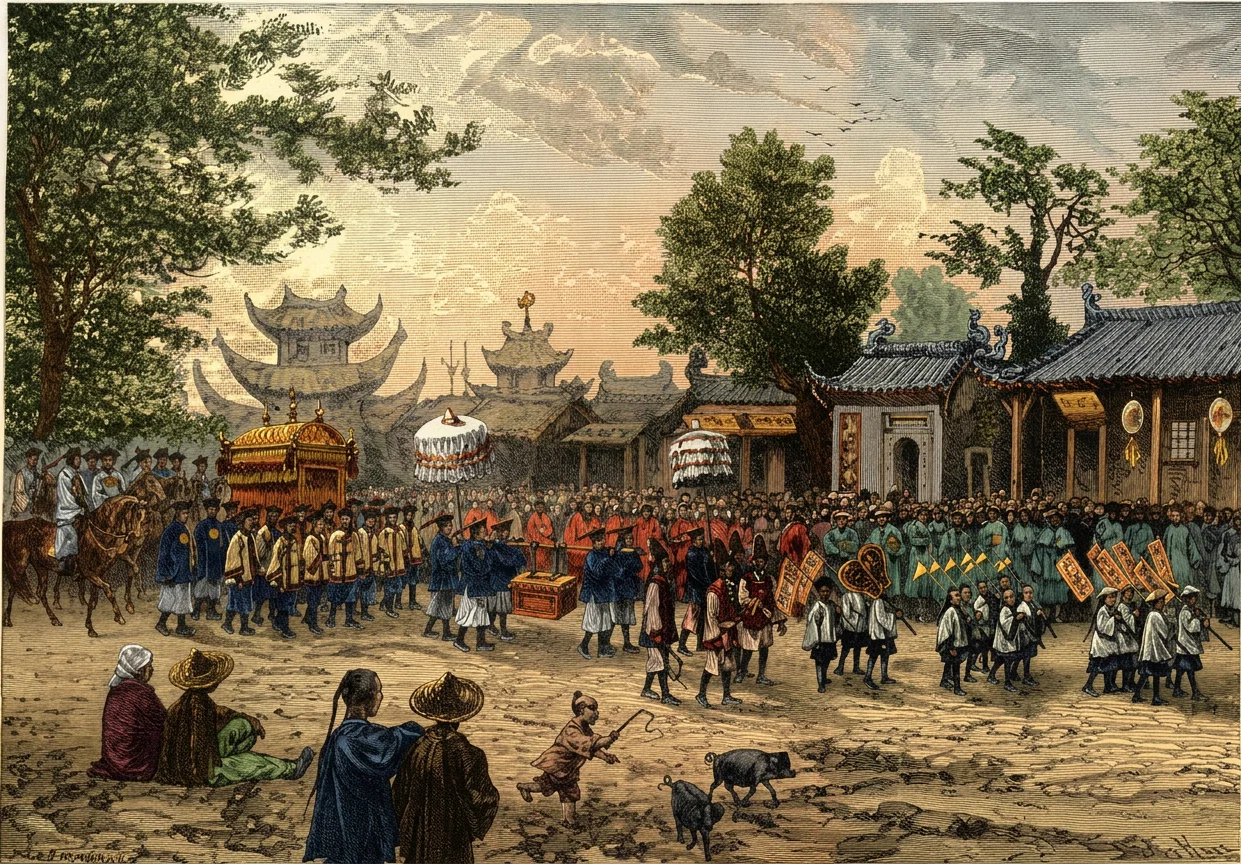
FESTIVAL STREET SCENE IN PEKING
Garments made from the finest silk, in all colors of the rainbow, embroidered with gold, such as the sons of the Orient love, are seen on New Year’s day in China. These garments are rented for the occasion, as but few are able to buy such clothes. The poor pay a certain sum for these borrowed articles, returning them after one day’s wear and pleasure. But what of that? The festival comes but once a year, and one must take part, in spite of borrowed clothes and empty purses. He must greet his friends with a “Happy New Year!” The whole of New Year’s day is spent in making calls. But it would not do to get tired of the endless greetings. No; one should rather be pleased to see the large number of Chinese come, and in their most polite manner bring their greetings, “Mu-si, Hao-ko-nien” (Happy New Year, pastor), bowing low in their respect, and offering their card as a token of friendship. The Chinese receive with gratefulness the missionaries’ cards. This small act of kindness leads to an intimate friendship between the missionary and the Chinese. When one goes to China, it is wise to be friendly and accommodating, as far as is in accordance with the word of God; for thereby many may be won to the gospel.
But little thought is given to eating and drinking during the first and second day of the New Year; for every one is busy going from house to house with the New Year’s greeting. At each house, however, simple refreshments are offered, such as dried peas, peanuts, and a certain kind of berries. Melon seeds are chewed as a pastime. As the festival-robed250friends come with their hearty Hao-ko-nien, we are obliged, by the etiquette of the country, to urge them to crawl on hands and feet onto the kang, and partake of the food there.
The mandarins, the highest civil and military officers, also parade the streets. But they are out to exhibit their official rank more than for anything else. Their rank is shown by buttons, and by the peacock-feather in their cap. These officers are clothed in the finest and costliest fur I have ever seen. They are seated in gold- and silver-mounted sedan-chairs, carried by eight or more men, who are usually dressed in uniform. Heading the procession is a company of the strangest-looking men one can imagine, from fifty to one hundred of the most noted beggars in the community. These are trained to act a part in the festivities of the day. It matters not whether they have any clothing or not. The more ragged they are, the better the procession is enjoyed. Each is given opportunity to earn at the most twenty “cash” (one cent), which is regarded as a great deal for them, even on New Year’s day.
During the festival the mandarins supply these sons of misery with a uniform, consisting of a long red shirt. Trousers are not needed, but a high paper helmet is worn. These men carry the banners, and lead the band music, which is of such a character it is impossible to describe it. Following the mandarin in his sedan-chair are subordinate officers on horseback. Each rider is accompanied by a soldier, who holds the horse’s tail so as to keep up with the rider when he gallops down some side street with a greeting in behalf of the mandarin to some of his friends. The streets through which the mandarin passes are packed with persons of all classes and ages.
Restored with AI
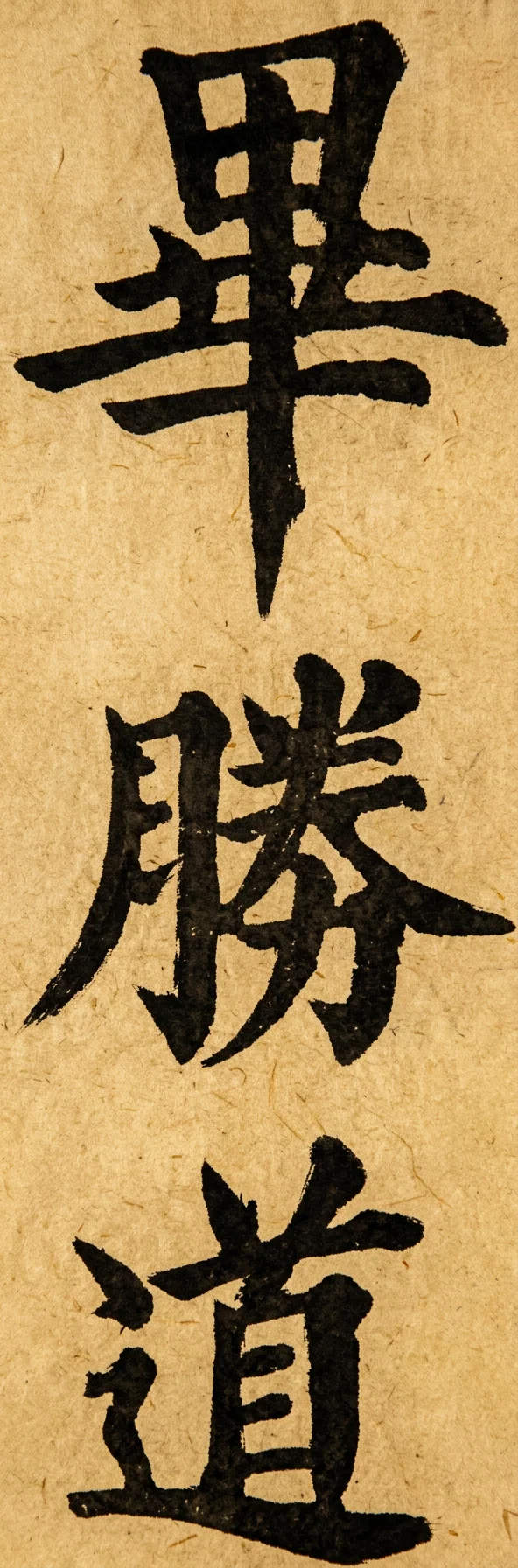
Brother Pilquist's signature, in Chinese characters.
This year the Chinese New Year’s day fell on the 31st of January.