DR. O. C. GODSMARK

11%

Review and Herald Publishing Company · Battle Creek, Mich. · Aug 9, 1900

FromThe Youth’s Instructor, Vol. XLVIII, No. 32

Read the full edition

DR. O. C. GODSMARK

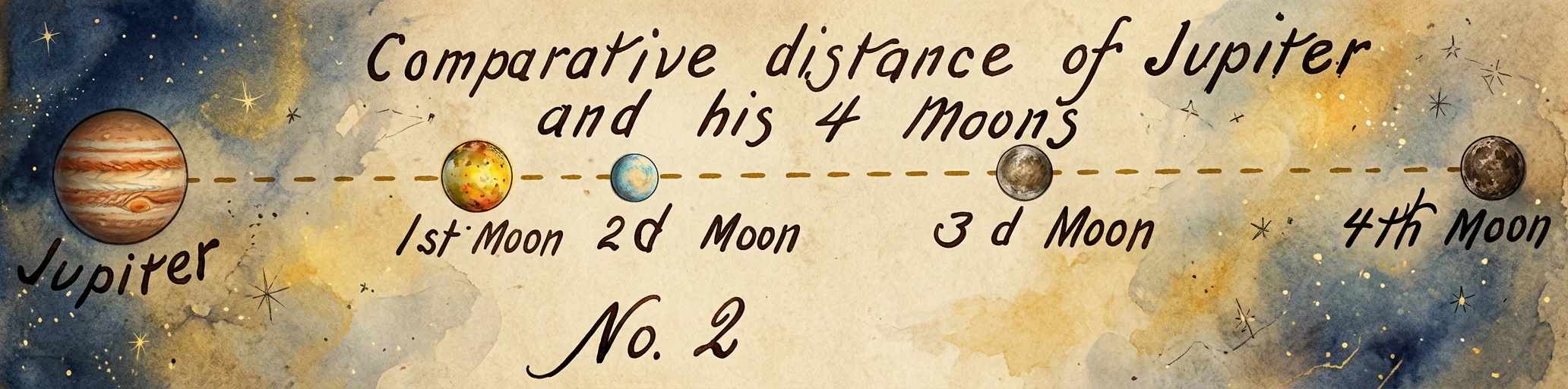
These moons, revolving in nearly the same plane, pass through many eclipses. In one month of our time Io suffers eighteen; the second eight or nine; the third about four; the fourth does not pass through an eclipse nearly so often. This fourth moon, Callisto, is quite different from the others, being much darker, and always keeping the same side toward the planet, the same as does our moon. We have reason to believe that these moons, unlike our own, have both moisture and an atmosphere; and for all we know, they may be inhabited.
Restored with AI
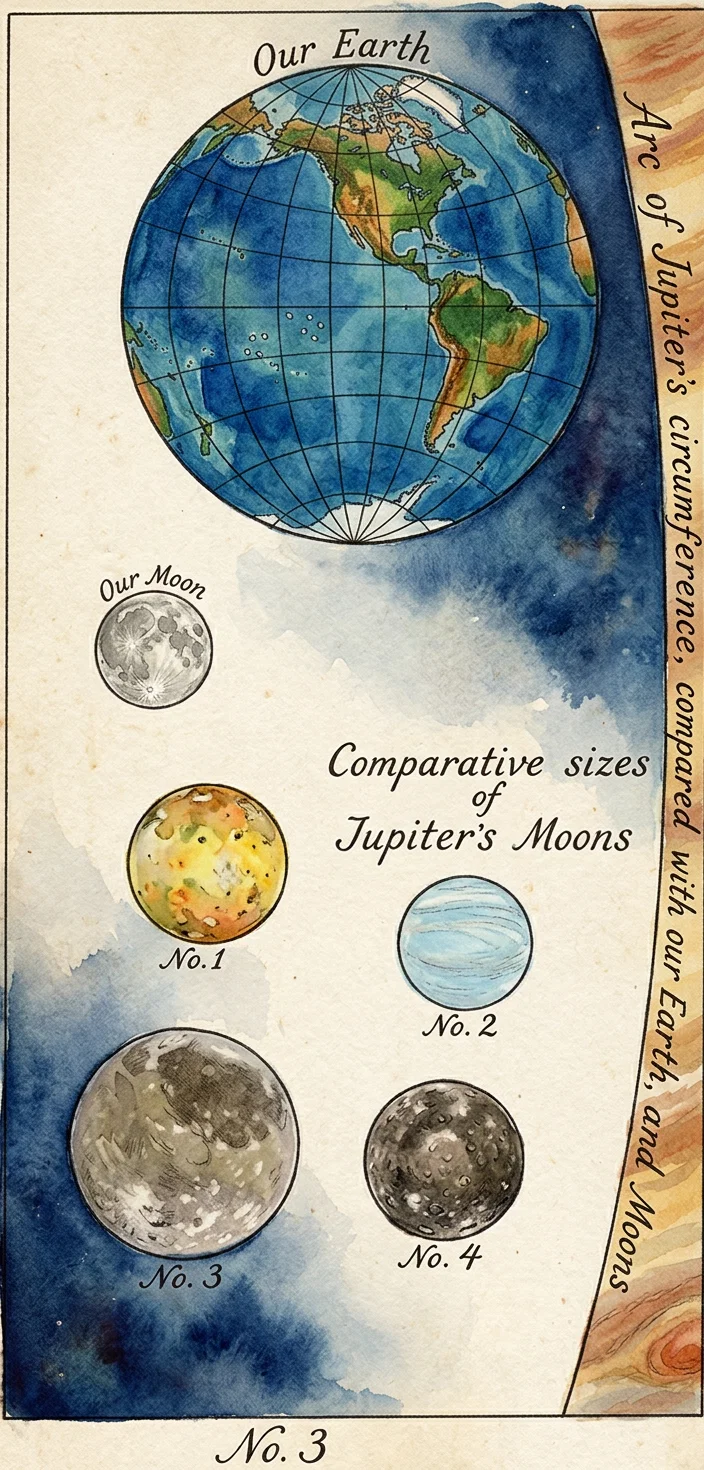
The third illustration gives an idea of the size of these moons as compared with our earth and moon. By comparing the size, as given in the engraving, of our earth and moon with the moons of Jupiter that appear just below, we see something of the magnitude of Jupiter’s family, which travel with this planet in its journey (occupying nearly twelve years) around the sun. No. 1, which is Io, is 2,440 miles in diameter; No. 2, Europa, is 2,190 miles in diameter; No. 3, Ganymede, is 3,580 miles in diameter; while No. 4, Callisto, is 3,060 miles in diameter. Our own moon is 2,163 miles in diameter, and our earth is 7,926.
Restored with AI
The planet Jupiter itself has the enormous diameter of 88,439 miles. To get an idea of this, continue, with a pencil, the arc of the circle that appears in the right of this engraving so as to make a perfect circle, and you will have a comparative illustration of the size of Jupiter, as shown in connection with its moons, our moon, and our earth.
In some future article we will learn more about these interesting satellites. May we all so live that Jesus may trust us with a home in his eternal kingdom, where we may study his wonderful works throughout eternity.

DR. O. C. GODSMARK

861 5th St., Milwaukee, Wis.