Achillea Millefolium is the botanical name of one of the most common weeds that grows in this country. Achilles is said to have been the first to discover its healing properties, and on this account we have the first of its two names. The second name, which botanists call the specific name, is derived from mille, “thousand,” and folium, “a leaf;” that is, thousand leaves, evidently from its finely cut, much divided, tansy-like leaves.
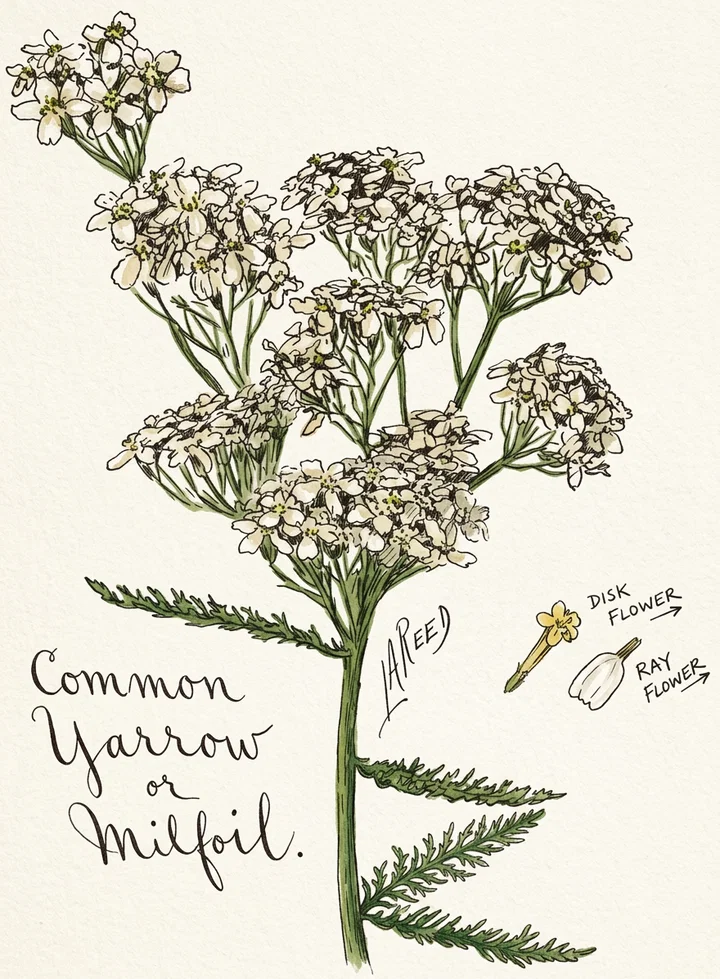
This plant belongs to the Composite Family, along with ironweed, asters, fleabane (already described), daisies, goldenrod, ragweed, sunflower, marigold, dog-fennel, tansy, wormwood thistles, and burdock. If you look carefully at the flower-head of the Yarrow, you will notice that what appears at first glance to be one large flower is really a bunch of smaller flowers. What looks like the center of the single flowers is really a bunch of what are called disk-flowers. They are something the same shape as the single blossoms in the flower-head of the lilac. The ray-flowers are a brighter white, and look something like a paddle with a very short handle. The disk-flower is the flower that produces the seed; the ray-flower is for display, and is a sort of sign that the flower hangs out to attract insects, which help it to produce seed by bringing about fertilization.
The flower-heads of the yarrow that I have seen are a grayish-white, but I have heard of a pink variety. Among the common people for many centuries, yarrow-tea has been used as a medicine. The plant has a strong herby smell, not at all unpleasant. There is a small steamboat-landing and settlement in southwestern Oregon, within sound of the roar of the Pacific Ocean, which, from its immense fields of the weed, has been called Yarrow.
L. A. REED.