I remember hearing a song, one line of which was, “Did you ever see an oyster walk upstairs?” I frankly confess that I have never seen an oyster perform in that manner; but I have been told of fishes that do something almost as wonderful, and that is, climb trees. There is an Indian fish called the “anabas,” or climbing-perch, which is so formed that it can not only remain out of water for a long time, but can also climb into bushes and trees. Then there is a family called “frog-fishes,” which have fins so shaped and placed on the body that they can use them as legs. They can live out of water for two or three days; they take advantage of this fact, and creep about on land like small four-footed creatures. Another fish that goes for a walk on shore is the strange-looking sea-bat.
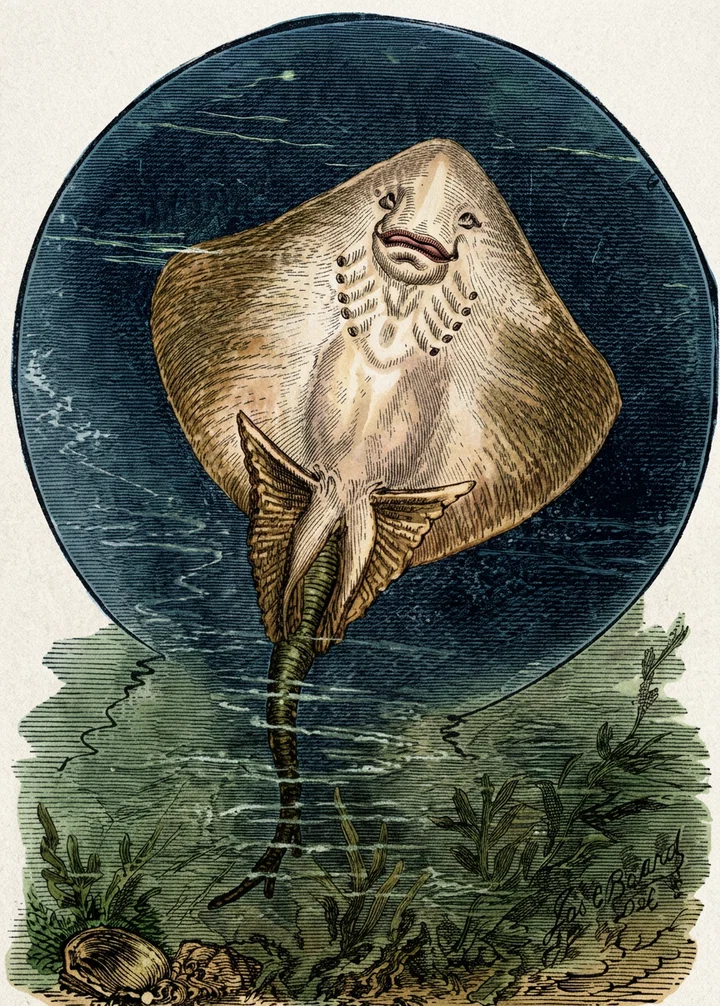
The skate is an odd-looking fish, which is abundant on some coasts. It attains a large size, a fine specimen having been known to weigh two hundred pounds. When angry, the skate bends its body into a bow-like form, till the tail almost touches the nose; then, with a sudden fling, lashes out with the tail in the direction of the offender.p. 94
Some queer fishes are clad in various kinds of armor. The body of the remarkable pipe-fish is so long and slender that he curls it around the seaweed. It is covered with large, bony plates instead of scales, and the skin from its sides laps over to form a long pouch underneath. In this pouch Mr. Pipe-fish carries the eggs deposited by Mrs. Pipe-fish.
Mr. Pipe-fish has a remarkable cousin, known as the sea-horse. His armor-plates are strangely formed, and his large eyes, at the beginning of his long, turned-up nose, give him a very fierce appearance. He curls his tail around a weed, and the upper part of him looks just like the head and neck of a little horse. Another kind of sea-horse is more remarkable still; he looks more like the skeleton of a sea-horse, whose flesh the waves have torn into long ribbons, which float in the water like real ribbons in a breeze.
The globe-fish, when among his friends, is gentle-looking; but when he comes across a stranger, he has an odd way of taking a long breath, and swelling out like a balloon. Then his sharp spines stick out, and look very unpleasant; and, oddest thing of all, he turns over and floats on his back. Another peculiar thing about him is that he has no teeth; instead, there is a plate of ivory along his gums.
Still keeping to those fishes that have bony plates upon their bodies, we have the sturgeon. He is an enormous fellow, sometimes attaining a length of twenty feet or more, and weighing several hundredweight. Although sturgeons have no teeth, they catch and eat enormous numbers of fish, such as mackerel and herring. In spring they assemble in great shoals, and ascend large rivers, where they lay their eggs.
The torpedo, or cramp-fish, is so called because it has an arrangement inside something like the cells of a galvanic battery, by means of which it has the power to give electric shocks. These shocks, though not so powerful as those produced by the electric eel, are still strong enough to benumb the arm of a man should he take hold of the fish; it is believed the torpedo uses its power for the purpose of catching its prey.
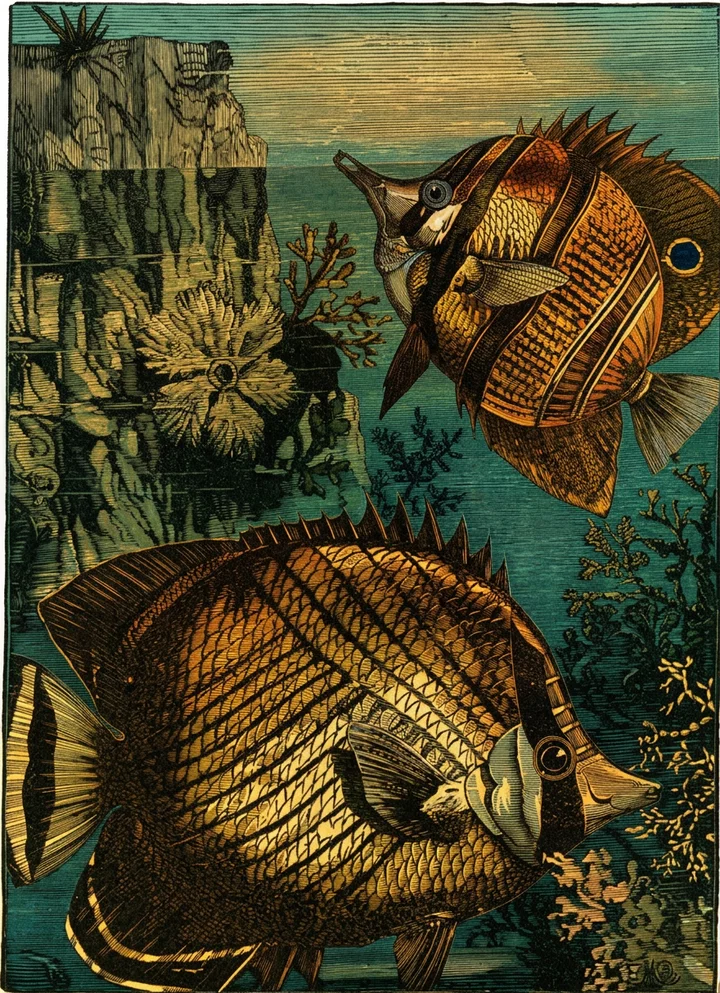
The Chinese squirt-fish, or archer-fish, shoots its prey. This archer is said to be fond of insects. Its mouth is drawn out into a kind of beak, and by means of this it can shoot out a drop of water at any fly that may be resting on a plant at the water’s edge. The result is that the fly usually drops into the water and becomes a victim. But the archer-fish is outrivaled at this game by the beaked chætodon, which continues its habit of “shooting” flies even in captivity . For this reason it is held in high esteem by the Japanese as a pet. They keep the fish in a large glass bowl, and amuse themselves by holding over it a fly at the end of a slender rod, and seeing the fish try to capture it. This fish is found in the Indian and Polynesian seas.
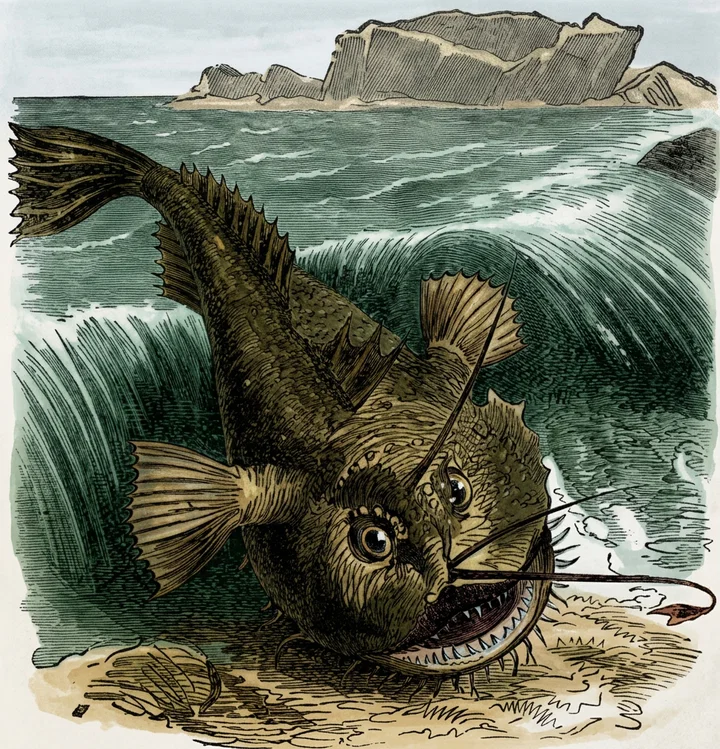
But this is not nearly so clever as the method adopted by the fishing-frog, a fish about five feet in length. This remarkable creature reminds one of an enormous tadpole, for it seems to be nearly all head. Its mouth extends across the whole width of the head, and the under jaw protrudes beyond the upper. To add to its charming appearance, both jaws are provided with a double row of sharp teeth. What entitles it to special mention, however, is the foremost of three long spines upon the top of its head. This is pliant enough to bend over like a fishing-rod, so that the tip, which is red and fleshy, resembles a worm. Being so big and ungainly, the fishing-frog can not chase the smaller fishes that he feeds upon. He has a better plan; he half buries himself in the mud and weeds, so that he can not be seen clearly; then he sets his fishing-rod gently moving. This, of course, is too much temptation for some silly little fish, which, without stopping to think, rushes at the supposed worm. The great mouth of the fishing-frog opens, and the little fish is seen no more.—Edward Step.