Manners and Customs
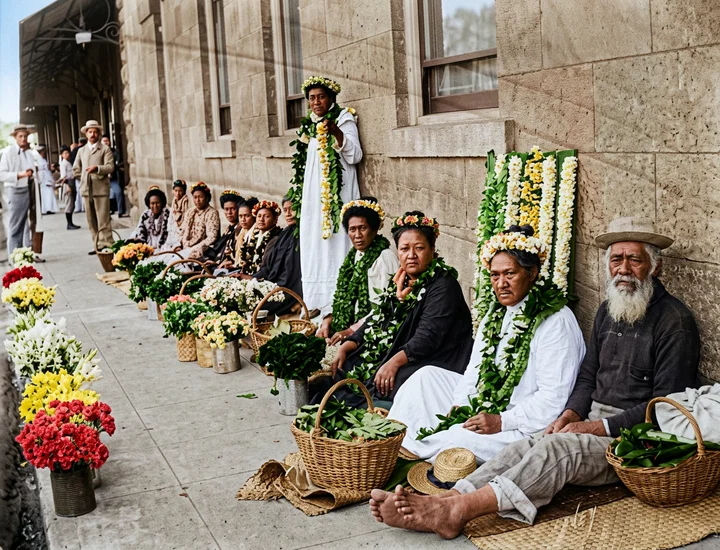
The most beautiful, perhaps, of the many interesting Hawaiian customs is that of presenting leis (pronounced lās) to departing friends. These leis are long strands or wreaths of small flowers. They are made in an artistic and curious manner by native women, and are very beautiful.
In order to see the lei-women at their best, we must visit them when their trade is briskest, and when they are unconscious of observation. This will be when a large steamer is preparing to sail; so we will visit the wharf on “steamer-day.”
All along the road near the entrance the women are sitting upon mats, or pieces of mats; while near them are their baskets, in which are leis and other flowers. The former are also carried suspended from the left arm, in readiness for possible customers.
Soon a young man comes hurrying down the street. Instantly the mats are deserted, and he is surrounded by a smiling, chattering crowd, each eagerly forcing upon his attention her leis.
Hastily interrogating, “Three for fifty cents?” and receiving an affirmative reply, he selects one made of the beautiful green leaves of the maile, one of red carnations, and one of white, tosses the coin to the lucky vender, and escapes inside the gate.
Almost every gentleman, unless he is very dignified and unapproachable, has to encounter the importunities of the lei-women on these occasions. The latter, however, are almost invariably pleasant and good-natured, and soon exchange their flowers for the more substantial silver.
As the time draws near for the boat to leave, the trade in flowers almost ceases; and the lei-women gather up their mats, and prepare for the trip down town. There they will sit all day on the sidewalk, a long row of them, leaning up against buildings, chattering, making leis, and enjoying themselves generally. It is nothing unusual to see them stretched out upon the sidewalk fast asleep.
About nine o’clock in the evening they will take a hack or bus, and ride up the valley and out into the country, where most of their little homes are situated. One not acquainted with the Hawaiian indolence and dislike for anything requiring exertion, might wonder that they do not walk, as an American or Englishwoman would do under the same circumstances: but no; a Hawaiian seldom walks when it is possible to ride. A gentleman, in speaking to us of this characteristic of the native Hawaiian, before we came here, said, “If a Kanaka goes down town with fifty-five cents in his pocket, he will spend twenty five for a hack to ride down, the same to ride back, and five cents for the article he wishes to buy.” While this statement may be somewhat exaggerated, it is more likely to be literally true. We ourselves have witnessed similar instances.
But to return to the wharf. Within the gate all is bustle and confusion. Wagons are here, there, and everywhere. With difficulty we thread our way through them, and stand beside the great ocean steamer. Behind us the government band discourses sweet music; while from above floats down a mingling of fragrant odors, which remind us that some of the sweet things of Eden still remain in the world. Friends on the wharf are saying their last good-bys to friends leaning from the boat above, many of whom are almost hidden by leis,—green, yellow, red, orange, pink, and white, besides many others made of an endless variety of mixed flowers.
Soon the cables are taken in, and the boat swings slowly around. Some of those on board take the leis from their necks and hats, and throw them back as mementos to their friends on shore; others retain them as souvenirs of the fair land from which they are about to sail, and as tokens of love from the friends from whom they are parting. Now the boat is out in the stream; and we turn away, thinking of the time when there will be no more good-bys, no more partings, and wondering how many of those present will pluck never-fading flowers, and share in the joys of those who will dwell forever in the glorious earth made new.
LENA E. HOWE.