ASTRONOMICAL STUDY—NO. XI
Saturn
AS ALL our readers have now learned where to find the planet Jupiter, and have a fairly correct idea of this, the largest, and at present the most conspicuous, of all the planets, we will turn our attention to the next in order as we journey from the sun, and study for a time the most beautiful, if not to the naked eye the brightest, of our sister-worlds. We refer to the planet Saturn. This “mansion” of our Saviour’s creation, when viewed through a telescope, is the most wonderful, and the most beautiful to look upon, of any of the worlds that accompany our sun in its onward march.
To the unaided eye, Saturn appears as a first-magnitude star, shining with a steady, yellowish light, and is at present to be seen about thirty degrees to the east of Jupiter. It is among the first stars to appear in the early twilight after Jupiter. We hope you will all look for these planets, and fix their position in mind; you will then be prepared to watch these heavenly wonders as they, from night to night, speak to the inhabitants of this world of the glory of God; for the heavens do declare the glory of God, and he is pleased to have us reverentially study into their mysteries.
As a planet, Saturn has a mean distance from the sun of 886,065,000 miles. At its nearest approach, it is 841,097,000 miles, and at its farthest distance, 931,033,000 miles, from our sun. Its nearest approach to our earth is 774,000,000 miles, while its most distant point from us is 1,028,000,000 miles. Its length of day is ten hours, twenty-nine minutes, and seventeen seconds. Its equatorial velocity is 24,476 miles an hour, which is second only to that of Jupiter.
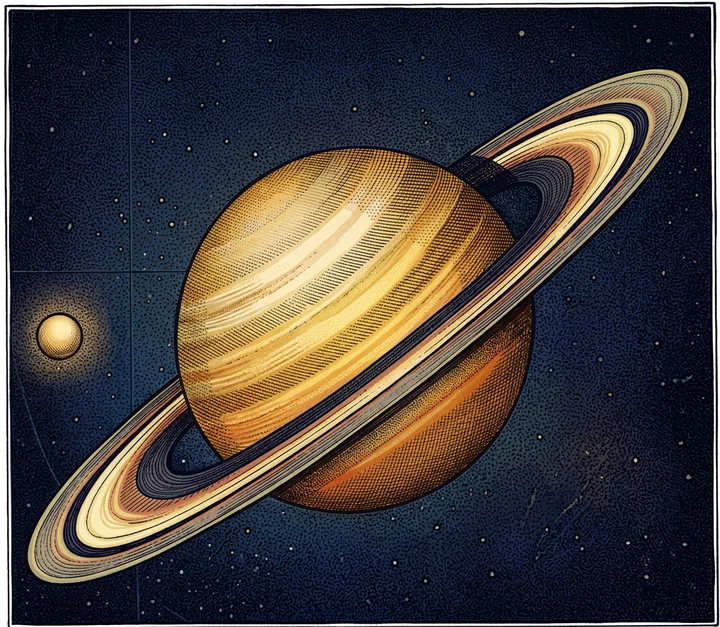
Its onward, or yearly, motion in its journey around the sun is slow, being only 21,560 miles an hour, requiring 10,759 days, or about twenty-nine and one-half years, of our time to complete one revolution. In size Saturn is next to Jupiter, being 75,036 miles in diameter. The great wonder connected with this planet, and that which makes it the most beautiful of all in our system, is its rings. These are three in number, and present many interesting features, which it will be our pleasure to study in a future article.
The accompanying illustration shows Saturn with its rings, also one of its eight moons. These rings are at present so tilted that they present to us much of their surface, thus making the planet appear brighter than it does when only their thin edges are turned toward the earth. In our next we shall learn some interesting things concerning these wonderful accessories of this beautiful world, which we trust we shall some day have the blessed privilege of visiting. DR. O. C. GODSMARK.