In Japan there are eighty-four thousand nine hundred and twenty-four Buddhist temples, and the number of priests attached to them is about fifty-seven thousand seven hundred. This does not include the Shinto temples and shrines, which are numerous. There are also many wayside shrines, where travelers stop and worship as they pass. In every heathen household there is the niche where the gods are kept, and all the members of the family daily bow before the gods, and make them offering of food.
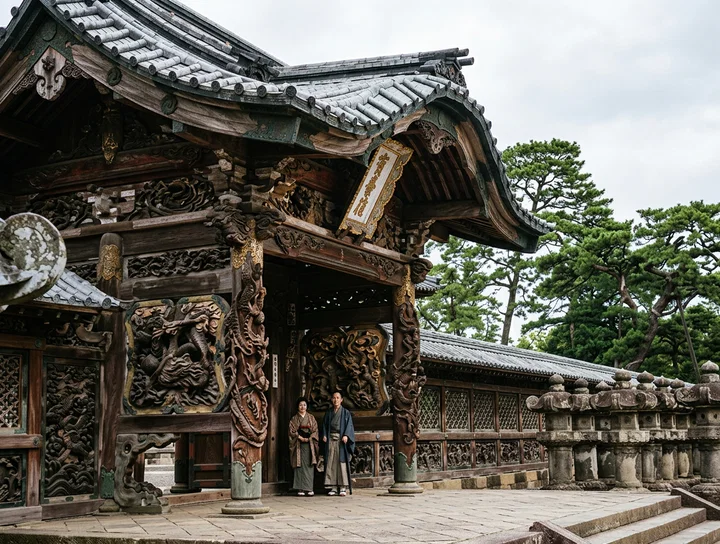
The Buddhist temples are generally adorned with grotesque carvings, and resplendent with gilding. In our illustration is represented the gate of the temple at Shiba, Tokyo. This is quite a celebrated temple. The courtyard contains the tombs of several of the noted shoguns of Japan. The temple at Asakusa, a district in Tokyo, is also a place of note. It is surrounded by pleasure gardens, many acres in extent. In these grounds are fairs, refreshments, booths; and the people eat, smoke, dance, and engage in every gay sport and pleasure known. To the Japanese mind there is no incongruity in placing a temple cheek by jowl with a theater.
It is a regular fair, the busiest mart in the city. There are venders going about hawking their wares, beggars, thieves, pickpockets,—all mingling in the motley throng, and plying their vocations. The priests in their sermons tell the people that they can invest their money well by laying it out upon articles to be obtained in the temple grounds, such as dress, ornaments, fancy pipes, combs, strings of beads for prayers, gods made of various kinds of metal, shrines for family altars, and the like.
Before the temple gate stand two gigantic wooden demons, reminding one more of the mythological gate-keepers of the infernal regions than of the guards of a sacred place. They are adorned with straw sandals hung upon them by coolies, to propitiate them and cause them to give the donors strength in their feet. Within the temple there is a babel of noise and confusion, with filth and bad smells. There are sacred pigeons whirring here and there to the detriment of hats and clothing. There are ladies elegantly arrayed in silks, officers dressed in splendid uniforms, coolies, rustics, children with dirty-faced babies on their backs,—all mingling promiscuously in the throng, making their offerings and saying their prayers.
The main altar, behind which the chief god sits, is protected by a wire grating. The worshipers must be careful to throw money into the coffer before praying to him. They write their prayers on slips of paper, put them into their mouths, chew them to pulp, and spit them out at the god. If he is hit and the wad sticks, it is considered a good omen, and they believe that the prayers will be answered. Hearing, you see, depends upon the softness of the wad and the skill of the ejector. Of course the old god is a disgusting-looking object, with these spit-balls sticking all over him.
Not far from the main altar stands the old god Binzuru, supposed to be the healer of diseases. Crowds are always gathered around him. They rub the repulsive-looking old monster, supposing that in this way healing power is extracted from him, and then rub the diseased portions of their own bodies. This idol is greasy and filthy beyond description. Portions of his face are quite worn away by the friction of so many hands. They doubtless contract disease in this way. For instance, a man who has some contagious skin disease rubs the idol well, and leaves germs which cling to the hands of the next man who touches him; and so the god is a means of conveying infection.
Isn't it pitiful to think of people supplicating this monster to heal them of their bodily infirmities, and knowing nothing of God, who is the healer of soul as well as body? The Buddhists are now building a temple in Kyoto, which has already cost five million dollars, and will probably cost as much more. Why, the very ropes with which the gigantic beams were elevated to their places, were made from the hair cut from the heads of the devoted women and girls of Japan! Isn't that a spirit of sacrificial devotion? If we were as ready to sacrifice for Christ as some of these people are to sacrifice for their heathen gods, it would not be long before the far East would be rejoicing in the glorious liberty of the gospel.
The Buddhist temple services are very similar to those of the Roman Catholics. The Buddhists have altars, shrines, candles, flowers, incense, shaven heads of priests, processions, beads, etc. The priests sing out the prayers and sermons in a monotonous way, while the people sit on the floor in true Japanese fashion, and nod their heads at intervals. Prayer-meetings or church services such as we have, in which the congregation takes an active part in the speaking and praying, is unknown among them. You can readily see how empty and hollow is all this show, and how unsatisfying to an earnest soul, who is really a seeker after truth.
There is nothing in heathen religions that can give the people any help or comfort amid the perplexities and trials of life, or that can shed one ray of light or consolation into the dark portals of the grave. How the great tender heart of the Master, who died for them, yearns over them in pity and compassion, as he sees them dying without the knowledge of his saving love! His commands to us are explicit: “Go ye into all the world, and preach the gospel.” Shall we not show our love to him by our obedience, and hasten to send thep. 346 bread of life to those who have not yet received it? To us has been committed the truth. Again let us remember his command: “Freely ye have received, freely give,” and if we are faithful to the trust that our Lord has committed to us, it will not be long before it can be said of Japan, “The people which sat in darkness saw great light; and to them which sat in the region and shadow of death light is sprung up.” MRS. J. A. BRUNSON.