Bidding farewell to the friends who accompanied us to the boat, we stepped aboard the steamboat “Bengal” of the Peninsular and Oriental line, at London, on Jan. 22, 1895, en route for Calcutta. Sailing down the Thames, we soon entered the English channel. On account of a heavy storm, we were obliged to cast anchor for about twenty-four hours alongside the Isle of Wight; but this delay was afterward made up, so that we reached our destination at the appointed time.
Our vessel touched at Gibraltar; Naples; Port Said, at the entrance to the Suez canal; Aden, the southern point of Arabia; Colombo, the principal city of the island of Ceylon; and at Madras. At each of these stopping-points, the vessel was thronged with dark-skinned natives of these various countries; and as I thought of the thousands and millions, of whom these are the representatives, who have never heard the first sound of the message for this time, I realized as never before the vastness of the work to be done in carrying the truth to every nation, kindred, tongue, and people.
Restored with AI
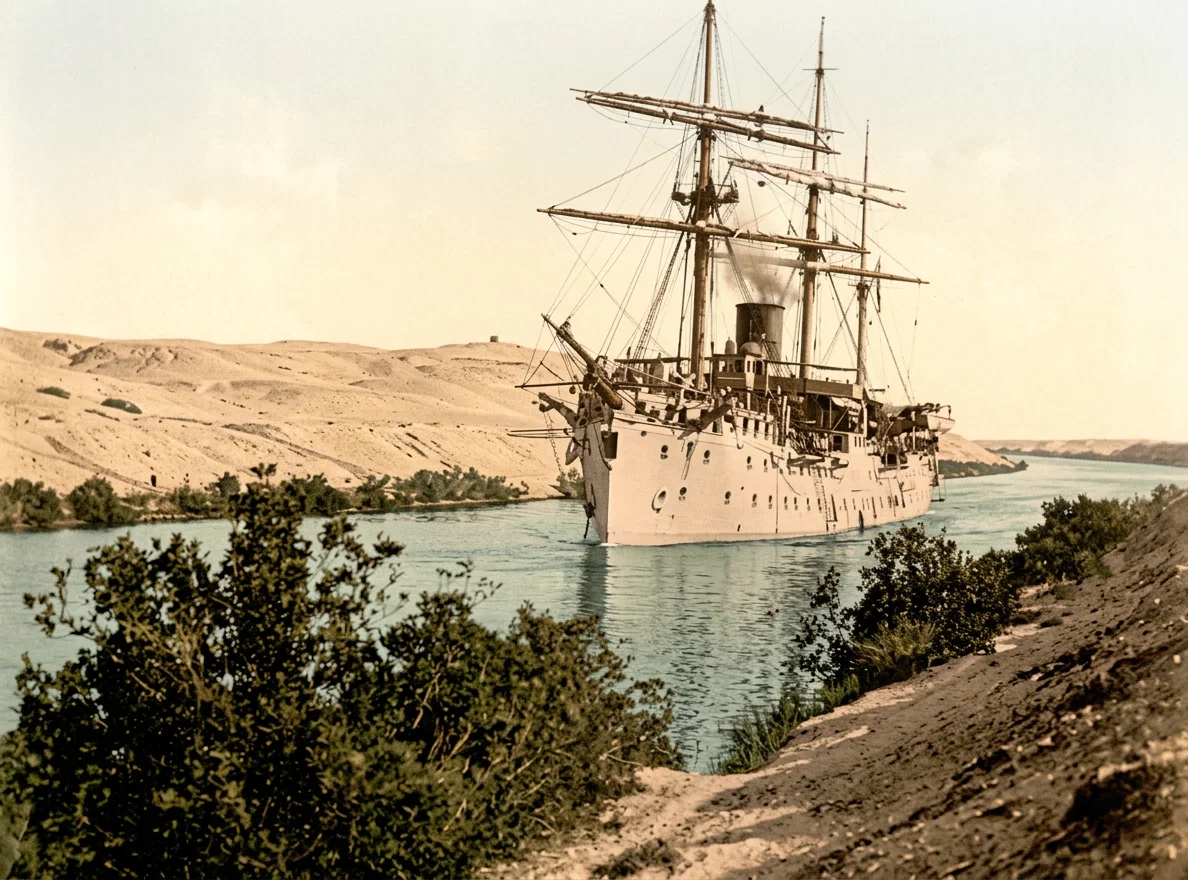
THE SUEZ CANAL.
The passage through the Suez canal was made on the Sabbath-day; and as we sailed down the arm of the Red Sea, with the land of Goshen on one side and the Wilderness of Wandering on the other, it added much to the interest of the scene to take the Bible, and read again the story of God’s wonderful dealings with his people in connection with these places. The peninsula of Sinai, as seen from the vessel, presented a very dreary, desolate appearance, and well merits the description given by the inspired writer, as “that great and terrible wilderness,” “a desert land,” and “the vast, howling wilderness.”
At Colombo we went ashore, and spent a pleasant afternoon in conversation with some of the English missionaries stationed there. The natives of this island, called Cingalese, are a very interesting people. They are quiet and peace-loving, gentle and hospitable, with intelligent, and, in the educated classes, intellectual countenances.
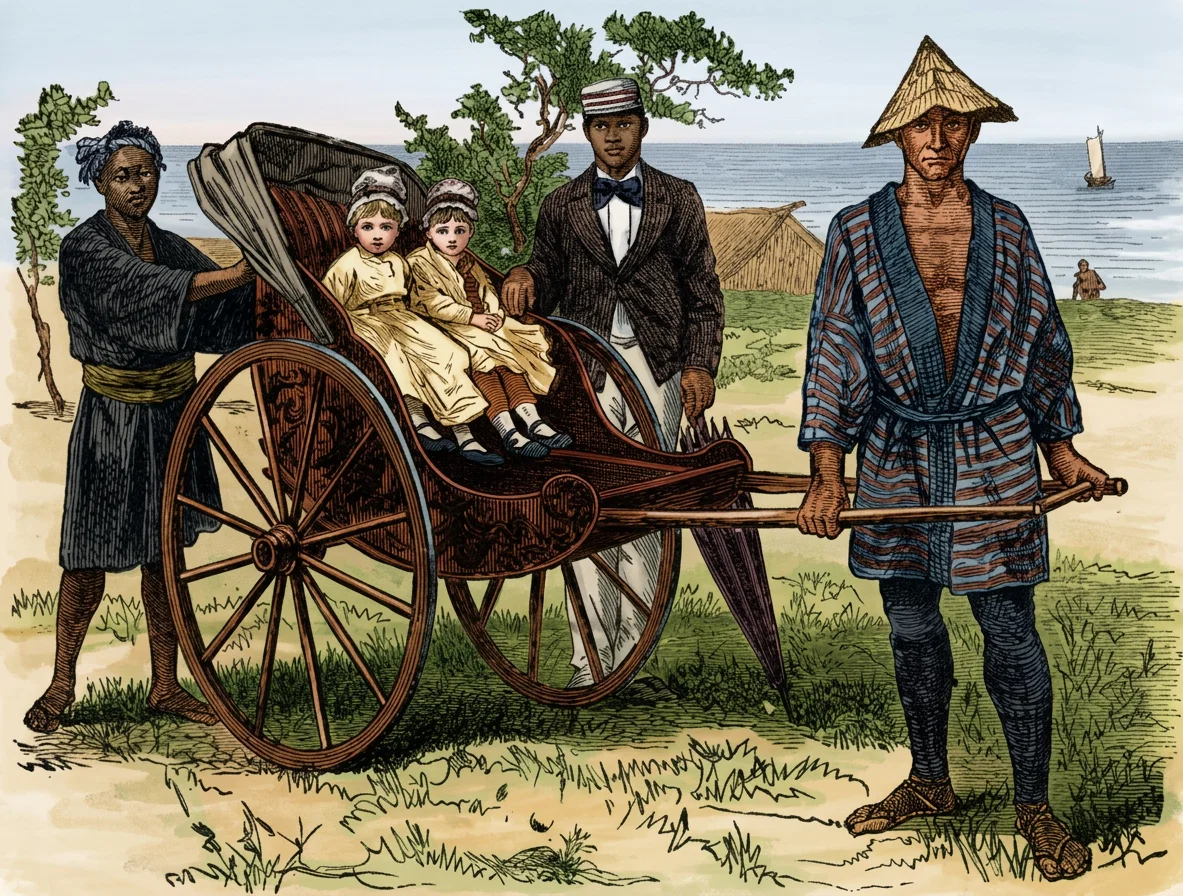
The dress of the men is very similar to that of the women, so that in the distance it is impossible to tell to which sex they belong. They also have a peculiar way of dressing the hair, combing it straight back from the face, and doing it up in a coil at the back of the neck. On the top of the head they wear a round comb inverted, with the teeth projecting into the air. Here we had our first ride in a jinrikisha. The jinrikisha came from Japan, and has found great favor on this island. It is something like a big baby-cab, with shafts, and is drawn by a man. The carriers seem to find the work both easy and profitable.
Having reached the ferry, we embarked in a frail-looking canoe, made from the hollow trunk of a tree, so narrow that I had difficulty in getting into it, and returned to the ship, which was anchored some distance out in the bay.
Restored with AI
A JINRIKISHA.
Another week’s sailing brought us to the mouth of the Hugli River, a branch of the Ganges, on which the city of Calcutta is situated. As we came nearer and nearer land, the water became more and more muddy. It is estimated that it would require fifteen hundred large ships sailing down the Ganges every day, to carry the amount of earth and sand the river daily bears to the sea. In this way thousands of acres are thrown up each year; but while new land is thus constantly forming, large portions of cultivated land are swept away from time to time, so that the poor native does not notice that the river makes much amends for the loss it often causes him. Nevertheless, the land is steadily gaining on the ocean, and those who cultivate near the river often have new fields thrown up in the course of a few weeks. Bishop Thoburn, in his book on India, says: “I have myself seen wheat growing rich and green in the month of December, in fields where I had seen the water flowing fifty feet deep six months before.”
The mouth of the Hugli is so wide that one cannot see across it, but it gradually narrows. On account of the shifting sand beds, navigation is very dangerous. Not far above the mouth of the river is an uncommonly treacherous shoal called the “James and Mary.” If a ship strikes the bottom here, she is immediately pushed over by the strong current. In a few minutes even large vessels disappear.386Numbers of ships have been lost at this point. When our vessel reached this place, passengers were called on deck, the life-boats were lowered, and every man stationed in his place, ready to get the passengers into the boats at a moment’s notice; but our brave vessel passed this dangerous shoal without accident, and a few hours later we were safely lying at anchor in the harbor at Calcutta, after a voyage of thirty-three days out from London.