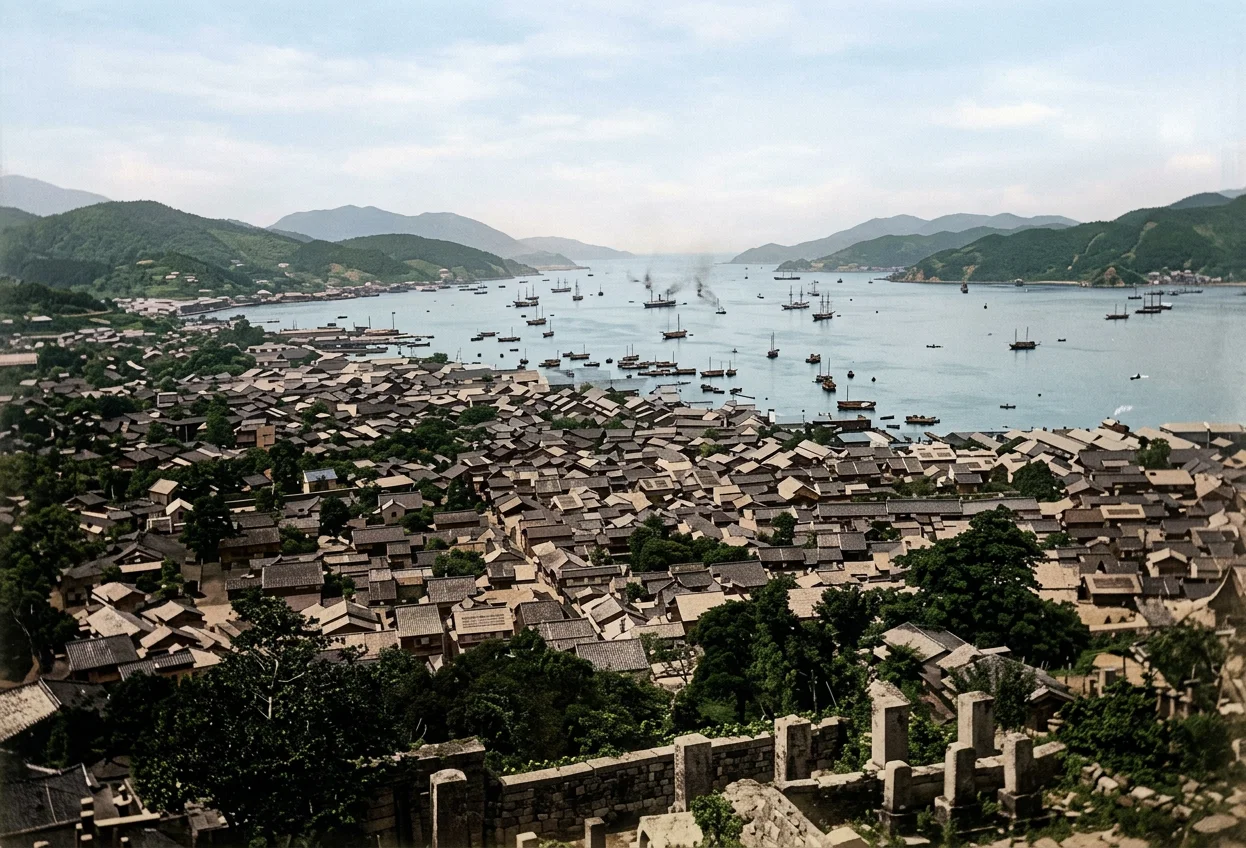
The three best-known cities in Japan are Yeddo, Kioto, and Nagasaki. Yeddo is the old name of Tokio. It was the governmental station of the shoguns (ministers), and it is the present capital. Kioto was anciently the capital, where, for hundreds of years, the successive emperors lived; while Nagasaki was famous as the great and only seaport. Many interesting incidents and stories are related about this place; for it is always one of the topics of every mother’s stories to her children.
Restored with AI
PORT NAGASAKI, JAPAN.
Nagasaki is one of the ports which was opened to foreign commerce by the treaty of 1858, in July 1, 1859. Previous to 1859, this was the only place where the foreigners resided and traded with the Japanese. The very first intercourse between Japanese and foreigners took place in this town, in 1545, by the visit of a company of Portuguese. The Dutch and the British East India Company followed them, in 1600 and 1613 respectively. They all alike established commercial relations. It was, for a long time, the central station of Xavier and other Catholic missionaries, whose first visit occurred as early as that of the Portuguese did, as above mentioned. Those who wished to know about the foreigners and their countries, and those who had a desire to learn the sciences and languages, be it from curiosity or real interest, were obliged to visit this place, before 1859, notwithstanding various difficulties which must be met with. Thus being famous in history, the name Nagasaki, as the pioneer city of civilization in Japan, became well known to the people, and even to foreigners.
Nagasaki is situated on the peninsula in the northwest of the island Kiusiu, which is the third largest island of the Japanese archipelago, and located southwest of the main island, or Hondo.
The harbor is formed by a beautiful inlet of the sea, which stretches northward a distance of about seven miles, and is but a mile in width. Both sides of the inlet are inclosed by delightful hills, about one thousand five hundred feet in height. Those hills are broken into varying ridges and beautiful valleys. A number of the most picturesque-looking isles, crowned with charming evergreens, are scattered here and there.
The city lies on the north side of the bay, being about two miles long and one and one-half miles wide. It is laid out with great regularity and neatness. The streets cross each other at right angles. They sometimes ascend the hills, and frequently terminate in steps.
Immediately to the south lies a small artificial island, called Desima, connected with the mainland by a bridge. This was occupied by the Portuguese from 1637 to 1639. Afterward, for about two hundred years, it was the trading-post of the Dutch traders. In 1639 a decree was issued by the government that all the foreigners should leave the country. This was brought about by the intrigues and political intermeddlings of Catholic missionaries. The Christian faith was then prohibited. Many missionaries and native Christians were killed, and all the rest were expelled from the country. A few Dutch traders, however, were permitted to remain in this small island, under rigorous restrictions.
The foreign settlement lies to the south of the native town, on ground which inclines considerably toward the sea. The British, German, French, Russian, and Portuguese consulates occupy the hilly ground back from the bay.
The great Nagasaki dock deserves mention here. The Prince of Hizen, who governed the province in which Nagasaki is located, commenced to build it in 1865, and in 1879 it was rebuilt by the government. It occupies a deep gorge between two hills at Tatagami. On the western side of the firth, opposite the town, a few hundred yards to the north of the dock, are the engine works of Akaonura.
The Nagasaki hospital, which was established in 1861, being the oldest one in Japan, is located on a beautiful hilltop. It has grand buildings, and commands a fine view of the scenery round about.
There is a normal school, a high school, a commercial school, and an agricultural school here. The government is in charge of these schools, which are attended by hundreds of young men. There are also many children’s schools. Children over six years of age are obliged to attend some one of them. In the foreign settlement, five colleges for boys and six for girls were founded. They are now conducted by the foreign missionaries and the natives, according to the Western educational system. There are many young men and women who graduate from Nagasaki every year, prepared to fight on the Lord’s side. There are also many private schools where2the languages are taught. Thus facilities for education are furnished not only to those who desire it, but even to those who do not.
The principal exports to China are seaweed, dried fish, and the like. Coal, camphor, tea, and tobacco are exported to Europe and America. Most of the coal is brought from the Takashima mines, about eight miles distant. It makes good coke, and is chiefly consumed by war vessels and merchant steamers.
The principal imports are cotton, woolen goods, sugar, and oils.
Nagasaki has regular steamship communications with Bachian, Kobe, Yokohama, and many important foreign seaports, as Shanghai, Bombay, Ninsen, etc. It is the terminus of a submarine telegraph line from Vladivostok. There exist telegraphic communications from here with every part of the country.