BEAUTIES OF SOUTHERN CALIFORNIA

8%

Review and Herald Publishing Company · Battle Creek, Mich. · Apr 26, 1900

FromThe Youth’s Instructor, Vol. XLVIII, No. 17

Read the full edition

BEAUTIES OF SOUTHERN CALIFORNIA

II

Restored with AI
In the days of ’49, thousands of men were lured from their Eastern homes to this far-off Western shore, by the hope of gaining wealth. Every privation was endured to reach that place where, rumor said, “they needed but to look around, and there they’d find the golden lumps lying on the ground.” Many returned disappointed; for so far from lying on the ground, the glittering gold was jealously hidden away, and money and hard work were required to bring it to light; but others, who looked for the value instead of the color, stayed. These gained wealth in different ways. Those realizing the value of the citrus industry rapidly changed this sandy desert of sagebrush into beautiful orange groves and vineyards, receiving gold for gold.
WHERE GREEN GIVES WAY TO GOLDRestored with AI
WHERE GREEN GIVES WAY TO GOLD
Southern California is noted for its abundance of fruit, the success of which depends largely upon the excellence of its system of irrigation. The water is conveyed from rivers directly into canals, or, perhaps, from the mountains through granite gorges to where a great dam has been built, making a reservoir, or lake, miles in length. From here it is carried, in many instances, a distance of twenty miles, stored in smaller reservoirs, then directed into cement channels down the valley, being tapped along the way for small rills, which silently meander through orchard and vineyard, beautifying all nature with their magic, and making the desert blossom as the rose.
Orchards are irrigated from four times a season to that many times a month, according to the situation of the land and the composition of the soil.
Nearly all the deciduous fruits of northern climes are raised here, besides oranges, lemons figs, loquats, guavas, and walnuts. Riverside is the mother of the orange culture of the State. The two original trees grown from the cuttings imported from Brazil, still stand there as the parents of all the “Washington navels.” For many years the crop from the Riverside orchards was estimated as half that of Southern California; but now it is regarded as amounting to one third. Still, last year’s crop exceeded three thousand car-loads.
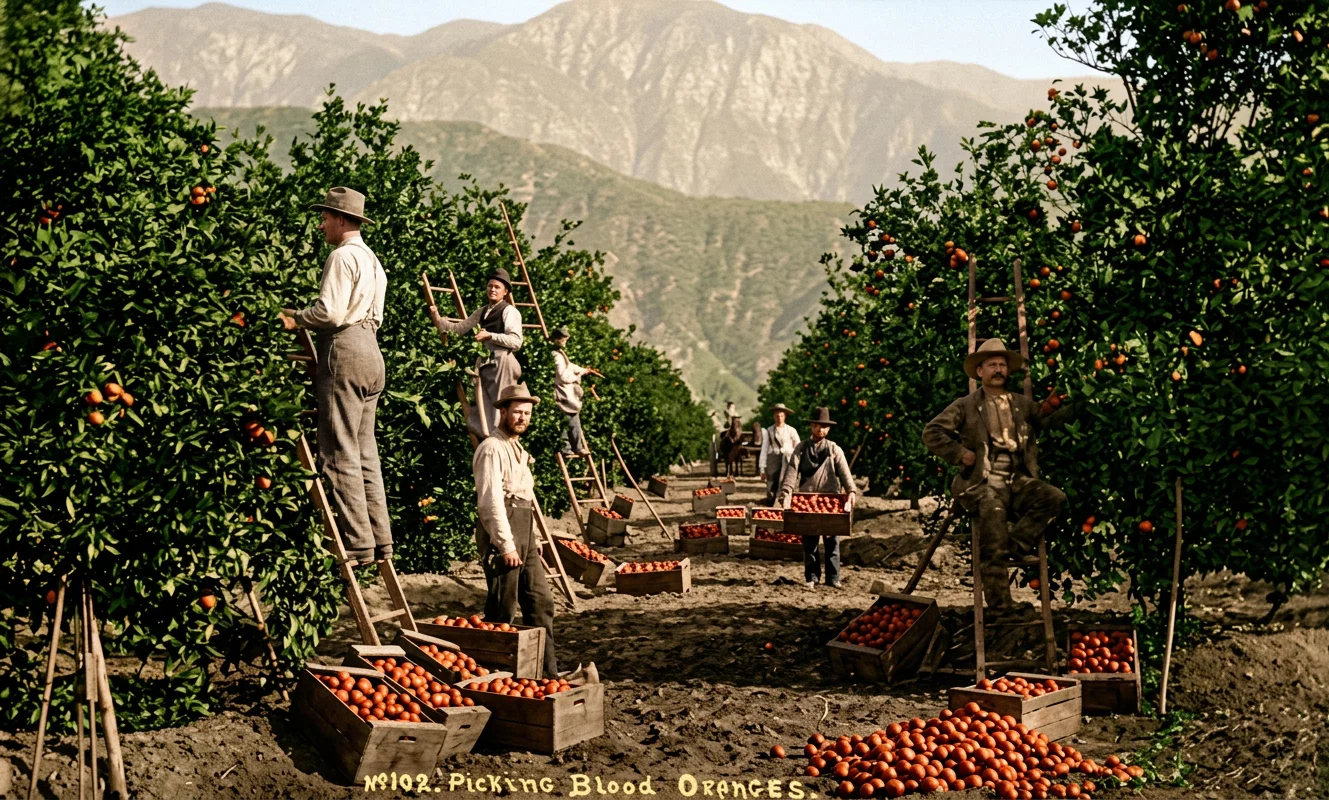
Oranges ripen at varying intervals during all the winter months; hence they are constantly being picked and carried to the packing-houses, scores of which are in operation at this season. The fruit is first scrubbed to remove all scale, then thrown into a device for polishing, and grading in lots of uniform size. Afterward it is rolled into large bins, whence it is taken to tables, wrapped in tissue-paper, and packed into boxes ready for shipment.
The orange orchard is a scene of beauty in the spring. In many places, where the fruit is left on the tree, there will be seen green and ripe fruit growing on the same bough, while the entire tree is covered with fragrant, pure white blossoms.
The olive is also a native of this clime, and is extensively cultivated; but is by no means so luscious as the orange. From its appearance in the ripe stage, one would imagine its flavor to be that of a large black cherry. You who have tasted olives doubtless have been convinced of the contrary. Before they are “cured,” olives are extremely bitter. This bitter taste can be removed by soaking the fruit in water, but it is a long and tedious process. The same results can be accomplished by putting the fruit in a solution of lye for a few hours, and then soaking it in water to remove the lye. After this it is put in brine to preserve it.
Great quantities of olives are utilized every year by extracting the oil, which is noted for its purity, and is a valuable article of commerce.
MRS. KATHLEEN WAGNER-GILMORE.