The Gap in the Sky

7%

Review and Herald Publishing Company · Battle Creek, Mich. · Apr 26, 1900

FromThe Youth’s Instructor, Vol. XLVIII, No. 17

Read the full edition

The Gap in the Sky

ASTRONOMICAL STUDY—NO. V

The Gap in the Sky
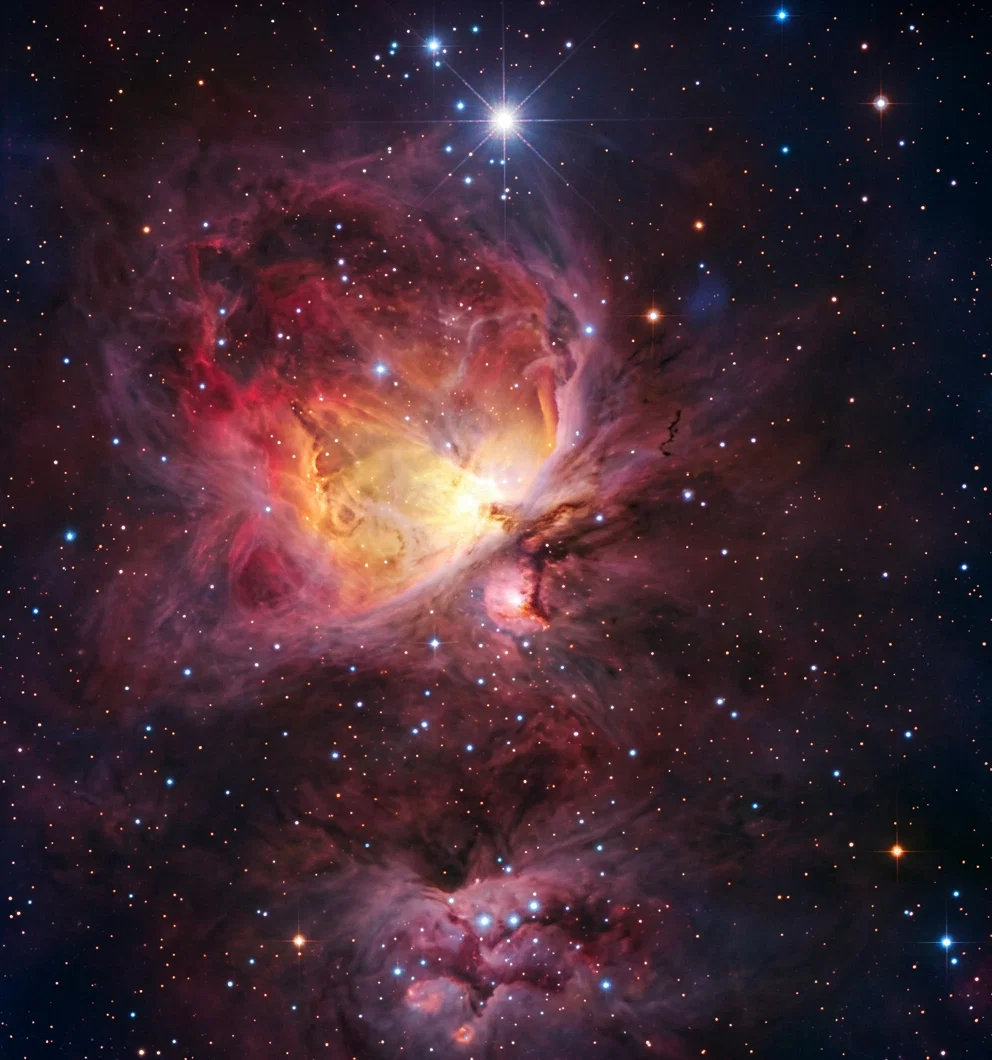
LAST week we learned the location of the constellation Orion, also where to find in this constellation the wonderful nebula that is the “gap in the sky.” As a people we have for years been interested in this portion of the starry heavens; for to us it speaks of a coming Saviour, and of the glories that shine forth from the throne of the Eternal One. When we say that this nebula is the “gap in the sky,” we believe we speak advisedly; for there is nothing else like it in all the heavens.
We are pleased to be able to obtain, for the INSTRUCTOR family, so perfect a picture of this sacred spot. The accompanying half-tone is a faithful reproduction of what we believe to be the best photograph that has ever been obtained of this opening into the glorious realms beyond. We do not like to speak of this opening as a “nebula;” for although it is thus classed in our works on astronomy, it is so different from all other nebulae—and there are over eight thousand of them recorded by our more modern astronomical instruments—that writers upon this subject can not but express wonder, admiration, perplexity, and reverence for this something, which, for lack of a better name, we call a nebula. With this one exception, all true nebulae seem to be composed either of clusters of fine stars or of what is called “fire-mist clouds,” and they are seen to hang separate from, and this side of, the blackness beyond. In other words, we can see space still beyond them; but as will be seen by the accompanying half-tone, this nebula does not hang out separate from a black substance beyond, but is a distinct opening into a realm of glory situated on the other side of the great, impenetrable sphere that seems to inclose all the visible works of God’s created universe known as the starry heavens. In this the light seems to be gushing out from the very heaven itself. As we view this wonder, we can not but feel that God in his mercy is permitting us to see a little of the glory of that city above, as it is reflected from those jasper walls through whose pearly gates the righteous nation soon shall enter in.
Herschel, the astronomer, in speaking of this open space, says: “This nebula has never been resolved into stars by the highest powers of telescopes that have yet been applied: nor is there any reason to believe that it consists of systems of stars, as is the case with other nebulae. It is, therefore, in all probability, a mass of self-luminous matter, but of what nature it would be vain to conjecture.”
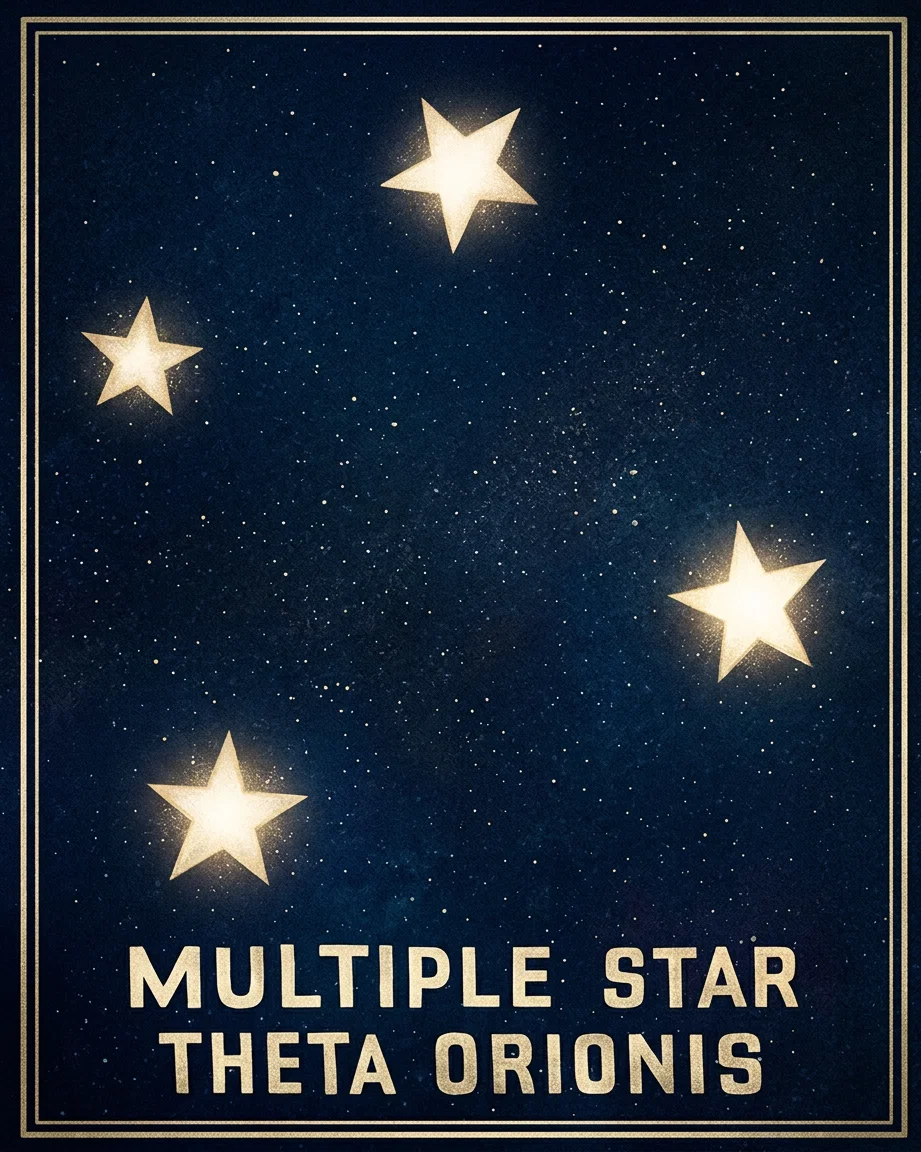
MULTIPLE STAR THETA ORIONISRestored with AI
MULTIPLE STAR THETA ORIONIS
“And there was war in heaven. . . . And the great dragon was cast out, that old serpent, called the devil, and Satan, which deceiveth the whole world: he was cast out into the earth, and his angels were cast out with him.” REV. 12:7-9. “And I John saw the Holy City, New Jerusalem, coming down from God out of heaven, prepared as a bride adorned for her husband.” REV. 21:2.
These and many other texts go to show that heaven is a place, out of which the city is to come, the angels that sinned were cast, etc. If heaven were a mere world like our own, or a globe like our sun, or even what is now our north star, it would seem proper to speak of Satan as being cast off from, or away from, it; but no, he was cast out of heaven. We do not believe that either the sun or what is now our north star is heaven. A deeper insight into true science entirely disproves this theory, and we believe it to be a distortion of the Scriptures thus to apply their teachings.
In “Early Writings,” page 34, we read: “Dark, heavy clouds came up, and clashed against each other. The atmosphere parted and rolled back; and we could look up through the open space in Orion, whence came the voice of God. The Holy City will come down through that open space.”
In 2 Esdras 3:17-19 we find reference made to this same gateway of heaven at the time the Lord spoke the law upon Mt. Sinai, in these words: “And it came to pass, that when thou leadest his seed out of Egypt, thou broughtest them up to the mount Sinai: and bowing the heavens, thou didst set fast the earth, movedst the whole world, and madest the depths to tremble, and troublest the men of that age. And thy glory went through FOUR GATES OF FIRE, and of earthquake, and of wind, and of cold; that thou mightest give the law to the seed of Jacob.”
THE GREAT NEBULA IN ORIONRestored with AI
THE GREAT NEBULA IN ORION
The small illustration gives an idea of these “Four Gates of Fire,” one of which—the smaller, upper left-hand one—is shown in the large illustration. Sir John Herschel, in speaking of these four gates of fire, says: “A fourth star was distinctly seen, in addition to the three, near the head of the opening, but smaller than the other three, and forming with them a small, irregular square. The aspect of this nebula is altogether different from that of resolvable nebulae. In the latter we fancy, by glimpses, that we see stars, or that, could we strain our sight a little more, we could see them [the larger telescopes since Herschel’s day show this to be a fact]; but the former suggests no idea of stars, but rather of something quite distinct from them.”
One more quotation, taken from Professor Dick’s astronomy, page 179, must close this hour’s study: “One of the largest and most remarkable nebulae in the heavens is that which is found in the constellation Orion. On directing the naked eye to the middle star of the three which form the sword [the star to which your special attention was called last week], the observer perceives something that has the appearance of a small, but not well-defined, star: this is the great nebula of Orion, of which, however, he can form no definite conception till his eye is assisted by optical instruments. With a common one-foot pocket achromatic telescope the nebulosity may be plainly perceived; but the higher the magnifying power, the larger the aperture of the object-glass, the more brilliant and distinct does this phenomenon appear. The first to discover this phenomenon was the celebrated Huygens, in 1656. He says: ‘Astronomers place three stars close to each other in the sword of Orion; but when I viewed the innermost with a telescope in the year 1656, there appeared in the place of that one, twelve other stars; among these, three that almost touched each other, and four more besides, that appeared twinkling, as through a cloud, so that the space about them seemed much brighter than the rest of the heavens, which appeared wholly blackish, by reason of the fair weather, and was seen as through a CERTAIN OPENING, through which one had a free view into another region, which was much enlightened. I have frequently observed this same appearance, in the same place, without any alteration; so that it is likely that this wonder, whatever it may be in itself, has been there from all times; but I never took notice of anything like it among the rest of the fixed stars.’”
DR. O. C. GODSMARK.