IN TWO PARTS.—PART I

7%

IN TWO PARTS.—PART I

FROM BAY ISLAND.

IN TWO PARTS.—PART I
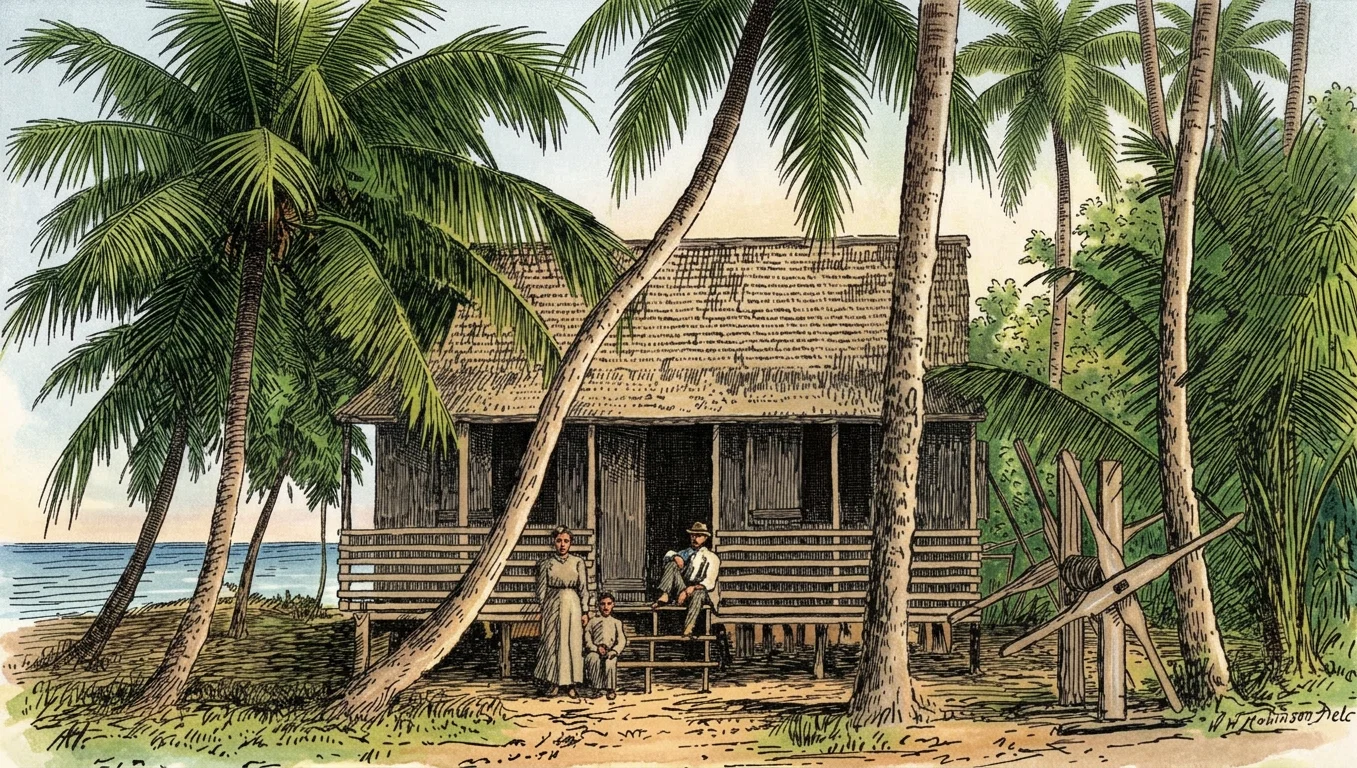
MISSION HOUSE AT BAY ISLAND.Restored with AI
MISSION HOUSE AT BAY ISLAND.
We are now fairly settled in our new home, which at first seemed so utterly strange. One of the strangest features to me was that of living on so small a spot of land; but now I feel quite at home, having no fears of being submerged by the neighboring ocean.
About one hundred yards to the south of us lies another little spot of earth of about the same size as our Shin Cay, but enjoying a less reputable name—“Hog” Cay—the two being connected by a board wharf, upon which people are passing almost continually.
For a few weeks after reaching our little island home, we occasionally went for a sail. This is a pleasant experience, especially when old schoolmates reunite on a foreign shore, and with heart and voice swell the familiar hymn, “How Cheering is the Christian’s Hope.” After reaching the island, Mrs. Hutchins and myself would climb along the rock-bound shore, and gather pretty shells. Perhaps before returning we would visit Sandy Bay, a favorite bathing resort. There we would all plunge into the salt water, which caused us to feel much refreshed. These pleasant associations were short-lived. Soon Elder Hutchins and his wife were gone to their new field of labor in Belize, and we were busily engaged with the school, and various other duties.

THE “WEE-WEES.”

The little island of Bonacca has a reasonably productive soil, and it is chiefly from the yield of the plantain and banana plantations and cocoanut walks that the people obtain a livelihood. Although the climate and soil of the Bay Islands are adapted to the raising of nearly all kinds of fruits, vegetables, and grains, not more than half a dozen kinds of eatables can be successfully matured; in fact, the planters claim that there are but few garden products which the “wee-wee” will allow to grow unmolested. They are sugar-cane, pineapples, and plantain suckers. These “wee-wees,” or ants, are especially fond of watermelon vines, squash and pumpkin vines, peas, beans, corn, and indeed almost everything that is eatable. We have thought that it would be so pleasant, as well as conducive to our health, if we could raise a few such eatables, as melons, sweet corn, etc.
In harmony with the thought, we sent to the States, and got a nice variety of garden seeds. And O, how they did sprout and grow! They grew night and day until they were about two weeks old, when out came a great army of “wee-wees”—millions of them. They are perfectly organized companies of workers, having leaders, and are all governed by a queen. She remains deep down in the nest under ground, which they burrow for their home.
Well, out they poured on our thrifty plants, and after cutting them down, bore them triumphantly away to molder in their subterranean camp. They marched along their trail with their green-foraged banners standing high, being firmly held at the lower edge by their jaws. Indeed they looked orderly and destructive. They live close by the growth they like best, and work at night if the planter troubles them during the day. Otherwise they labor during the daytime and rest at night. I am glad that our tomato-plants have not been taken, as they will bear the year round here, and we are so fond of tomatoes. I think the ants do not like the odor of this plant. I hope they will never learn to like it. These wee-wees are not so small as their name indicates, but are fully twice as large as the common ant of the States. It is almost impossible to hinder their work so that the cassava can grow at all, as they are especially fond of it.

OUR DIETARY.

About sunrise nearly every morning you see men in skiffs and dories leaving the cays, and paddling to the island to their work. They always go armed with their machete (masheet’), with which they plow the ground, cut wood, hoe weeds, plant their seeds, cut their cane, and do nearly all kinds of farm work. They use the hoe and ax but little, and have never seen a plow or harrow. When they intend remaining on the island all day, they usually take dinner with the people there. Likely the dinner will consist of fish and plantain. You may think this a very poor luncheon, but it is palatable when nicely cooked. The fish is fried; then with the rich brown gravy, it is boiled with green plantains or green bananas. This we call fish stew, and Mr. Miller and myself have learned to eat it with a relish.
Not every one here can afford wheat-flour bread, but fortunately we have what is called “bread-kind,” including cocoa, cassava, plantain, bread-fruit, yam, sweet-potato, and a few other products. These are prepared for table use in a variety of ways, some of which I shall relate to you later. Most of the island women understand so thoroughly how to prepare these different foods that a person with a good appetite can scarcely fail to like them after trying them a few times. Having learned to relish bread-kind, one finds that his desire for bread has, in a measure at least, vanished. While there are some whose circumstances will not allow them to use bread, there are others who use it every day. The bread of the island cooks is as good as that made by American cooks. It is nearly always sweet, light, and fine grained. I think the addition of a little cocoanut milk which they use improves it not a little. Neither compressed nor potato yeast is used, but yeast cakes manufactured by themselves. Thus nature provides for us healthful food. Ada B. Miller.