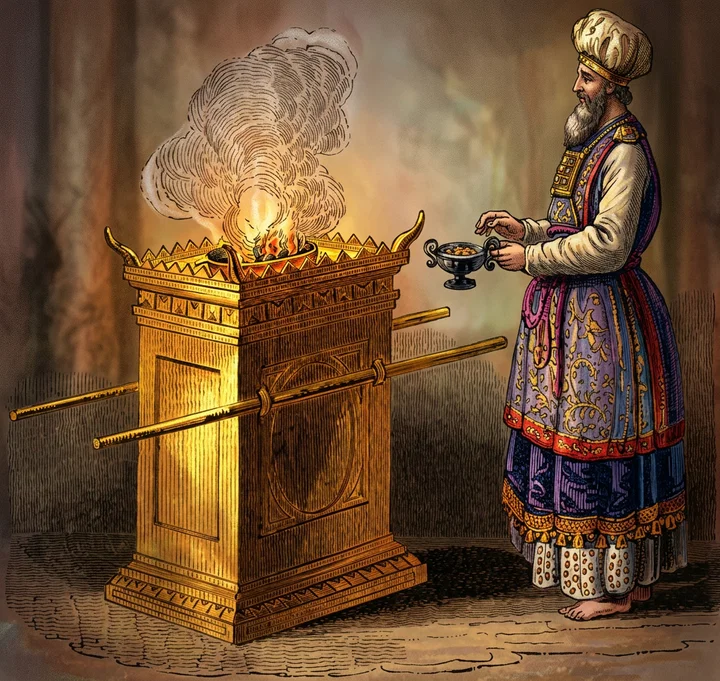
Just before the inner veil of the sanctuary was an altar made of wood, and covered with gold. It was about three feet high, and about one and one half feet in width and breadth. It was frequently called the golden altar, and its service was one of the most important parts of the daily ceremonies; and the priest who had the duty of attending to that work would never forget the solemnity of the hour. It was at such a time that the angel appeared to Zacharias, and announced to him the birth of a son. The angel stood at the right of the altar, and no doubt came as the smoke of the incense arose from the burning coals.
The fire upon this altar was kindled by God himself at the dedication of the temple, or sanctuary, and it was divinely preserved.
Incense, a perfume arising from resins and gums as a base, and other substances having a sweet perfume, and compounded “after the art of the apothecary,” was kept in the basins used in the holy place. With the spoons made for that purpose, the priest would throw some of the perfume on the burning coals, and from them a cloud would arise that no doubt was very sweet to the senses,—a sweet smelling savor. The compound could be used for no other purpose than the one named, and under the severest penalties the people were forbidden to make a similar mixture. Only the costliest balsams and oils entered into it, showing that the service of the true God is worthy of the best that can be given.
We read in “Great Controversy”:—
“In the offering of incense the priest was brought more directly into the presence of God than in any other act of the daily ministration. As the inner veil of the sanctuary did not extend to the top of the building, the glory of God, which was manifested above the mercy-seat, was partially visible from the first apartment. When the priest offered incense before the Lord, he looked toward the ark; and as the cloud of incense arose, the divine glory descended upon the mercy-seat and filled the most holy place, and often so filled both apartments that the priest was obliged to retire to the door of the tabernacle. As in that typical service the priest looked by faith to the mercy-seat which he could not see, so the people of God are now to direct their prayers to Christ, their great high priest, who, unseen by human vision, is pleading in their behalf in the sanctuary above.
“The incense, ascending with the prayers of Israel, represents the merits and intercession of Christ, his perfect righteousness, which through faith is imputed to his people, and which can alone make the worship of sinful beings acceptable to God. Before the veil of the most holy place was an altar of perpetual intercession, before the holy, an altar of continual atonement. By blood and by incense, God was to be approached,—symbols pointing to the great Mediator, through whom sinners may approach Jehovah, and through whom alone mercy and salvation can be granted to the repentant, believing soul.
“As the priests morning and evening entered the holy place at the time of incense, the daily sacrifice was ready to be offered upon the altar in the court without. This was a time of intense interest to the worshipers who assembled at the tabernacle. Before entering into the presence of God through the ministration of the priest, they were to engage in earnest searching of heart and confession of sin. They united in silent prayer, with their faces toward the holy place. Thus their petitions ascended with the cloud of incense, while faith laid hold upon the merits of the promised Saviour prefigured by the atoning sacrifice. The hours appointed for the morning and the evening sacrifice were regarded as sacred, and they came to be observed as the set time for worship throughout the Jewish nation. And when in later times the Jews were scattered as captives in distant lands, they still at the appointed hour turned their faces toward Jerusalem, and offered up their petitions to the God of Israel. In this custom, Christians have an example for morning and evening prayer. While God condemns a mere round of ceremonies, without the spirit of worship, he looks with great pleasure upon those who love him, bowing morning and evening to seek pardon for sins committed, and to present their requests for needed blessings.”
Connected with the altar of incense was the golden censer. It was a sort of fire-pan, with a perforated cover.
From the earliest days of history, censers have been used as utensils in which fire was placed, and then as they were swung from side to side, incense was placed on the coals, and the smoke would assist in the worship.
This practice has been continued in many religions even until now, and in the Roman Church, many services require the swinging of the censer by the altar boys.
In the Levitical service, however, the golden vessel was used to carry fire from the brazen altar to the altar of incense, and not to burn incense upon or in it. Only on the day of atonement did the priest take coals from the altar, and setting the censer in the most holy place, he would put some of the incense on the coals, and the cloud would fill the room, as the priest, once and again, entered the most holy in the service of that important day.
The use of the censer for the burning of the incense, and the swaying and swinging back and forth, are purely of heathen origin, unless all that practice can be taken from the one day of atonement. It was probably this special use of the censer that caused Paul to use the words found in Heb. 9:4.
Though the word is many times used in the Old and New Testaments, in no case is it connected with the idea of incense, but denotes the fire-pan in which the glowing charcoal was carried about in the service of the altar. It was upon the altar itself that the incense was burned.
All the services of the sanctuary were typical, and it is a glorious study to find out the relations that exist between the worship in the days of the earthly tabernacle, and the worship of the Christian to-day, who by faith now enters the throne of grace, which is within the second veil, through Christ, the living way.
May we devote our choicest gifts to the Creator; may we yield our whole bodies unto God; may our prayers ascend with that incense,—the righteousness of Christ,—which God will impute to us if we through faith approach his throne.
J. G. LAMSON.