The accompanying illustration represents a pack-train of mules, laden with corn, ready to start overland. Owing to the scarcity of railroads, and to the mountainous surface of the country, merchandise, machinery, and agricultural and mineral products are largely transported on the backs of horses, mules, and burros. Mules are more used for this purpose than burros, and burros more than horses. Mules and horses travel about twenty miles a day, with a load of from three hundred to three hundred and fifty pounds; and a burro travels forty miles, with about one hundred and fifty pounds’ burden.
A well-padded pack-saddle is strapped tightly on the animal, and the load is made into two bundles of equal weight. The mule or horse is blindfolded, so he will not move away as the load is being lifted and secured with rawhide ropes by two muleteers. The mule soon learns to brace himself with his feet, in order to preserve his balance when the load is being put on his back.
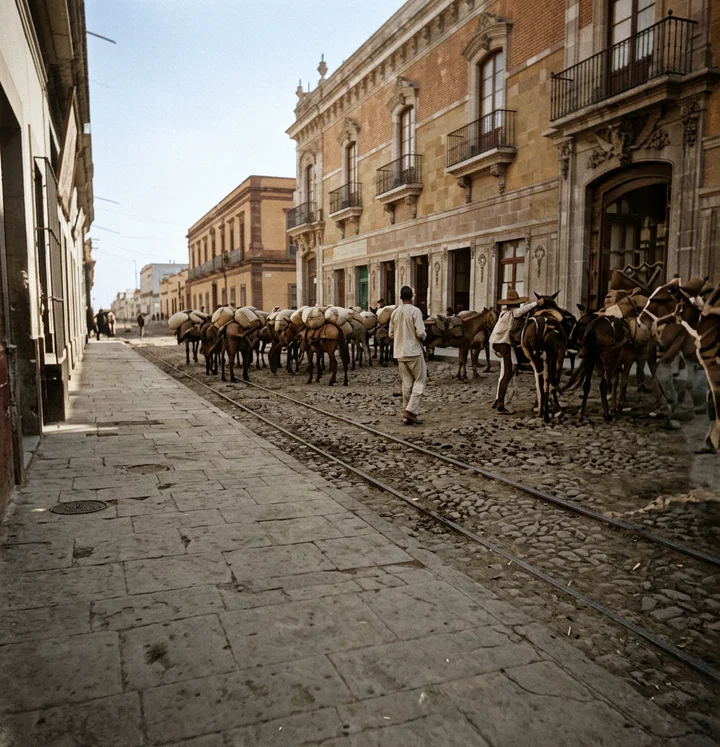
Two mounted muleteers have charge of ten or twelve animals, and they are kept busy hastening from one animal to another, and adjusting the packs, which frequently become disarranged by the mules’ running against one another, lying down, or grazing by the wayside.
The pack-animals are put out to graze, when the end of the day’s journey brings them to a country town or village; and when they come to a large city, they are put into an enclosure in an inn-yard, and fed straw and corn.
Some of the Indian charcoal-burners carry a load of one hundred and fifty pounds of charcoal on their own backs, as they drive their laden burros to market. The women, who go with the men to make purchases at the market, sometimes carry seventy-five or one hundred pounds of charcoal in this way.
The Bible colporteurs in this field carry their stock of Bibles and Testaments through the country on the backs of animals.
ALFRED COOPER.