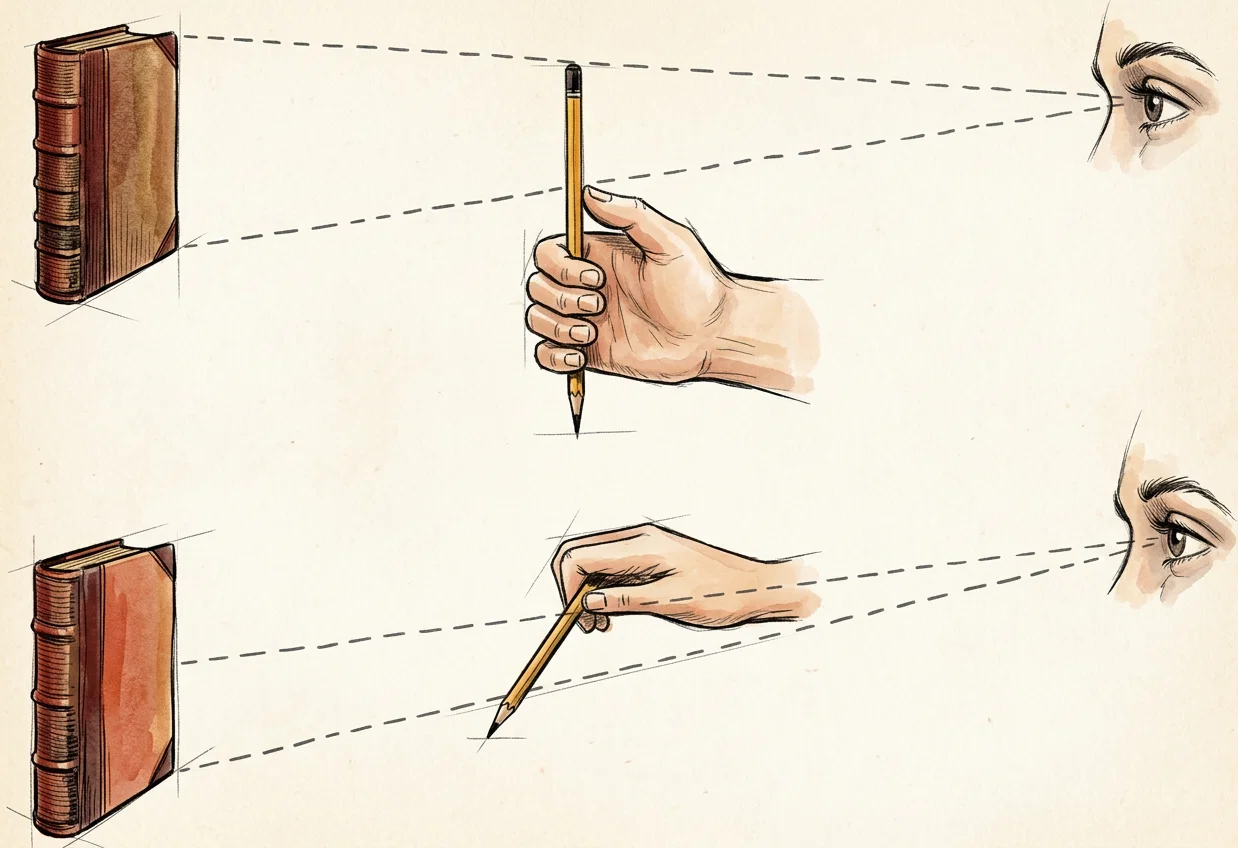
Something might be said here about measurement and apparent proportion. If you have ever visited an art school, you have perhaps noticed, with no little amusement, the students holding at arm’s length a pencil or ruler, and with one eye closed, apparently criticising the same intently.
If you will take a pencil and hold it out at arm’s length before you, closing one eye, that you may the more clearly see both the pencil and the object to be measured, you will see for yourself the use of this practice. Suppose you wish to draw the view you see from your window. There is a house in the distance, which appears smaller than another near by, and you wish to draw it so. But how much smaller? Perhaps you guess at it, and after drawing it, find that it is either too small or too large. This is where the pencil at arm’s length will help you.
Measure upon it the height of the house in the distance; then, still keeping your arm out, compare the height of the distant house with that of the nearer house. Perhaps it will be one and one-half times, perhaps four times, the height of the small house; but whatever it is, you know that this is the size of the smaller house, compared with that of the larger one; that is, in proportion to it. By comparing, in this way, the width of any object with its height, you can easily find the proportion.
Restored with AI
By stepping back from the object, the amount of space taken on the pencil each way will be lessened; but the proportion will remain the same.
Restored with AI
Be sure, in taking such measurements, to keep the arm always straight, as any deviation will make a corresponding variation in the measurements.
You should make a practice of measuring only until your eye is so trained that, unaided by measurements, you can draw objects in their correct proportion. An excellent way to obtain this training is to make a drawing without measurements, and then, by measuring, to note how closely its proportions compare with those of the object drawn.
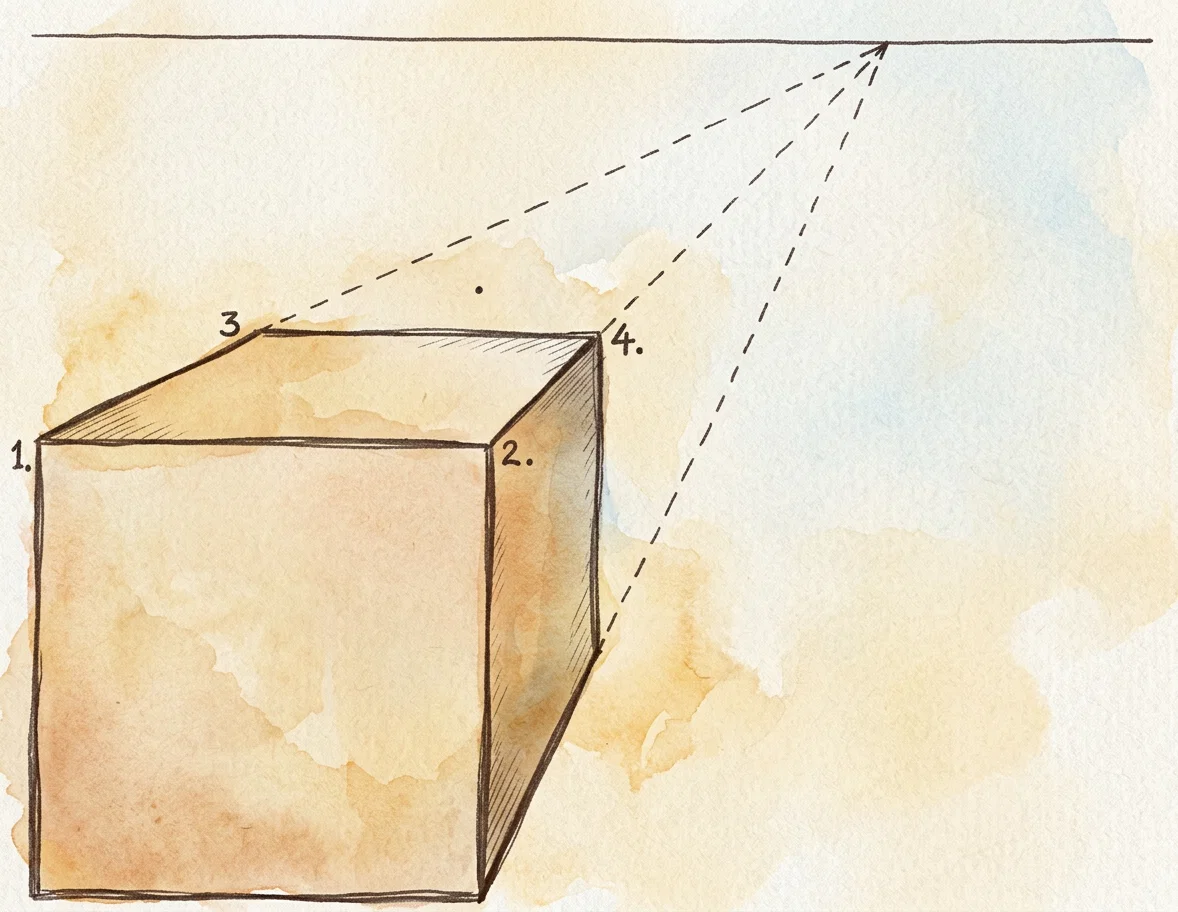
It will also be well to test, by measuring, what you learn by observation. For example, place in front of you a box or some other object having sides of equal length; then step back and a little to one side, so that both the top and one side can be seen. By measuring on your pencil the length of the box (the line marked 1 and 2 in the accompanying drawing), and comparing it with the line marked 3 and 4, you will see that line 1 and 2 is longer than line 3 and 4.
Compare the height, or the nearer side-line, with that of the farther side-line, and you will see that the nearer line is also longer than the farther line. Notice that none of the receding lines appear parallel, showing how, if the lines were carried on, they would meet at a point opposite the eye.
Restored with AI
When we are drawing, we must realize that the direction of our retreating lines is to be the same as those we see before us, and that just as the lines in a block or road retreat toward an imaginary line, so on our paper they must retreat toward an imaginary line.
Restored with AI
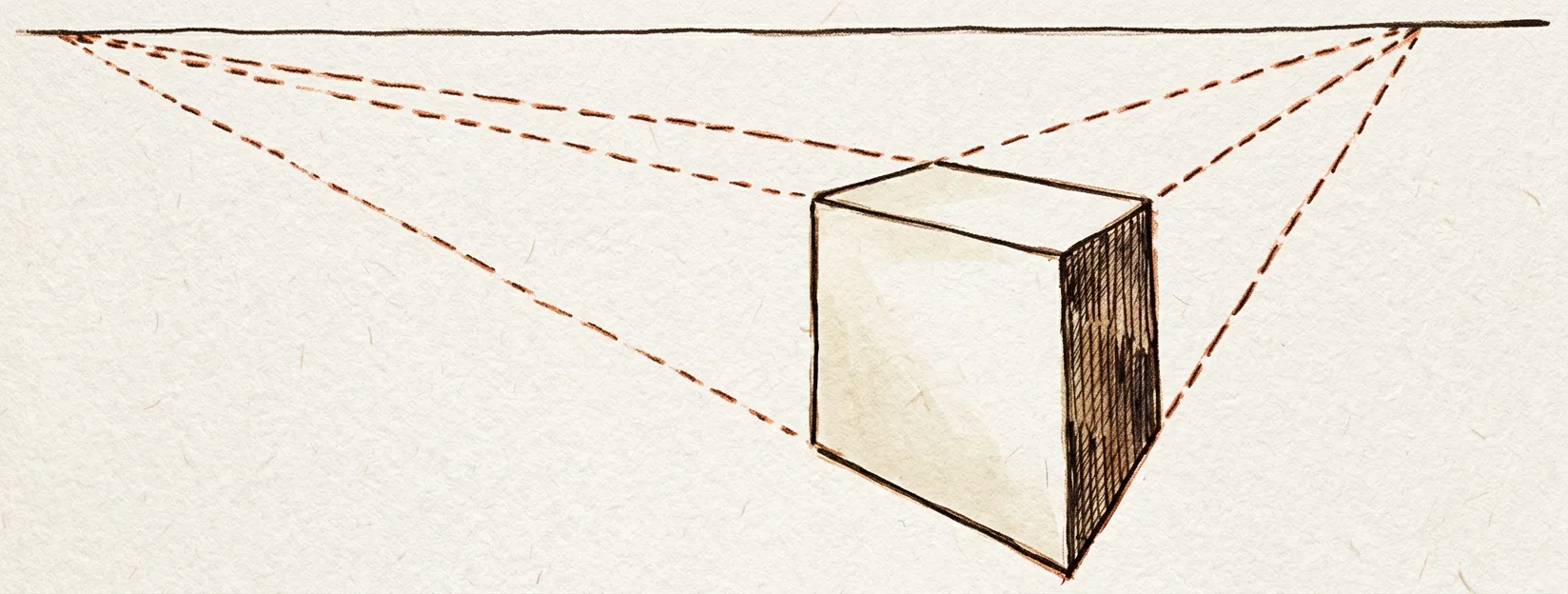
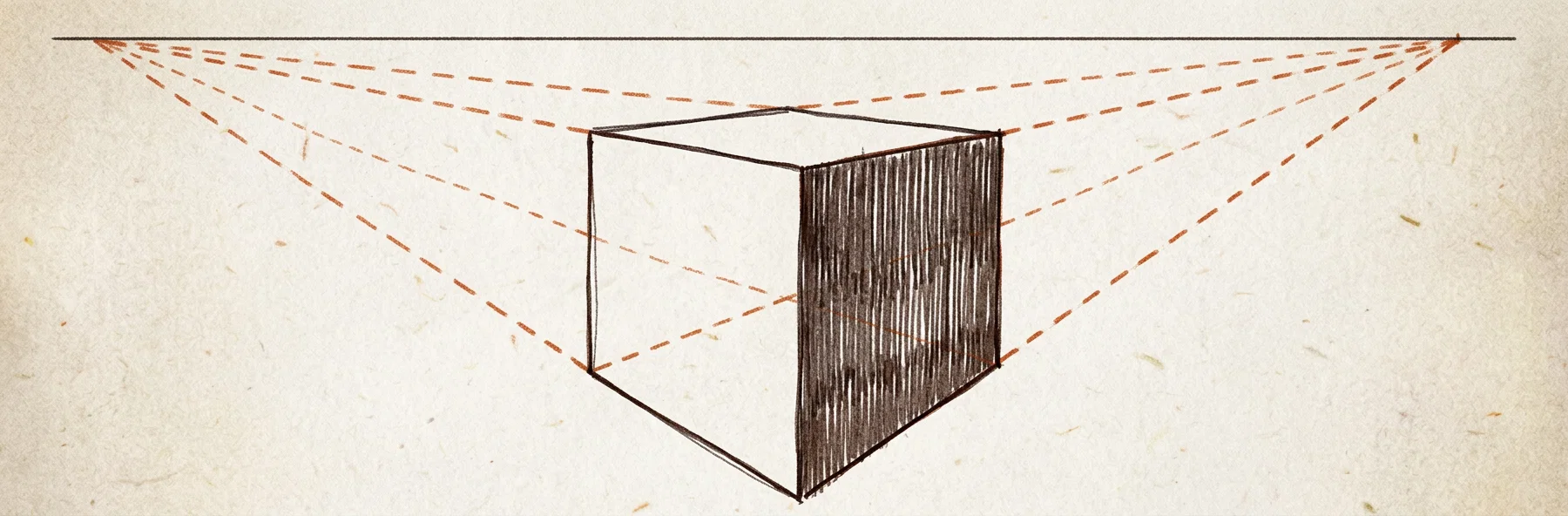
If we take our box, and turn it so one corner will be facing us, there will then be two sets of lines vanishing toward two different points on the imaginary horizon line; and according to the extent the block is turned, so is the distance of these points on the horizon line, as shown in the accompanying drawings. Such drawings as these, or any enlarged forms, such as street corners or angles of houses, are said to be in “two-point perspective.”