II
When a “steam donkey,” as the loggers call a traction engine, is used instead of the ox team to haul the logs from the forest to the track, the work is robbed of much of its picturesqueness. One’s sympathy can never be drawn out by an unfeeling mass of iron and steel. The oxen do not complain at being thus emancipated; but then, oxen never complain.
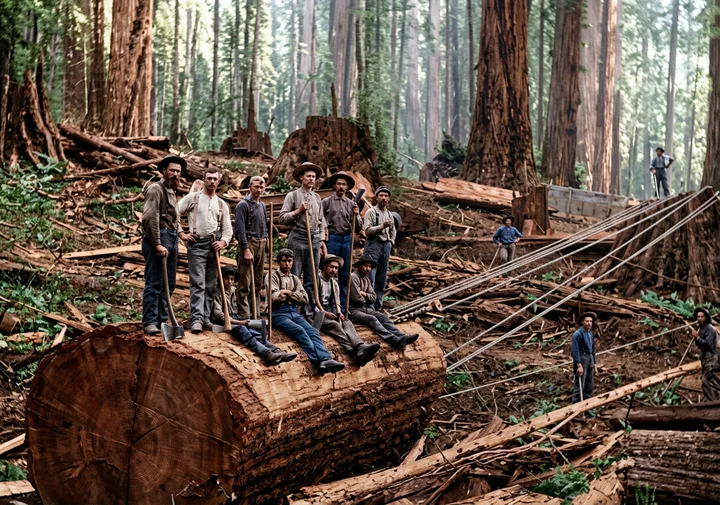
When the work of the cattle or “donkey” is finished, the scene is truly a desolate one. All the good timber has been removed; all the refuse has been burned; and only the great stumps bear silent testimony to the majestic grandeur that is now gone forever.
Cut down a pine forest, and in a lifetime the marks of the ax have disappeared, and the forest is again ready for the lumberman. But it has taken thousands of years for the giant redwoods to attain their present size; and when they are cut down, all the young trees perish with them. In a few years the ground they once protected is covered with brambles and worthless shrubs,—a wilderness indeed.
It is a common saying among California lumbermen that a redwood stump will neither rot nor burn. I have seen some that were cut a generation ago, and I could see no more effect of time and weather on them than on one that had been cut only the year before. But redwood stumps have been destroyed, although I can not say how long it took to complete the process.
Some years ago, when a friend of mine was clearing land occupied by a forest of young redwoods (by “young” redwoods is meant trees not older than a century or so), he noticed that the trees always grew in circular clumps; and in grubbing out the stumps, he nearly always found the remains of a mammoth tree, which had once stood in the middle of the circle. Sometimes these stumps and roots bore evidence of having been destroyed by fire. This being the case, the destruction must have taken place before the young timber began to grow. Forest fires kill the young redwood timber, but they have little or no effect upon a sound tree of any considerable size.
It is probably a good thing for the coming generation that redwood stumps do rot so slowly. It is almost incredible to note the amount of lumber that is left in some of these stumps. I once measured one, and found that between forty and forty-five thousand feet of lumber might be taken from it without difficulty. The size of this stump did not greatly exceed that of hundreds of others that stood within sight. Of course it would not pay to handle these stumps while there is plenty of good timber to be had: but the good timber will not last forever; and when it is gone, it is more than probable that the despised stumps will be utilized.
Some, who claim to be conversant with the subject, estimate that the redwoods will, at the present rate of destruction, last two hundred years. Their judgment is probably biased by their pecuniary interests. Without claiming to be an authority in the matter, I think it is safe to say that before the rising generation has grown old, the redwood forests will be a thing of the past.
One would think that after the terrible destruction of timber in these forests, the logs would all be utilized, once they reached the mill. This, however, is not true, except of the small mills, situated near a thickly settled district, where the poor lumber can be sold at the mill. Near the large mills a fire is kept constantly burning; and to a casual observer, it would seem that more lumber goes into this fire than is piled up for shipment.
Around the outside of each log, next to the bark, is a few inches of white wood called the “sap.” This is much like the top of the tree, and makes such poor lumber that it does not pay to ship it. It is taken off in slabs, and goes to feed the voracious fire. When a tree has been “wind split,” there is a strip six or eight inches deep on each side of the crack that has turned black. This also helps to keep up the fire. The waste from these and other sources is so great that but a comparatively small portion of the tree is finally made into marketable lumber.
The best of redwood lumber is about the worst lumber on the market. It varies almost as much in color as it does in weight. Some is as white as pine, and some almost as red as blood, while every shade between is represented. Lumber cut from the butt of the tree seasons slowly. Once it does season, though it does not rot, it soon becomes so brittle that it is unsafe to use it in a building where any great strain will fall upon it.
All things considered, it is safe to conclude that what remains of the redwood forests might better be preserved as a recreation ground than cut down and turned into a wilderness.
J. EDGAR ROSS.