We have been studying the purpose of fruits (I use the word “fruit” in a broad sense), and have learned that their primary function, or use, is that of self-propagation. God commanded the earth to bring forth “the fruit tree yielding fruit, . . . whose seed is in itself.” And while the pulp and the juice were meant for food, the seed within was designed for a far different purpose. If you had all the flour, ground wheat or corn, there is in the world, and I had but one kernel of wheat or corn, and it the only kernel in the world, I should have far more than you; because in a few years my kernel could produce sufficient wheat or corn to fill all the fields of all the world. God not only made fruit for food, but he so made it as to keep us forever supplied.

There is also much to be learned from the colors of fruit. If the different fruits are not in some way carried from the tree or plant upon which they grow, they must nearly all fall in one spot. Only a few of these will be able to grow; the rest will be crowded out. How may these fruits be carried to other and distant places, where there is more room, and where they may have an opportunity for growth? In answering this question, let me ask another: Why are many of the berries so highly colored? They would be just as useful to us for food if they were the same color as the leaves; but being so bright, they are very conspicuous, and attract the attention of multitudes of birds. I have counted fully twenty different kinds of birds eating the fruit of the mulberry tree,—an unknown number of each of these kinds. The seeds of berries are not digested by many birds, and hence are scattered by them hither and yon. Do you catch the secret?—The berries are bright-colored to attract the birds; and the birds, by eating the berries, sow the seeds here and there.
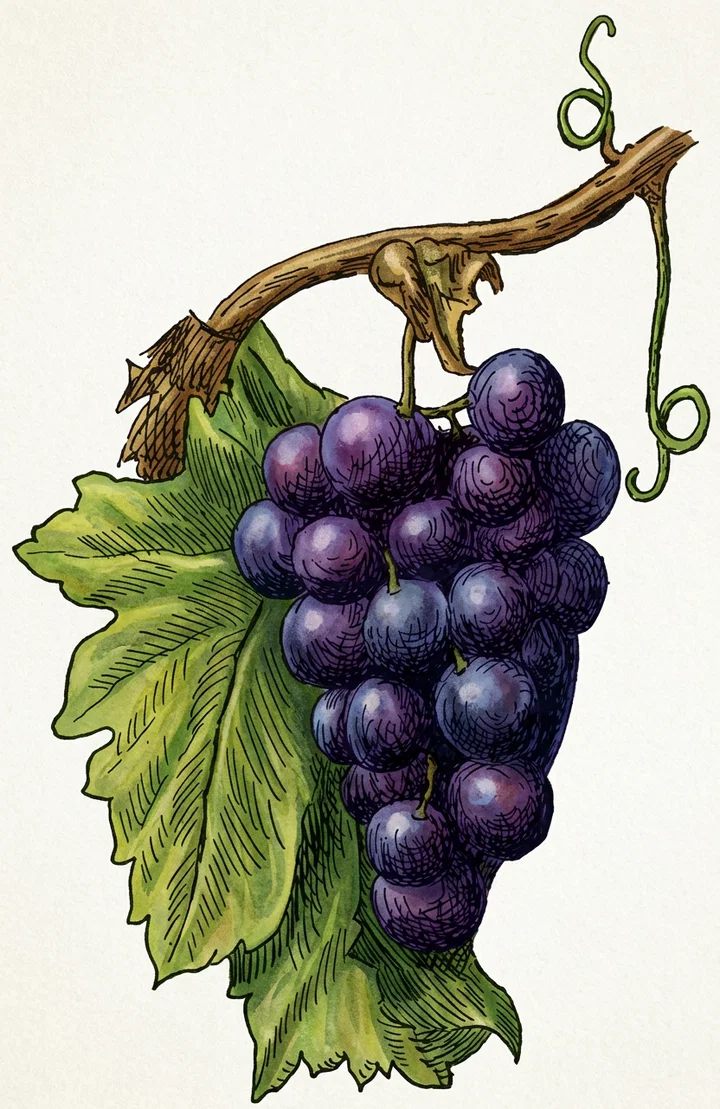
Does this help you understand why most grapes are purple? Why are they not red, like the cherry?—Well, we have seen that the color is to make the berry or fruit noticeable. The cherry, growing and ripening in the early summer, when the leaves are green, is easily seen, in contrast with the green foliage; for green and red are as opposite as opposite can be in color. But in the fall the leaves themselves become red; and if grapes were also red, they would not be easily seen. Grapes are generally blue or purple, sometimes green, and show forth in decided contrast with the fading and reddish leaves.
Unripe fruits and seeds are usually hidden away in the foliage, and are of the same color as the leaves. But when the fruits ripen, and the seeds are ready for the sowing, the fruits almost invariably take on a color strikingly in contrast with the color of the foliage. The different tones of red stand out best when surrounded and backed up by green; therefore, for plants with green foliage, a red coloring of the fruits is the most advantageous. On this account the strawberry, the raspberry, the currant, the wild cherry, and the red-berried elder are red in hue. On the other hand, red fruits would stand out but little against a background of foliage that has donned the red or yellow tints of autumn by the time they ripened; and accordingly the prune, the plum, and the grape are blue or black. Following out the same law of contrast, white berries occur principally in plants that cast their leaves before the fruit is ripe; standing out against the brown, black, or gray background formed by the leafless branches and the fallen leaves of autumn, these white fruits are easily seen.
But these are only a few of the means which God has devised, and which he uses, for the carrying out of his purposes. The birds and animals think only of satisfying hunger, and seek the fruits purely from self-interested motives; but nevertheless they thereby fulfill the will of God in sowing the seeds. Even so we ourselves, though seeking only the satisfying of self, often unwittingly carry out the great purposes of God; for he has ordained that even the wrath of man shall praise him, and the remainder, which is purposeless, he restrains. But how much better when we intelligently and in full measure learn his great purposes, and, forever yielding ourselves to the work, become co-laborers with him!
L. A. REED.