THE ISLAND OF MADEIRA

9%

THE ISLAND OF MADEIRA.

This isle is celebrated all over the world for its healthful climate, and consumptives, more especially, find here a most salubrious atmosphere to bring about their convalescence. It is situated west of the northwestern border of northern Africa. Its length is about thirty miles, and its breadth thirteen miles. It has a coast-line of eighty or ninety miles. The mean altitude of its elevations is about four thousand feet, its highest summit being sixty-one hundred feet. The name “Madeira” is Portuguese, and signifies woodland, the whole island having originally been covered with woods, which, of course, have disappeared long ago. As seen from the dimensions just given, it has an almost oblong form, and is ribbed, as it were, from east to west by a chain of volcanic mountains. Its population ten years ago was as high as one hundred and thirty-five thousand inhabitants, wholly Portuguese in nationality, excepting some half-breed mixtures of African blood among the lower classes.
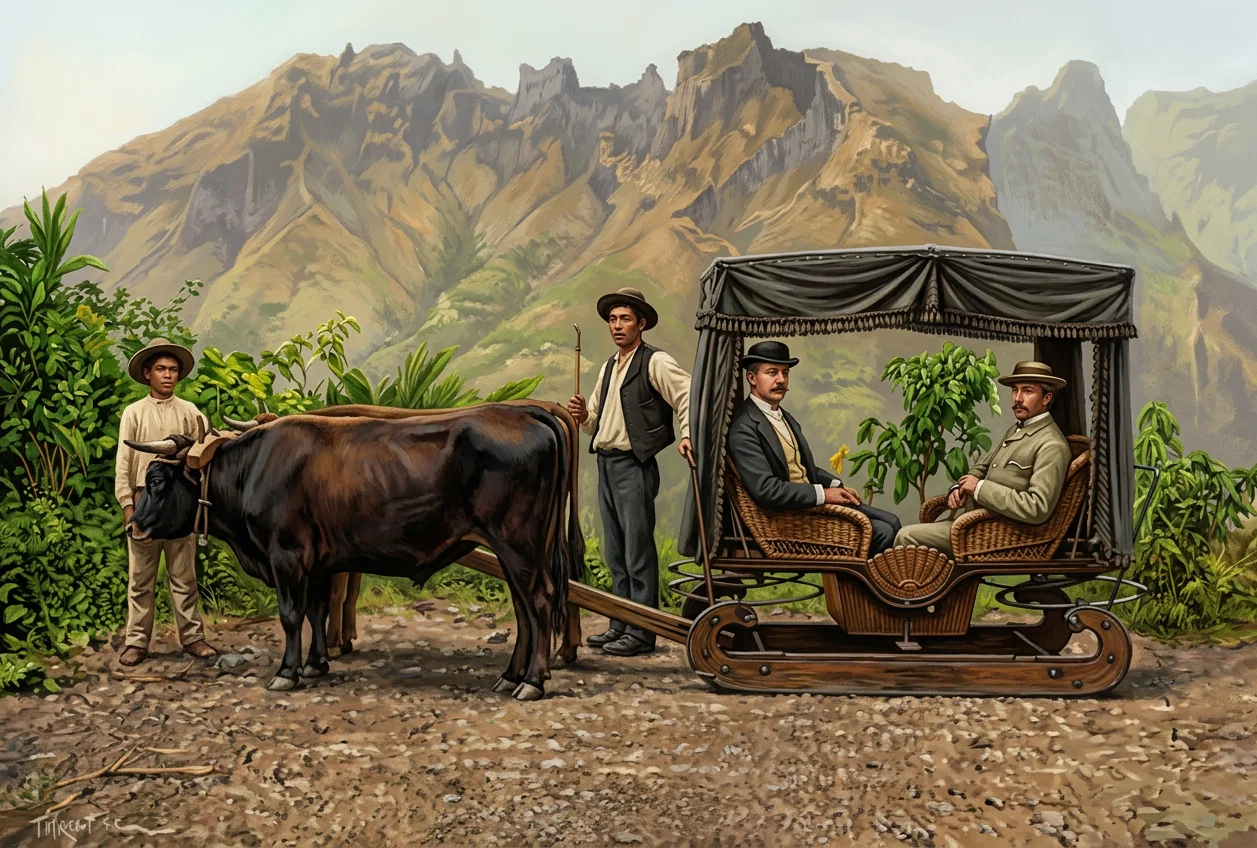
A CARRO.Restored with AI
A CARRO.
Funchal, the capital, is situated upon a large bay on the southern edge of the island; its white houses, surrounded by shady gardens in terracing tiers, are the first thing to please the visitor upon his arrival. Here all the foreigners upon the island spend the winter months; it is likewise the residence of the authorities and the corps of consuls.
The city of Funchal, although it has but a population of some nineteen thousand, covers nevertheless a very extensive tract of territory. Its villas lie very much scattered at different heights in the environs, and whoever visits here must expect to spend almost any length of time to get from one place to another; for it must be conceded, from the start, that the means of locomotion in use here, as well as the pavements of the streets, are of such a nature that one is not able to shorten distance in any way. In general one travels on horseback, and is followed by an armed attendant that carries a fly-chaser, made of long horse-hair, and who does not quit the rider for one single instant, his position being at the heels of the cavalier whether this one travels at a walk, a trot, or a gallop. To get over rough or steep places the attendant clings to the horse’s tail. These persons bear the name of arrieros (rear-runners), and seem indefatigable. But often travelers use the carro. It is a conveyance built on the sleigh, or cutter, principle, with seating room for four persons, and having a cover and curtains. The carro is drawn by a pair of oxen, whose yoke is adorned with little bells. The span is preceded by a child or boy that leads the way, and followed by a man who incites the cattle by whip and voice, and steadies and directs the carro wherever the road has a turn or a descent. Wheeled vehicles are not found here.
Many people prefer the hammock to this mode of locomotion altogether, the hammock being less fatiguing, and more adapted for sick persons.
A sidewalk is a thing almost wholly unknown in Madeira, and the stranger that has but just disembarked must be resigned to getting his feet bruised and sore during the first part of his stay here; for the pavement consists of little stones of fragmentary basalt rock, having sharp edges which are very disagreeable.
The foreign colony is for the larger part composed of Englishmen, a considerable number of whom have become fixtures at Funchal, and have erected comfortable homes for themselves here. The commercial intercourse of the isle is almost wholly with England, and a thousand vessels of all kinds of tonnage cast anchor here during a single year. Men-of-war ships also run into the harbor from time to time, and their officers are always welcomed with joy by the leading residents.
The health-seekers, with but few exceptions, can go out of doors almost every day. Even in the winter season there are hardly three weeks at the utmost during which one would not be able to walk out into the open air,— and such air!—soft, pure, without miasma and without dust, except when the wind blows. This hot wind, called leste, by the natives, is the sirocco of Madeira, and blows from east southeast, carrying a fine sand dust that gives the sky a yellow coloring, though otherwise it is invariably clear and cloudless. When this wind begins, the inhabitants endeavor as soon as they can, to get home, and see that the doors and windows are shut, for the sand penetrates mercilessly through everything. This leste, quite irregular as it is, blows most often in summer; sometimes, however, two years go by, and it is not seen. This wind once past, the temperature returns immediately just as it was before it rose, the dryness disappears completely, and the air is charged anew with a pleasant moisture like that of a hot-house.
Some almost miraculous cures are said to take place on Madeira; for how many consumptives that have been pronounced incurable in Europe have not at some time or other landed at Funchal, and saw their strength gradually come back, and found themselves soon in the way to complete recovery!
This island is a convenient stopping-place for steamers from the north to points on the African coast; and may we not believe that soon God’s last message of mercy will find entrance here, too? AUGUST KUNZ.