People who never had an opportunity to witness the ocean shore and to behold the mountain waves breaking against the rocks and cliffs in a heavy tempest, can have but a faint idea of the sight; and seeing it for the first time, one is reminded of the words of Job, where he gives the decree of God by which the waters are kept in their place: “Hitherto shalt thou come, but no further: and here shall thy proud waves be stayed.”
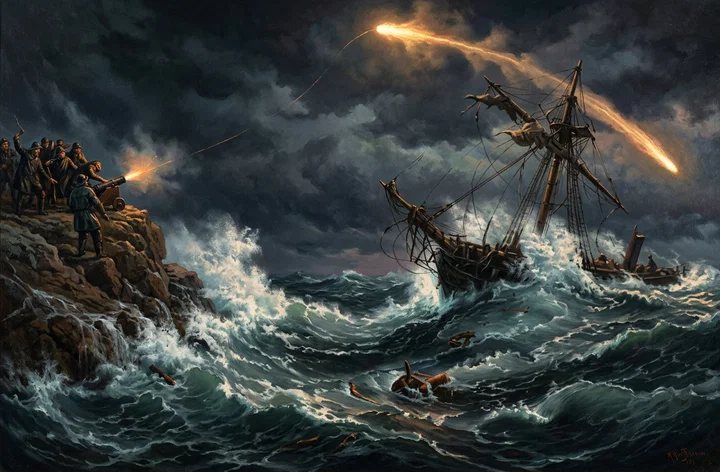
Many imagine that a sailor’s life is a very pleasant one, and this causes so many to become sailors; but the reality is quite different when it comes to be experienced; and after a little they try to get something else to do. Like everything else in this nineteenth century, shipping has increased largely; and as a consequence, old Neptune has added to the number of his yearly sacrifices, although the science of navigation has advanced nearly to perfection.
It is a heart-rending sight to behold a stranded vessel, and to witness one after another of the poor sailors swallowed up by the merciless waves, without being able to extend to them a helping hand.
Friends of sailors have exhausted their skill in inventing life-saving apparatus, until finally the United States has taken the lead, and in this, as well as in other things, has excelled all others, showing to the world what can be done in rescuing the perishing from stranded vessels.
When the captain of a ship sees no way to save the vessel, and a “L. S. S.” is marked on the chart for lee shore, the only thing to do is to steer for the life-saving station, and make preparation to coöperate with it. Signals of distress are shown, to call the attention of the life-saving crew, who are keeping a constant watch, night and day.
Besides having one or more life-boats, the life-saving station possesses what is called the “Beach Apparatus,” which consists of a small cannon, bullets, shot, powder, shot-line, whip-line, hawser, breeches-buoy, sand-anchor, shovels, and a crutch. All these are placed properly on a hand-cart, and are always ready for use. This apparatus is occasionally brought out to a drilling place, where the crew practises. Each man has his number and his own work to perform, so that in case of disaster, the work can be carried out with perfect order, whether by night or by day.
The crew consists of eight or nine chosen men besides the captain. In case of a disaster, the apparatus is brought to the most convenient place for operation. Each of the crew takes his proper place, and at a given signal all go to work according to regulations laid down.
When the cannon is placed on the ground, powder is put in according to distance. The shot is put in, and the shot-line connected to the shot by a wire which will not burn. At the same time the sand-anchor is put down if necessary, and the rest made clear. The captain points the cannon, gives it the proper elevation, and makes ready to fire. If any of the wreck’s rigging is left, the gun is pointed to windward, so that the shot-line can be caught by it. When the shot-line is aboard, the whip-line, which is rove through a tail-block, is fastened on it, and signal is given to the vessel to haul away. The tail-block is made fast to a mast, if any, or to the highest part of the vessel. Both ends of the whip are on shore. A four-inch hawser is now fastened on the whip-line, and by it hauled off to the wreck, and made fast by the sailors on the ship. The hawser is then hauled taut by the crew on shore, the block for the breeches-buoy clasped on the hawser, and both ends of the whip-line made fast in the same. All in readiness, the breeches-buoy is hauled off to the wreck; and if all goes well, all are on shore in a short time. If there are passengers on board, a life-car can be used in place of the buoy, and six or seven can land at once.
It is not only at sea that a sailor is exposed to danger; but when on shore, traps even more destructive than the hidden shoals, await him, and more become a prey to these than to the ocean storm. Each one of these sailors was once a mother’s darling and one for whom Christ died; so those whose lot in this world is better, have certainly a duty to perform in behalf of the sailors. If any one can say of a truth,—
“Go for my wandering boy to-night; Go search for him where you will; But bring him to me with all his blight, And tell him I love him still.”
it certainly is a sailor’s mother.
CAPTAIN J. CHRISTIANSEN.