The use of cotton in the manufacture of cloth began at a very early period in the history of the world. The Egyptian dead who were embalmed when Joseph was prime minister of Pharaoh were swathed about with fine cotton cambric. The Hindus and Chinese used it for clothing more than a thousand years before Christ. Although it had been so long in use, cotton never took a prominent place among the materials for the clothing of man until about the beginning of the present century.
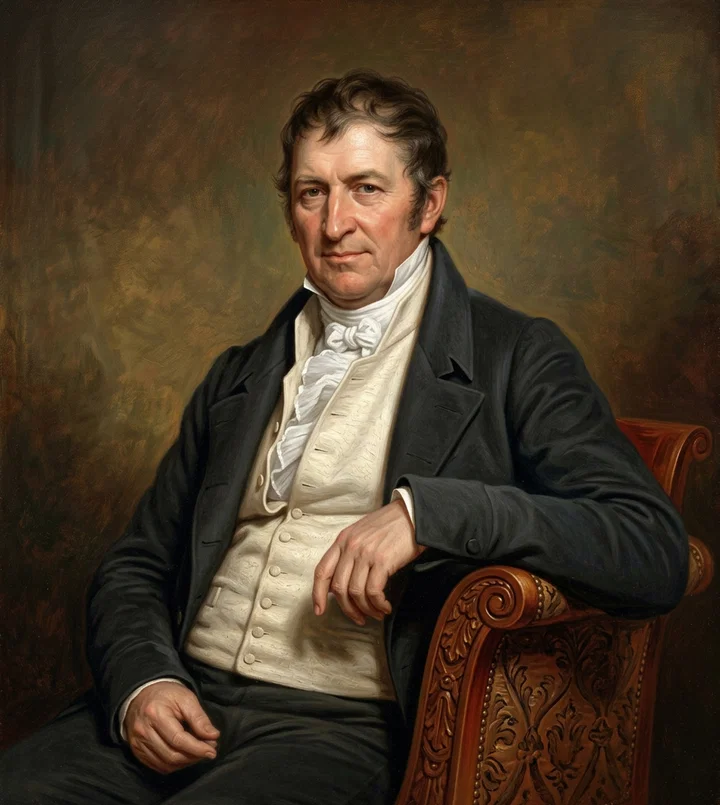
The cotton fiber grows upon a seed, which is about the size of a small bean. To separate this fiber from the seed, as it was done by hand, required so much time that it made the material very expensive. To pick one pound of lint cotton from the seed was considered a day's work for an ordinary hand. This difficulty had always stood in the way of its extensive use. In 1792 Eli Whitney, a native of Westborough, Mass., who had just graduated from Yale College, came to the State of Georgia for the purpose of teaching school. Observing the slow and tedious process by which the cotton was picked from the seed, he set to work under great disadvantages to invent a machine for that purpose. Finding a friend in the person of the widow of General Nathaniel Greene, he made her estate his home, and received from her the necessary means for the development of his plans. Before the close of the following year, success had crowned his efforts. He had discovered a simple process by which one man has been enabled to do more work in picking the cotton from the seed than a thousand men could do by hand in the same time; and the cotton gin, one of the most important inventions of the age, was put into operation. Its remarkable success was an astonishment and a wonder to the world. The first large exportation of cotton to England after the gin was brought into use, consisted of ten thousand pounds (about twenty bales), yet this was such a surprise to the authorities that they held the cotton until investigation was made as to where such a quantity could have been produced.
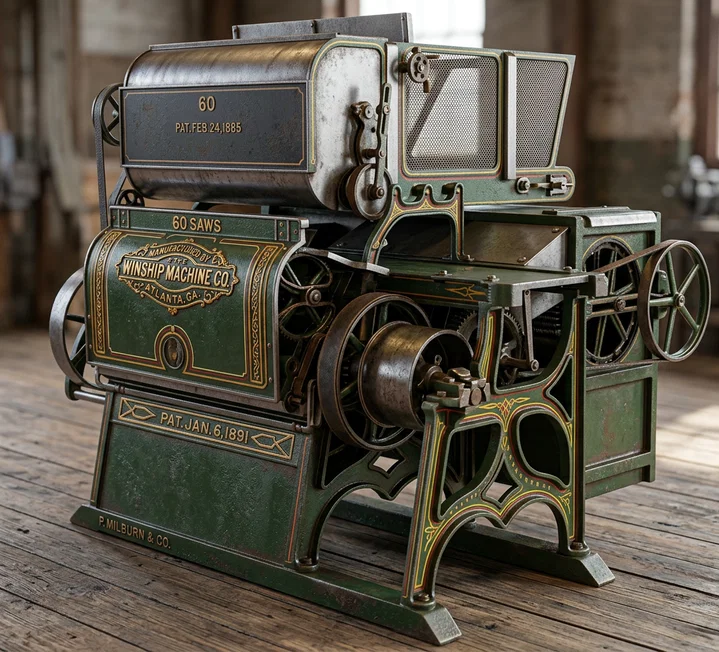
The main features of Whitney’s invention consist of a system of circular saws set upon one shaft. The sharp pointed teeth pass up through ribs of steel into the cotton as it comes from the field, and carries the lint forward, leaving the seed behind; and back of the saw cylinder is a revolving brush which removes the lint from the teeth. The process is so simple and so effectual that the familiar question naturally arises, “Why was not this found out before?” Why should the world, with all the talent of past ages, have gone on for thousands of years picking its cotton from the seed by hand, until the advent of Eli Whitney? But such was the case, and it was no matter to the world “why.” When the discovery was made, there were men sharp enough to discern its advantages, and before Whitney had secured the protection of his rights as the inventor of the cotton gin, other men had begun making them, and soon their manufacture of his machines had got beyond his control. After fruitless attempts to secure his rights, Mr. Whitney, becoming thoroughly disheartened, abandoned his claims, wound up his business, and left the State a poor man. He had given millions upon millions of dollars to the South. He had opened the way for the vast cotton manufacturing interests in Europe and America; but he had not received a dollar above expenses as a remuneration for the services he had rendered.
A few years before the invention of the cotton gin, two poor laboring men in England, Sir Richard Arkwright and James Hargreaves, had invented other machines, perhaps of nearly equal importance,—the carding mill and the spinning-jenny. These inventions had caused a complete revolution in the manufacture of cloth, and the gin laid the foundation of the great cotton industry by bringing this texture to the front rank as the most economical material for cloth making. Cotton mills and manufacturing towns were built up rapidly in England and America, and made a demand which stimulated the cultivation of cotton until it has reached its present immense proportions.
Those who have never traveled in the South can scarcely realize the extent to which this industry is carried on. The broad fields, hills, and valleys covered with the green foliage, beautiful flowers, or the snow white open bolls of the cotton plant, present to the eye of an observer a delightful picture. This can be seen almost everywhere throughout the cotton belt. To give the reader an idea of the extent to which cotton is raised, we will take for example the crop of 1893. The number of acres planted was 15,963,966. Suppose we reduce these acres to square miles, and then imagine them to be arranged in one long cotton field a mile in width. Should we undertake to walk through this field lengthwise, we should have to travel twenty-four thousand nine hundred and forty-three miles, or about the distance around the earth. Imagine the work required to till this vast field! It has to be gone over five or six times with a plow, three times with a hoe, besides the planting, and picking three or four times over as the bolls open.
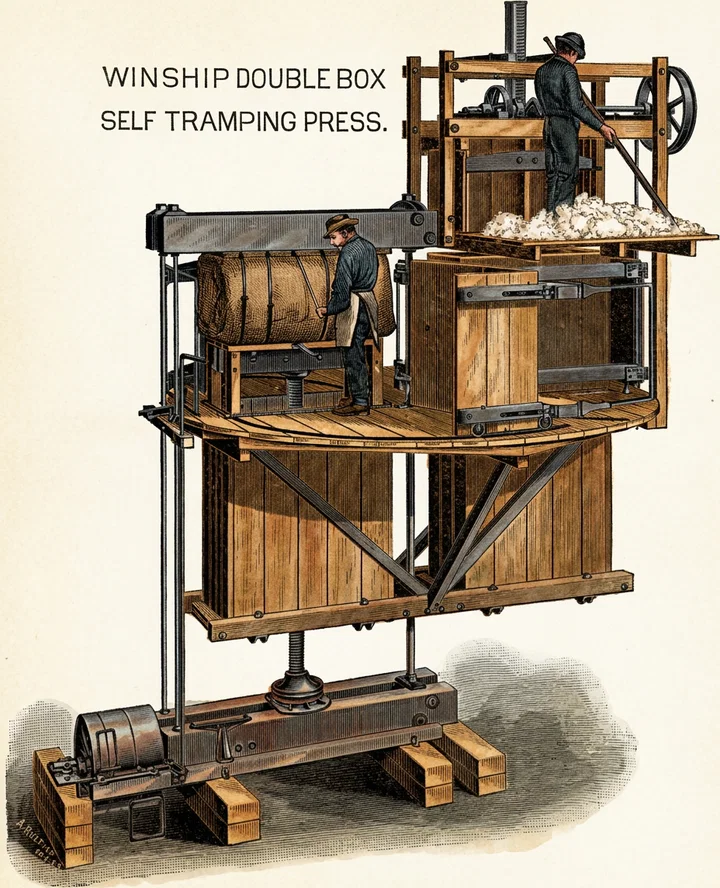
As the cotton is picked, it is drawn to the gin for separating the seed. The latest improved gin, as built by Winship and Company, of Atlanta, Ga., receives the load at one end of the building, where the cotton is drawn up through flues out of the wagon by means of suction; and within thirty minutes the driver goes to the other end of the building, where the seed is emptied into the wagon, and his cotton, all baled up, is ready for him. And this work has been done by three men with the cotton gin, that would have taken one man more than a year to accomplish by hand.
A bale of cotton usually weighs about five hundred pounds. The number of bales of cotton produced in 1893 was 7,532,000. Here again let us try to bring this vast numberp. 290 within the grasp of our comprehension. Suppose these bales of cotton are to be loaded into wagons as they come to market. Three bales constitute the ordinary load for two mules. Allowing each team one rod of the road, they would form a procession seven thousand eight hundred and forty-eight miles long, or nearly the distance through the earth; and the seed, if put in wagons and drawn by teams, would form another procession about fourteen thousand miles long. This was only an ordinary crop. The largest number of bales ever produced in one year was in 1891, which amounted to 9,018,000. During the days of slavery, the largest number reached was 4,861,000 bales. Thus time has demolished the old argument that cotton could not be successfully produced with free labor.
In the preparation for the great Cotton States and International Exposition, let the name of Eli Whitney be inscribed upon the walls of its palaces, let his portrait hang in the most conspicuous place, and let his memory be cherished by all who behold the results of his work. For what Columbus was to America, Whitney has been to the great cotton industry of the South.
Rodney S. Owen.