ASTRONOMICAL STUDY — NO. XI
Positions of Our Planets
In the diagram given in this article we have a comprehensive view, which a moment’s study will enable all easily to understand, of one of the most wonderful manifestations of God’s power and goodness presented to the mind of man by the material universe,—the wonderful mechanism of our solar system.
Last week we studied the beautiful planet Saturn, and expected this week to make a special survey of its wonderful rings and moons, the former being that which especially distinguishes that world above its fellows as a place of beauty; but as we shall soon enter upon a new month, and are in so favorable a position to study the different worlds that adorn both our morning and evening sky, we will turn our attention to Saturn’s solar brothers and sisters this week, and look at the family as a whole. Let none forget the position of this planet, however, nor neglect to look for it each evening, and watch its onward march among the stars shining in purity beyond.
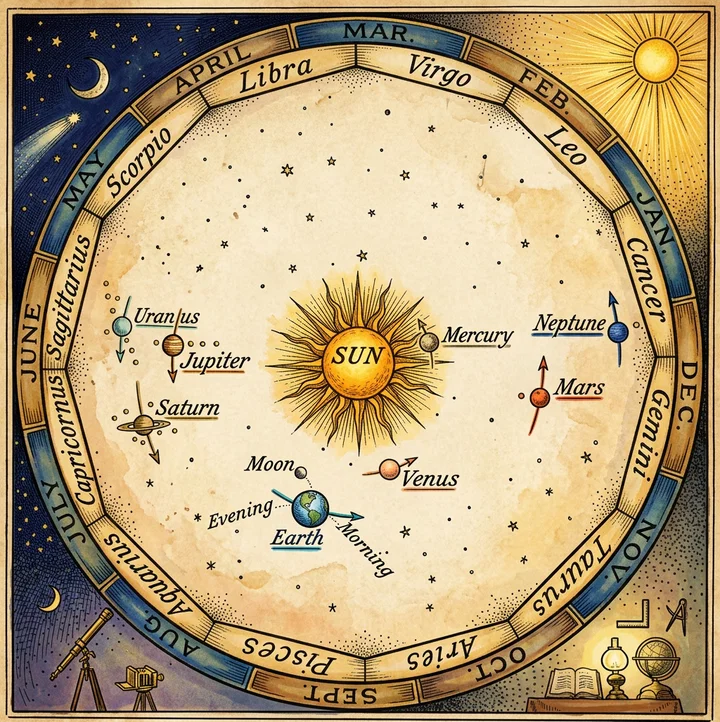
Now for the diagram. Let us see if we can understand it. If so, we can understand the manner in which all our worlds mark out their yearly courses around their common center, the sun; and we shall, I trust, be drawn nearer the great heart of Him who so loved this one small world that he gave his only begotten Son, that whosoever believes on him should not perish, but have everlasting life. Remember that, as presented in the illustration, the sun is in the center of our system; and all the planets travel around the sun, just as does our earth, each making its own year, which differs in length with each planet, according to the time it takes each to make the journey. Our earth requires three hundred and sixty-five days to get once around; Mercury, which, as you will see by the diagram, is much nearer the sun, gets around, and so completes its year, in eighty-eight days of our time; Venus, which is somewhat farther away, yet still nearer than we, gets around in two hundred and twenty-four days of our time. The planets that are farther from the sun than we,—Mars, Jupiter,p. 267 Saturn, Uranus, and Neptune,—all having farther to go to get around to their starting-point in the heavens, have longer years than do we.
You will notice that they are all journeying around the sun in the same direction as we, and in fact all swinging in about the same level. We say “about;” for we understand that we are writing for common people,—such as heard our Saviour gladly, and would be glad to understand some of the riches of his creative work if our scientific friends of this world’s fame would only tell the beautiful story in language that all could understand.
If it is pleasant just after sundown this evening, as the first stars begin to appear, stand facing the south, the chart squarely before you, the top to your right and the bottom to your left. Imagine yourself standing, in the diagram, on that part of the earth marked “Evening,” just where the earth is rolling out of the light of day, away from the sun, toward the east. Notice how correct the diagram is. This leaves the sun just sinking over the western hills, as is the fact, and exactly as illustrated in the sketch. Now look directly before you, toward the south, and a little to the west, and you will see Jupiter and Saturn shining forth exactly as presented in the illustration. Uranus you will not discern, as it is so far away; but it is there, just as illustrated, still farther beyond Jupiter. The moon may bother you for a few evenings; but it will soon pass on to the east, and then we shall see these beautiful worlds shining silently on in the path where God has placed them. What a wonderful sight,—Sun, Earth, Moon, Jupiter, and Saturn, all witnessing to the power that directs their majestic march along the great highway over which the foot of fallen, mortal man has never trod!
But where is Mars? Where is Mercury? Where is Venus—that beautiful star which so richly emblazoned our western evening skies all last winter? Are these gone forever?—No, indeed. They are only somewhere else in God’s great universe. Let us look them up. To-morrow morning, a full hour before daybreak, we will arise, and behold the beauties of the eastern heavens. Take your diagram; stand facing the south, with the top of the diagram to your left and the bottom to your right. This will bring the sun to your left, or toward the east, where the real sun will soon appear. Now imagine yourself on that point of the earth in the diagram marked “Morning,” just where the darkness is about to merge into daylight; and what do you see in the eastern heavens? There are Mars and Venus, shining in all their glory as morning stars. We shall be a little too late to catch Mercury, for reasons given in our study on that planet. Neptune is also in that part of the heavens, but so far away that the naked eye can not discern it.
Now watch these planets, and study your diagram; and if time will admit, next month we will have another figured out. Then by comparing the two, we shall see just how far each one of the worlds has moved on in its circuit around the sun, and so be enabled to understand something of the changes continually going on in our great solar system.
DR. O. C. GODSMARK.
801 5th St., Milwaukee, Wis.