MY DEAR BOYS: Your letters, with the one from Cousin Ralph, came this morning; and I will now try to answer his questions about snow and hail,—how the different-shaped snowflakes are formed, and what it is that makes the rings on the inside of a large hailstone.
As we have already learned, all the water that falls to the earth as rain, dew, and so on, is carried up into the air in the form of vapor. This vapor forms clouds, which float high above us until they come to a place where the air is cold enough to condense it, when it falls as rain. But if the air is so cold that the vapor is frozen before it has time to form into drops of water, it falls as snow instead of rain. As they fall, these tiny particles of frozen moisture gather together in little groups; thus the snowflakes are formed.
You may have noticed that the flakes are much larger at some times than at others, and that the larger ones fall in warmer weather. This is because the little ice-crystals are not frozen so hard in the warmer weather, and so stick together more readily.
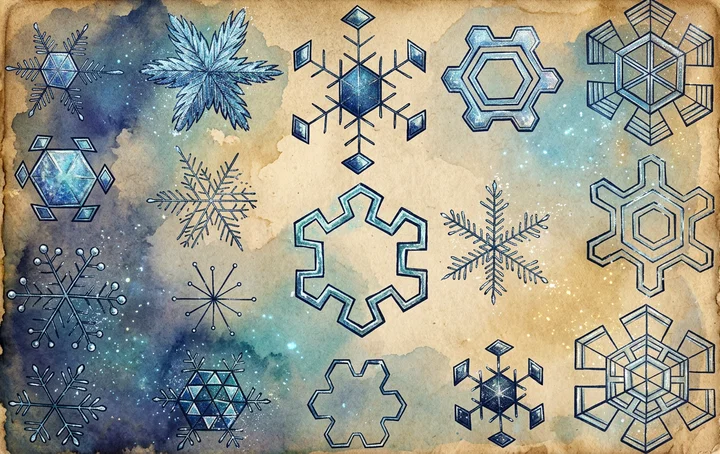
As we look out on the snow, it appears like one great mass of white; but if you will catch a few of the falling flakes on a piece of dark cloth, and examine them under your magnifying-glass, you will see that each particle of the frozen moisture is a beautiful little ice star-crystal. These appear in an almost infinite variety, but all are some form of the six-pointed star.
I have always liked to think that David and Job were thinking of these beautiful little snow-crystals when they said: “He giveth snow like wool: he scattereth the hoarfrost like ashes. He casteth forth his ice like morsels: who can stand before his cold?” “God thundereth marvelously with his voice; great things doeth he, which we can not comprehend. For he saith to the snow, Be thou on the earth; likewise to the small rain, and to the great rain of his strength.” I shall not tell you where to find these texts; for I would like to have you find them for yourselves, and write them in your books.
Here are some pictures I have made of the little snow-stars. Fig. I. See how many of these forms you can find to draw in your books.
Hail, too, is moisture that is frozen high up in the air. If you will take a large hailstone, and press it against a warm stove, or some other surface that is hot enough to melt away half of it, you will probably find a tiny snowball at the center, and around this the rings of which Ralph spoke. Fig. II.
Some hailstones do not have these rings, but are simply drops of rain that have passed through a layer of air cold enough to freeze them on their way down. Sometimes several of these frozen raindrops freeze together, and form a larger hailstone.
No one really knows what makes the rings that Ralph asked about, but there have been two theories advanced, either of which may be correct. I will explain them both to you. The first is that the tiny snowball that you found at the center of the hailstone was caught by a sort of whirlwind, and kept whirling round and round through a cloud containing particles of snow and another holding particles of water, with a layer of cold air between them. As the tiny snowball passes down through the cloud containing particles of water, some of these collect around it and are frozen, forming a layer of ice as it passes back through the cold air; when it passes through the snow-cloud, some of the particles of snow stick to the surface, and are frozen fast to it in their turn, thus forming another layer, or ring. And so on until the lump of ice is too heavy for the wind to carry, and falls to the earth. If you will study the figure marked No. III, it will help you understand this process. The line and arrows represent the path and direction of the wind; a represents a cloud containing snow; b, one containing particles of water; and c, a layer of cold air.
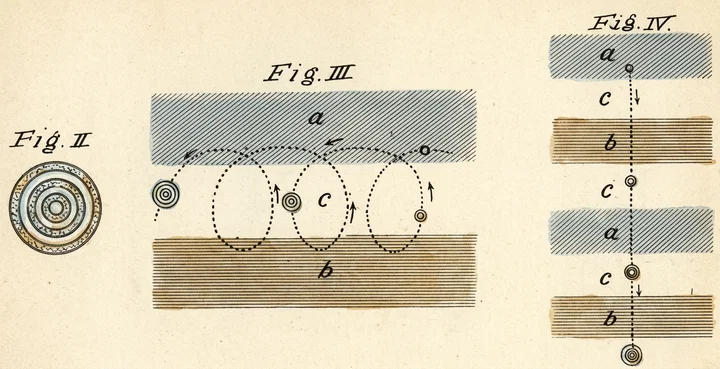
The second theory is that as the snow starts to fall, it passes through several layers of cloud, with layers of cold air between them, thus forming the different rings. Fig. IV will help you understand this.
Please send this letter to Ralph as soon as you have read it.
Yours affectionately, UNCLE JOHN.