The Australian continent is divided into five colonies, of which Queensland, occupying the northeastern portion of the country, is one. We are likely to have inadequate ideas of the countries situated on the other side of the earth from us. I well remember that in the geographies I studied in my boyhood, Australia was represented on a map of very small proportions in the last part of the book. But when one travels the distances represented so feebly, and sees the extent of territory included in these lines, he realizes that his conceptions of the country need reforming. Just the same state of things is apparent on this side of the earth. To many of those who have not seen them, the continents far away assume small proportions. The colony of Queensland covers an area of over six hundred and sixty-eight thousand square miles. This is nearly one fourth of the area of the United States. There are fifteen districts, some of which exceed in extent the largest of the States. The eastern coast-line is fifteen hundred miles long in a straight line, and with the numerous indentations it would be much longer. A narrow peninsula juts northward between the Pacific Ocean and the Gulf of Carpentaria to within twelve degrees of the equator, and one half of the colony lies within the tropics.
The first settlement in the country was made in 1825, when a penal colony was opened for the reception of criminals from the Old World. This unfortunate introduction to the civilized world was not long continued; for in 1842 the country was thrown open to settlers. In 1859 a separate colony was formed. Up to the present time the country has received a population of not far from half a million white persons. In the meantime, the aboriginal race is fading rapidly away, and is now perceptible only as one visits the interior or one of the reservations.
The natural resources of Queensland are more varied and abundant than those of any of the other colonies. It is true that far interior the country is arid and subject to continued droughts; but nearer the coast, rains are more frequent, and here are found vast ranges for cattle and sheep. Still nearer the coast we find a range of low mountains extending throughout the entire colony. Here are gigantic forests of useful timber, fertile valleys and plains, and rich mines of gold. There are also extensive areas of coal lands. On the higher lands, grains and fruits of a temperate zone are grown; while on the lower and coastal grounds are found an abundance of the tropical fruits,—bananas, oranges, mangoes, pineapples, guavas, and a long list of others, with even the names of which the most of our readers are unacquainted. But a stranger not only has to acquaint himself with the name; he must also overcome a large amount of gustatory prejudice and sundry squeamish sensations before he can come into really friendly relations with most of them. When this is accomplished, he soon loves the things he once despised.
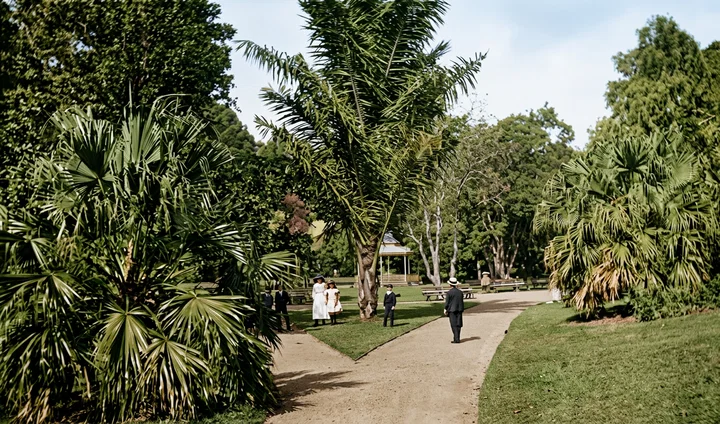
Brisbane, the capital city of Queensland, is a place of rare beauty. It is situated on the Brisbane River, about a dozen miles from the ocean. The site is the hilly slopes of the banks of the river, which winds its way in a tortuous course through the high range of hills. Many of the streets follow the ridges, or course, down the valleys without much regard to the points of the compass. A good system of trams, or street-cars, traverses the principal thoroughfares. The public gardens are attractive, and the people are of a progressive and enlightened class.
A movement to federate the Australian colonies in the form of a commonwealth, quite after the model of the Union of the United States, has been carried by a popular vote, and will be given effect in the next few months. In Queensland the food question is assuming a deservedly important aspect. The use of meat for food has from the outset been very prevalent. Now the cattle are becoming so infected with disease as to cause alarm in the minds of those who have the public welfare at heart. Conventions are frequently called to discuss the situation, and the government is urged to take stringent measures to prevent the increase of death and destruction from the infection. It is fortunate and providential that at this time special efforts are being made to introduce to the people better habits of living, and a far more healthful diet than that which consists of the flesh of slaughtered animals, with tobacco, tea, coffee, and intoxicants. With an abundance of fruits and grains the year round, there is no necessity for slaughtering animals for food.
Fresh vegetables are always in the market. Ripe tomatoes may be had the entire year. Indeed, there is no other thing that so puzzles me as to attempt to grasp the methods of the farmers. They seem to plant, plow, or sow, to reap and thrash, whenever the notion takes them to do so. No doubt there is something of method in their movements, but it is not the principal feature of their work, I am sure. To-day I have seen corn just coming out of the ground, and other fully eared. Potatoes and cabbages are always growing, and just now the orange trees have three crops upon them.
G. C. TENNEY.