Bassorah (Arabic, a “margin”), is a city of the Turkish province Irak-Arabee, half a mile distant from the west side of Shat-el-Arab (the conflux of the Tigris and Euphrates). Joined with these by a canal is the most influential seaport and trading-post for this part of the country, having been, in its most flourishing period, a great and rich city. In the middle of the eighteenth century it numbered upward of one hundred and fifty thousand inhabitants; but the population rapidly diminished, so that in 1825 it was reduced to sixty thousand, and the plague of 1831 reduced it to thirty thousand, and the plague of 1838 to twelve thousand. In 1854 it numbered only five thousand, and in 1862 from four thousand to four thousand and five hundred. Being neglected by the Turkish government, the place is becoming more and more abandoned, in spite of its natural loveliness and other attractions of no mean order. Its situation, for instance, is most favorable for commerce, and the country around is as fertile as any on earth.
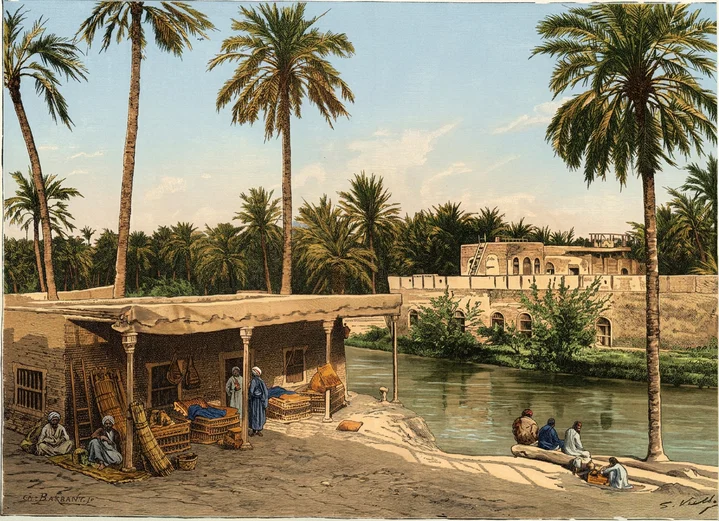
The many stately ruins about the city tell of its former splendor; the present buildings, however, dilapidated as most of them are, tell the sad story of neglect and decay. The unexampled filthiness of the streets and the unimproved marshy districts in the environs, make Bassorah a most unhealthful place; and this unhygienic condition of things is heightened, especially in summer-time, by bad drinking water. Such are the fruits of neglect on the part of an imbecile government, when a little judicious labor in draining the marshes and cleaning the streets and watercourses, together with necessary repair on houses, might by the exceedingly great fertility of the soil, turn the place into a paradise. But as it is, the date-palm is about the only fruit raised for export; of this, however, large quantities are shipped. Rice is but little cultivated. Since 1862 an English steamboat company established a regular line between Bassorah and Bombay. The present Bassorah took its rise in the seventeenth century, after the complete abandonment of the site of the old city by that name, whose ruins can still be seen about two miles to the southwest of the Bassorah of to-day.
The older city was founded in 636 A. D. by the second caliph Omar, as a key to the Euphrates and the Tigris. As an emporium for the trade with India and Arabia, it reached its highest prosperity, and won for itself a name also as the home of distinguished poets and men of learning. In the fourth century of the hegira, one of the first Mohammedan academies of learning for the middle ages was founded here; but in the twelfth century the city seemed doomed to decay, which in later centuries increased more and more rapidly. At the conquest of Bagdad, by Murad IV—in 1638—this entire stretch of country fell into the hands of the Turks, and the present Bassorah became the seat of an important and influential paschali. Later it was alternately under the power of the Turks, the Arabians, and the Persians. From 1832-40 Mehemed Ali was in possession of it. Under the rule of Midhat Pasha (1868-72), governor-general of Bagdad and later grand vizier, the city began to rise in importance again, so that the number of its inhabitants is now estimated at over ten thousand.
Through the patronage of Midhat, the Turkish Steam Navigation Company “Oman” was founded, with headquarters at Bassorah. The water trade from Bassorah southward has, since the opening of the Suez canal in November, 1869, gained steadily in importance; but the increasing influx of sand into the river proves a fatal hindrance to its rapid extension. Being the most easterly point of importance toward East Arabia, it forms an excellent base of operation for the extension of Osmanic rule in this direction. Since the summer of 1874 the fortification of the mouth of the stream by means of coast batteries along its right bank, is begun.
The export, besides dates, is chiefly horses. The imports from India are coffee, indigo, rice, spices, and ship-timber for building the barges which ply up and down the Tigris and Euphrates. Two English and seven Turkish steamers run between Bassorah and Bagdad. A telegraph line connects it directly with India. Next to Bagdad, the ancient Bassorah plays the most important role in the history of the Mohammedan caliphs. A. KUNZ.