FLOWERS—what are they? Whom shall we ask? Should we direct the question to Webster, he would say: “A flower is an organ, or combination of organs, of propagation isolated by a circle of foliar parts.” I hear some one say, “He could not have been a lover of flowers, or he would certainly have said something of their beauty.” But others, who, because of their love for flowers, have made them a life-study, define them thus: “Flowers consist of peduncles, the ends of which form receptacles from which the calyx, corolla, stamens, and pistils grow.” Another has said: “Since the office of flowers is to produce seed, a perfect flower may consist of pistils and stamens only.” Had we never seen a flower, think you we would now have a clear conception of what one really is? No doubt our mental picture would fall far short of representing the sweet mignonette or the smiling pansy. Then let us not ask others what they are, but study them for ourselves, and know what they are.
Who will now direct us to a place where we shall be able to find the greatest variety and the most beautiful specimens? One may say: “The meadows just beyond the old mill, where in childhood I once roamed, certainly have the most beautiful.” Another will direct us to the forest surrounding the country school-house, once so thickly populated with those “bright-arrayed children of the mountains.” But as I listen, I hear some one say: “Away across the Rockies, just beyond the snow-capped peaks of the Sierra Nevadas, there, sheltered from the chilling winds of the prairies, and refreshed by the balmy breezes of the great Pacific, lies a land of sunshine, fruit, and flowers.” It is the flower-garden of the world. Thither let us go to gather our roses. What a delightful time we shall have! Although the flowers here bloom continuously, just now spring with all her charms has arrived, and clothed nature with her richest attire.
Restored with AI
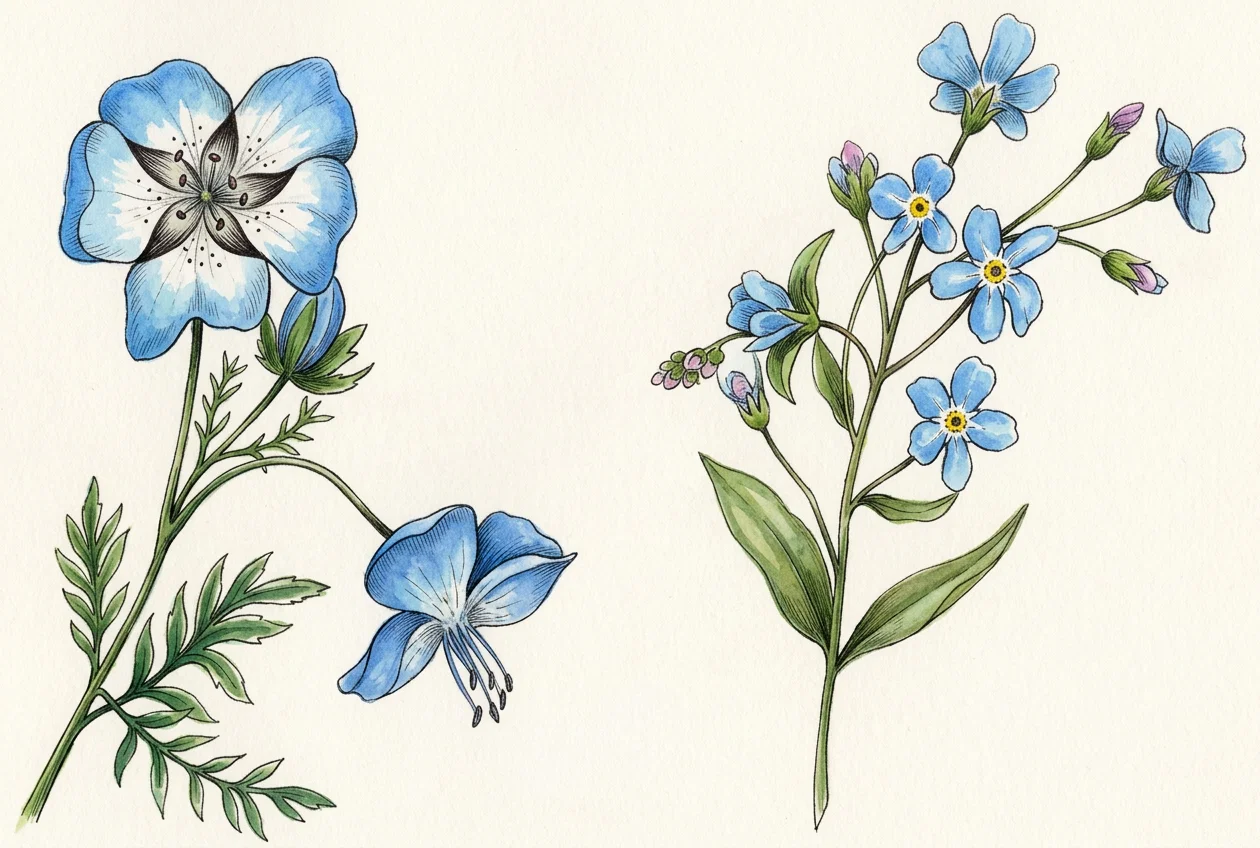
BABY-BLUE-EYES AND FORGET-ME-NOT.
As we wander along the trails of the mountains and by the streams in the valleys, we can find no cliff so high and parched, no valley so deep and dense, but that flowers are seen all about us, bending their graceful forms in the breezes, as if waving us a welcome. Every variety of the East may be found growing in thick profusion along the coast.
Restored with AI
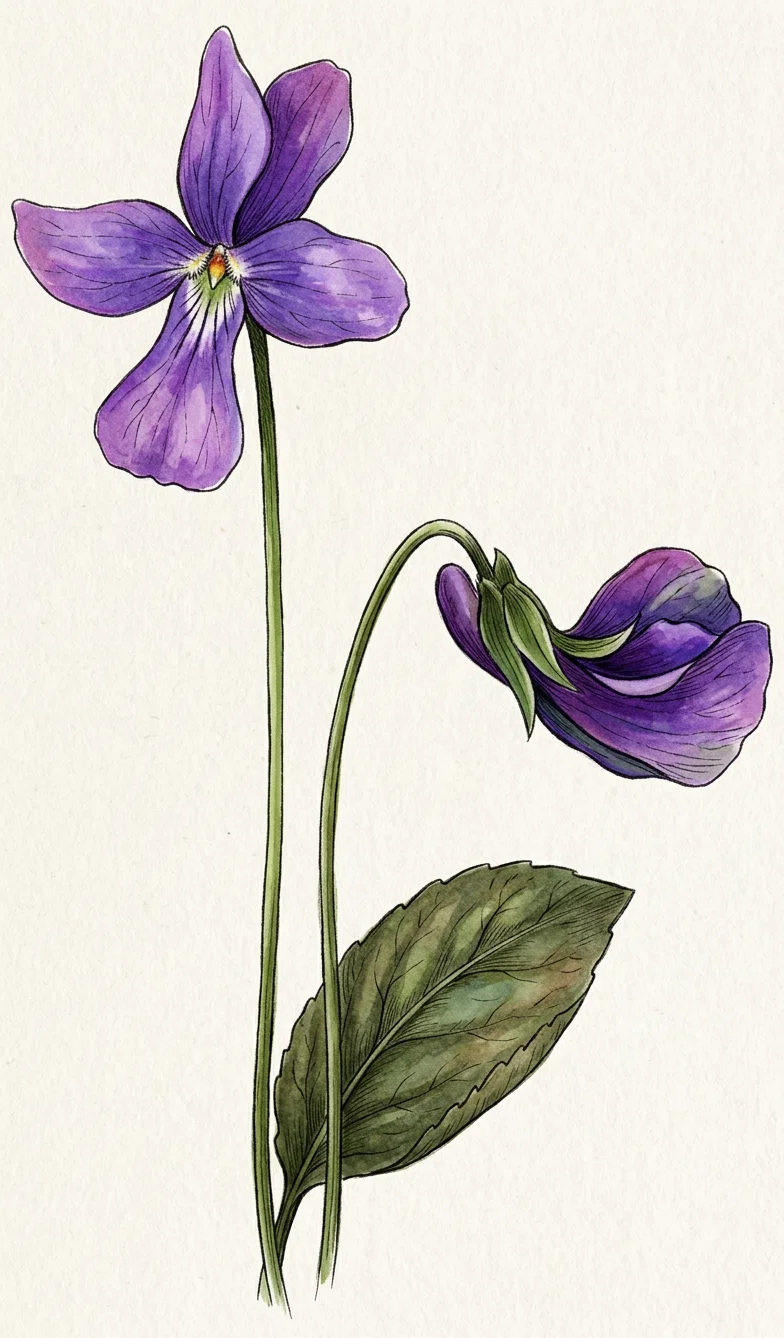
WILD VIOLETS.
It is not my object to tire you with scores of orders and hundreds of species, but simply to describe a few of the most familiar, that you may welcome them as old friends; or if you are strangers, that they may serve as an introduction to you to the home of the beautiful wild flowers of the world.
The fields just before us appear as if spread with a mantle of purple and blue; for, peeping up from its profuse foliage is the Nemophila, or, as it is tenderly called by the children, “baby-blue-eyes.” Who knows but that it was these flowers, wet with the morning dew, that Longfellow had in mind when he wrote,—
“Others, their blue eyes with tears o’erflowing,
Stand like Ruth amid the golden corn”?
The leaves of the Nemophila are pinnately parted into from seven to nine, and sometimes two or three lobed divisions. The corolla is from one half of an inch to an inch in diameter; it is bright blue to nearly white, and sprinkled with dark dots becoming more numerous as they near the center.
There are many flowers which I wish it were the privilege of all to pluck for themselves, and enjoy as we do. There are the pure white fragrant four-o’clocks, which are such welcome visitors to the children tired with their lessons; the lovely little Trifolium, or “bird’s eye”; the many varieties of daintily tinted primroses; larkspurs, pink, blue, and white; and snapdragons, as lovely as those found in the best cultivated gardens of the East, are found in great profusion in our open plains.
The wild violets are of three different colors,—blue, yellow, and white. The little blue ones are quite rugged, and often wander away out into the fields, while the white ones are more delicate, and seek the protection of the forest, where they may hide their sweet faces in the deep moss. The yellow ones resemble very much the wild pansy of the East, neither are they inferior to their fair sisters in beauty. The flower has the same shape as the cultivated violet, and is somewhat smaller than the Japanese violets found in every hot-house in the Eastern States and in every flower-garden in California.
Restored with AI
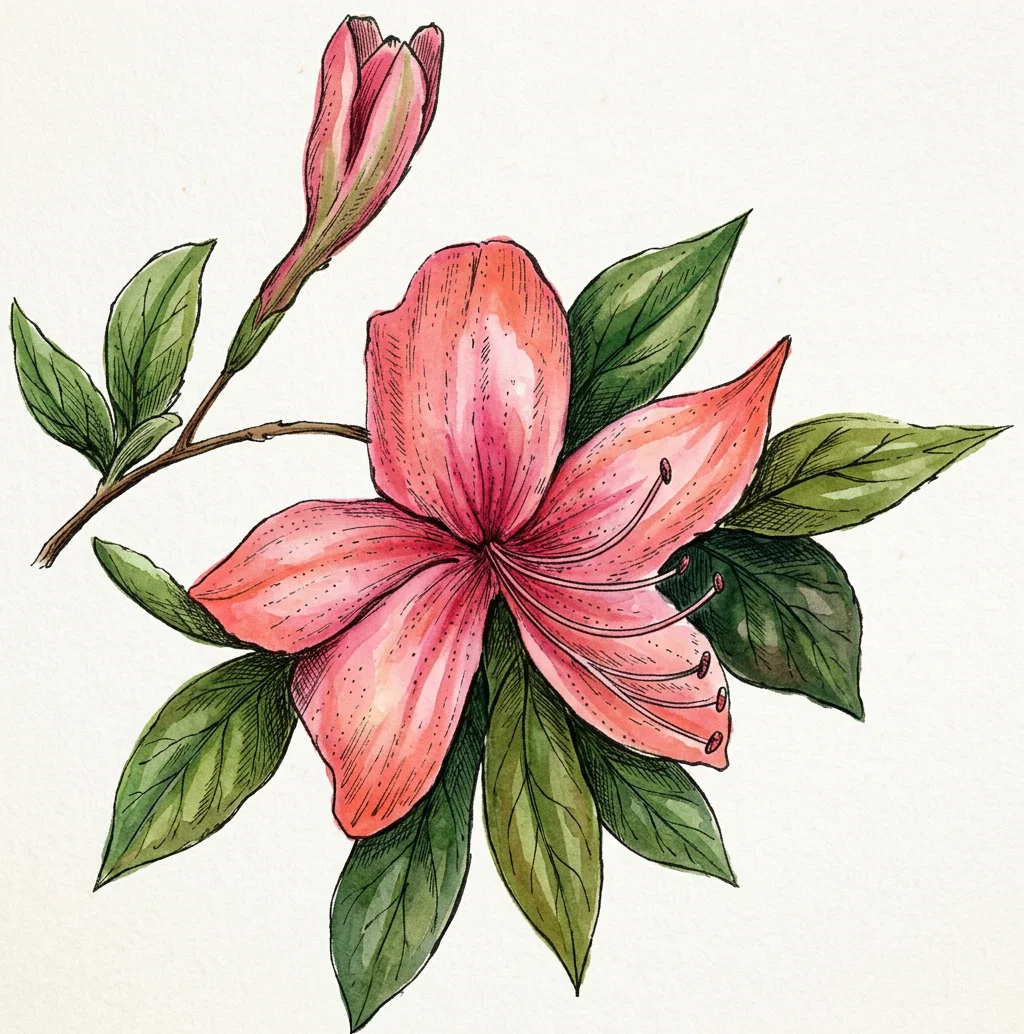
AZALEA.
I next present to you the little fairy of the mountains, so suggestive of its name. There are many others more gaudy in appearance, more beautiful to look upon, but none more true to its mission than this one. The forget-me-not is seen in thick underbrush or in small crevices in the rocks modestly lifting its smiling face to greet you, and then, as if conscious of its appellation, blushing and looking to the earth. The color of the flower changes from a light blue to a pale pink. The leaves are pale green, ovate-lanceolate, and from two to four inches long.
Those who can welcome the Azalea, the queen of wild flowers, as an old friend, can better appreciate its beauty than can those to whom it may be a stranger. This fragrant blossom is nearly three inches long, and belongs to the order Rhododendron. It grows on a shrub which is from three to five feet high; its color varies from a pure white to a dark pink, and again from red to crimson. The leaves are ovate-oblong, bright green, and slightly pubescent. KITTIE WAGNER.