SINCE an intimate knowledge of mission fields increases the general interest and activity in behalf of work in those fields, I will attempt to describe some of the experiences and conditions attending a missionary tour in Argentina. First, however, in order the better to understand the extent of this country, we will suppose it to be laid down lengthwise in the United States. With the northern extremity touching New York City, the southernmost point would reach a little west of Denver, Colo.
In all this vast country there are only about six and one-half millions of people, one ninth of this number being found in Buenos Ayres, the capital city. If we imagine the population of Pennsylvania to be scattered throughout the States mentioned above, we may get an idea of how sparsely settled is Argentina, and how great are the distances the missionary has to go between towns, villages, and even houses. In setting out from Buenos Ayres, if he has not the money to purchase a cart and horses, he buys two horses, one to carry himself, the other to carry his saddle-bags, filled with books, tracts, etc. After passing the quintas and the gardens of the city’s suburbs, the traveler soon finds himself in an open country, as level as a Western prairie, with nothing to be seen but grass and occasionally a few eucalyptus trees,—mere dots in the expanse,—marking the location of an estancia house, with its galpones, or storehouses. These estancias, or cattle ranches, occupy anywhere from three to one hundred square miles, the main buildings being situated in the center, while the remoter portions are looked after by posteros, or under-shepherds.
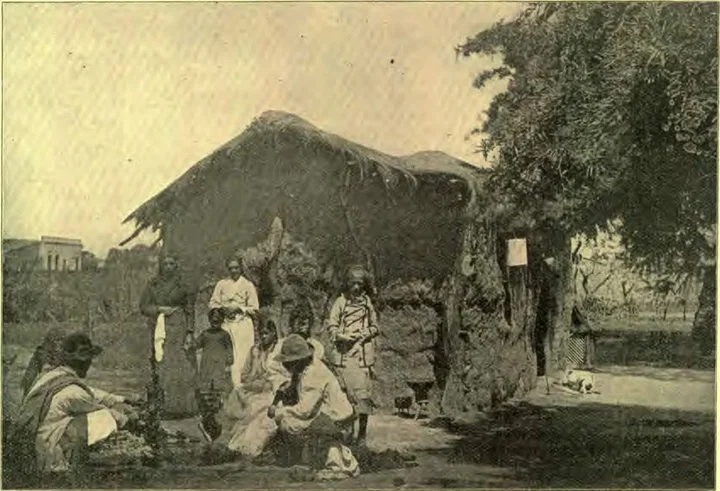
The accompanying illustration represents a typical house of one of these posteros. It is usually built by setting in the earth rough posts for the corner and center supports, to which are fastened small poles for framework and rafters. The black earth is then dug up in a circle from two to fifteen feet in diameter. Water is poured on, and thoroughly mixed with the soil by driving mules and horses through it. The addition of fine straw or chaff makes a mud mortar, which is quite adhesive and ready for use. Of this alone the walls are built. On exposure to the sun and air, they become hard and durable. Some, to give the houses a cleaner appearance, apply whitewash. The roof is usually thatched with grass. One of these roofs will last three or four years. The illustration shows a family at their evening meal, consisting of roasted meat, hard biscuit, perhaps a month old, and maté, or Paraguayan tea. The meat, as you will observe, is placed on iron rods set in the earth, around which a fire is made. When the meat is well roasted, each one partakes, cutting it off piece by piece, and eating it without plate or fork.
The missionary, unable to reach the distant estancia house, is glad to find a welcome with the postero; and although his bill of fare is meager, and his bed may consist of nothing more than sheep-skins thrown on bare boards, and his slumbers be often interrupted by the tortures of the too numerous fleas, the hearty hospitality bestowed goes far to atone for the discomforts endured.
On arriving at the estancia house, the missionary may fare better, if entertained by the major domo, or overseer; but frequently the unpopular truth he carries procures for him a cold reception, and he receives no more than the regular fare of the peons, which does not surpass that already described. At sunrise he is on his way toward the next estancia, having perhaps fourteen leagues, or forty-two miles, to travel in order to reach his destination. Passing along the road, which is simply the unbroken ground wired in to the width of eighty or ninety feet, he meets a troop of cattle on their way to Buenos Ayres, five or six mounted peons being in charge. These latter must be out day and night, rain or shine, their only bed being their saddle, which is mainly made up of rugs and sheep-skins bound by girdles to their horses. Proceeding, he soon comes to an almost impassable plan-tana, or immense mud-hole, reaching from fence to fence. The country being so level, rain-water stands in the gullies and low places, and troops of passing cattle churn up the black earth from the bottom, thus making the place impassable, even on horseback. The fence is then opened, and the missionary must pay from ten to twenty cents for the privilege of passing around, over private grounds. For this cause I have paid as much as fifty cents in a single day.
In attempting to reach an estancia house just at nightfall, I once entered by mistake through a gateway leading into a field that gave no outlet to the estancia. Night was coming on apace, so I tied the horses to a fence-post, and set out on foot to the nearest puesto. Fearing the ever-present dogs, I quietly stole up to the door and rapped. A voice from within called out, gruffly, “Who’s there?” Fearing the dogs, I did not reply, but kept on rapping. Finally the door was opened, and I was confronted by a man with a heavy cane in hand and a gun close by. He severely reprimanded me for not conforming to the custom of the country, which is to make your presence known by calling out and clapping the hands; however, on my pleading ignorance, apologies followed, and we soon became good friends.
The missionary has many avenues of usefulness open to him on his route. He may scatter good literature, give advice to the sick, hold meetings, and do what the people need above all,—tell them how to live healthfully, instructing them in the use of fruits, grains, and vegetables. These grow in abundance when cultivated; and it is only through indifference, indolence, and ignorance of their value, that the native subsists chiefly on meat. The missionary must always be cheerful and happy, meeting the people just where they are, without making unfavorable comparisons between their condition and that of those in more favored lands.
May the Lord move on the hearts of many young readers of the INSTRUCTOR to give themselves, with all they possess, to his work in these benighted lands.
E. W. SNYDER.