Man's Relation to Plants.
WHEN the Lord made man, he formed him out of the dust of the ground; and when man dies, he returns to the dust, as the Scriptures plainly tell us: “Dust thou art, and unto dust shalt thou return.” Not only was man formed from the dust of the ground, but the plants and animals were also made from the same material. In the Scriptures we read that the Lord is the Potter, and we are the clay. God, by his power, is able to take the soil, and change it from its dead, lifeless condition into beautiful forms, endowed with life. He is performing this miracle before our eyes all the time. When we plant seeds in the spring, they germinate, and send their roots down into the earth, and change the lifeless dust into plant tissue; and these various forms of vegetable life God has given to the animal creation for food. In studying the composition of the body, chemists have found that it consists of the same elements—oxygen, hydrogen, nitrogen, sodium, potassium, etc. (from fourteen to sixteen, in all)—that are present in good soil. In his wisdom, the Lord has made the soil of just such elements as are necessary to build up the body. When plants and animals die, their bodies decay, and return again to the earth, and make soil upon which future plants are to grow; and these new plants feed other animals, which have come upon the stage of action.
Let us study for a little while how the human body is related to the food that God has provided for man's use. We have learned, in a previous study, that the air is the food of the lungs, and that it enters the body at the nostrils. The food passes into the body through the mouth, a wonderful machine, composed of the lips, tongue, teeth, and palate. This machine is a mill, in which the food is ground up before it passes on to other parts of the body. Some of the teeth are used in biting the food, and others in chewing and grinding it. The tongue gives us the sense of taste. While the food is being ground by the teeth, there are several streams of watery fluid, called saliva, flowing into the mouth. This not only moistens the food, but also partially digests it by changing the starchy portion into sugar. If you will chew a dry plain graham cracker for some time, you will notice that the longer you chew it, the sweeter it becomes. The saliva acts upon the starch, and changes it to sugar. When the work is properly done in the mouth, the food passes down into a chamber called the pharynx; and if it were not for a trap-door covering the trachea, or wind-pipe, the food would go down into this, causing a coughing, choking sensation. Many of us have experienced this when we laughed while eating. After passing over the trachea, the food goes down into the esophagus, which leads to the stomach, the most wonderful machine in all the body. Here the food is churned very thoroughly by the contracting and dilating of the walls of the stomach. While this process is going on, the walls of the stomach secrete a fluid called gastric juice, which carries the work of digestion still further. This juice acts upon the albumen, changing it into a milky fluid called chyme. When the food in the stomach is fully digested, it passes through a small opening called the pylorus, meaning “gatekeeper,” which guards the opening at the lower part of the stomach. Here the food is further acted upon by the bile, which comes from the liver; the pancreatic juice, coming from the pancreas; also by the intestinal juice, secreted by the walls of the intestines. When these three juices have acted upon the food sufficiently, it is taken into the blood by little ducts found in the walls of the intestines. These ducts unite with others, which carry the food particles throughout the whole system, and thus the entire body is nourished, and built up wherever it is in need of repair.
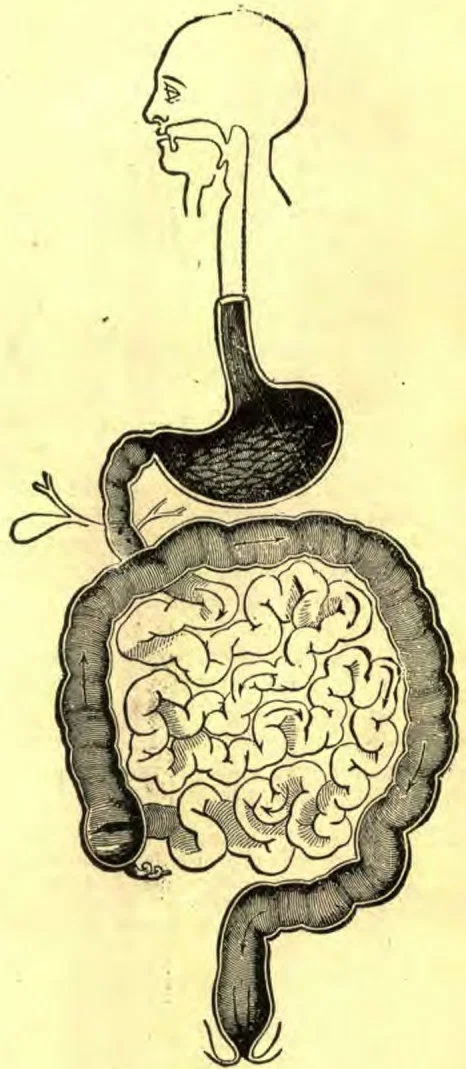
As we study the body that the Lord has given us, we see that it is wonderfully constructed. No wonder David exclaimed, “I will praise thee; for I am fearfully and wonderfully made.”
What have we learned thus far in our study of the body?—We have learned that man sustains a certain relation to the things with which he is surrounded. The eye receives light, giving the sense of sight. The nostrils receive air, which gives life to the body. They also contain the organs of smell, which receive the fragrance given off into the air. The ears receive sound, borne by the air. The skin is so constructed that we are able to feel the material things about us. The mouth is made to receive food that will build up our bodies. In it is the organ of taste, the tongue, which helps us enjoy our food. God has made everything pleasant for us. He has so constructed our bodies that we may enjoy the things with which he has surrounded us. We should honor him by keeping our bodies in so healthy a condition that we can enjoy these blessings, and use them to his glory. M. E. CADY.