It is a beautiful story told by Lafcadio Hearn of an old man whose great deed belongs to Japanese history. He was Hamaguchi, and his farmhouse stood on the verge of a small plateau, overlooking the bay. The plateau, mostly devoted to rice-culture, was hemmed in on three sides by thickly wooded summits; and from the outer verge, the land sloped down to the sea. Below were ninety thatched dwellings and a temple; these composed the village.
One autumn evening, Hamaguchi Gohei was looking down from his balcony on the preparations for some merry-making in the hamlet below. All the villagers were out, and he would have gone with them, had he not been feeling less strong than usual.
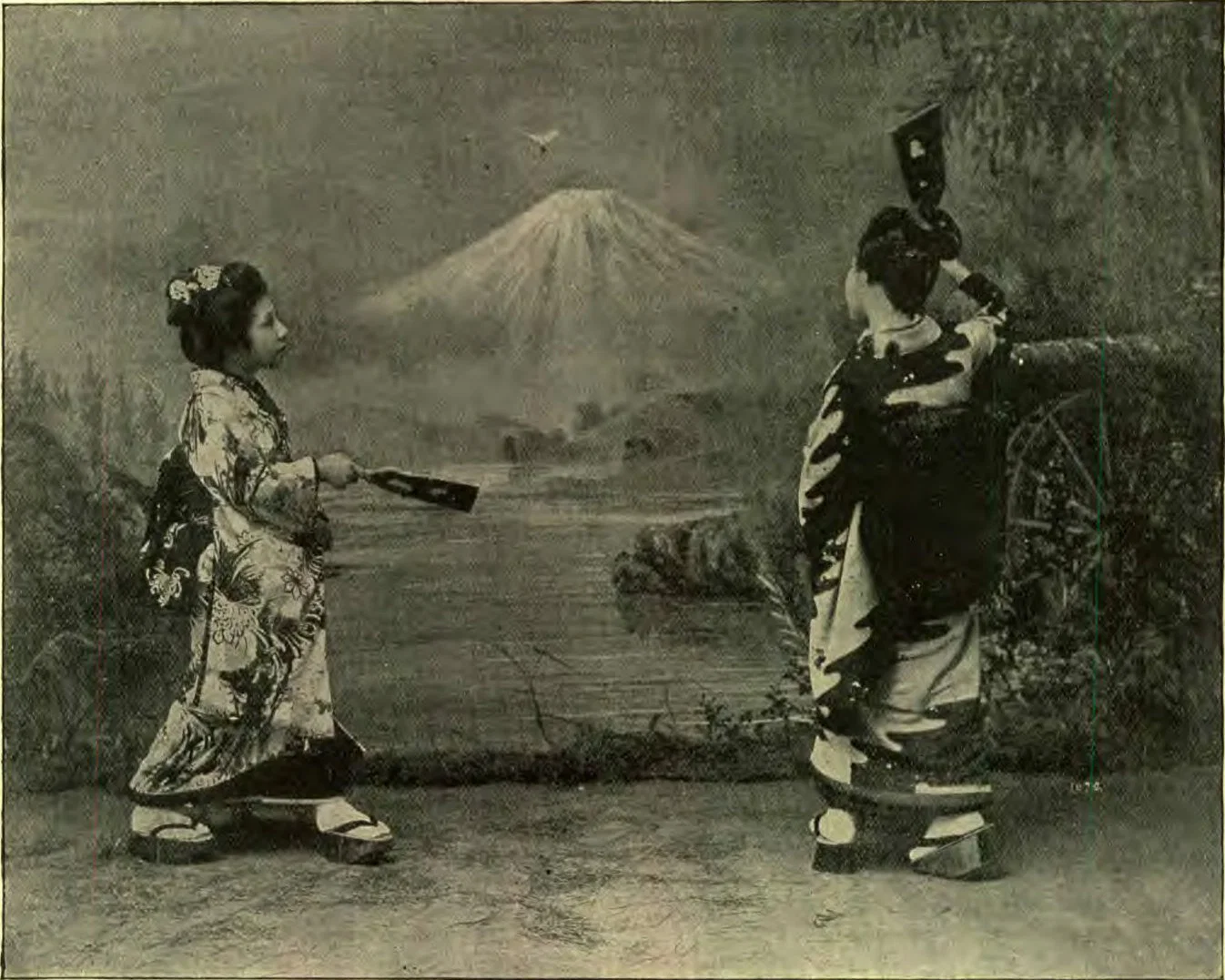
JAPANESE GIRLS PLAYING BATTLEDORE AND SHUTTLECOCK.
Suddenly there came an earthquake shock. It was not a very strong one; but Hamaguchi, who had felt many before this, thought there was something odd in its long, spongy motion. As the quaking ceased, he chanced to look toward the sea, and there he saw the strangest possible sight—it seemed to be running away from the land.
Apparently the whole village had noticed it, for the people stood still in wonderment; but only Hamaguchi drew any conclusions from the phenomenon, and guessed what the sea would do next. He called his little grandson, a lad of ten, the only one of the family left with him.
“Tada! Quick! Light me a torch!”
The child kindled a pine torch, and the old man hurried with it to the fields, where hundreds of rice-stacks stood ready for transportation. One by one he lighted them in haste, and they caught like tinder, sending skyward masses of smoke that met and mingled in one cloudy whirl. Tada, astonished and terrified, ran after his grandfather, weeping and calling, “Why? why? why?”
Hamaguchi did not answer; he thought only of four hundred lives in peril. He watched for the people, and in a moment they came swarming up from the village like ants.
And still the sea was fleeing toward the horizon. The first party of succour arrived,—a score of agile young peasants, who wanted to attack the fire at once; but Hamaguchi, stretching out both his arms, stopped them.
“Let it burn, lads!” he commanded; “let it burn. I want the whole village here.”
The whole village came, mothers and children last of all, drawn by concern and curiosity.
“Grandfather is mad. I am afraid of him,” sobbed little Tada. “He set fire to the rice on purpose. I saw him do it.”
“As for the rice,” said Hamaguchi, “the child tells the truth. I set fire to it. Are all the people here?”
“All are here,” was the answer; “but we can not understand this thing.”
“See!” cried the old man, at the top of his voice, pointing to the open. “Say if I be mad!”
It was the returning sea, towering like a cliff, and coursing swifter than the kite. There was a shock, heavier than thunder, as the colossal swell smote the shore, with a foam-burst like a blaze of sheet-lightning.
Then a white horror of sea raved over the village itself. It drew back, roaring, and tearing out the land as it went. Twice, thrice, five times, it struck and ebbed, each time with lesser surges; and then it returned to its ancient bed, and stayed there, although still raging. Of all the homes about the bay, nothing remained but two straw roofs, tossing madly in the offing. All lips were dumb until Hamaguchi observed, gently, “That is why I set fire to the rice.”
He was now as poor as the poorest in all the village; but he had saved four hundred lives. — Youth’s Companion.