25—Great Mullein

8%

Review and Herald Publishing Company · Battle Creek, Mich. · Sep 6, 1900

FromThe Youth’s Instructor, Vol. 48, No. 35.

Read the full edition

25—Great Mullein

24—Moth-Mullein

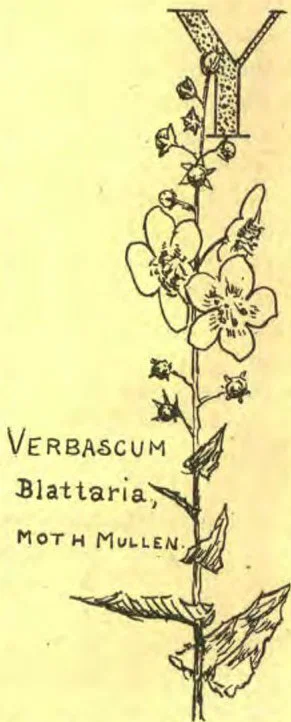
VERBASCUM Blattaria, MOTH MULLEN.
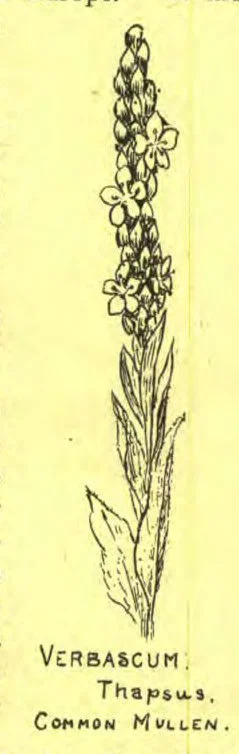
You would not suppose that this plant is related to our Common Mullein. However, it is closely related to it. The Moth-mullein is quite smooth, whereas our Common Mullein is very woolly throughout. The stem of the Moth-mullein is green and slender, while the stem of the Common Mullein is of a whitish green, and is tall and stout. The flowers of the Moth-mullein are large, showy, yellow or white, tinged with purple, and arranged at distances from one another on the stem: this method of flowering is called a “loose raceme.” The flowers of the Common Mullein are crowded close together in what is called a “dense spike,” and the flowers are much smaller than those of the Moth-mullein, and yellow.
The Moth-mullein is much visited by moths; hence its name. The flowers of the Moth-mullein perish in a short time after being picked. It is claimed that the cockroach and this plant can never agree, cockroaches holding it in great abhorrence.

25—Great Mullein

The Common Mullein, or Great Mullein, is called in Europe the “American Velvet Plant.” However, it is not a native of this country, but has been naturalized from Europe. It first came, it is claimed, from the Island of Thapsus.
VERBASCUM. Thapsus. COMMON MULLEN.
From its leaves the Greeks made lamp-wicks. The Romans prepared the dried stalks in suet, and burned them as funeral torches, calling them candelaria.
For a number of years the flowers have been collected, thoroughly dried, and kept in dry, well-stoppered bottles; dampness causes them to lose their delicate color. They are used to make poultices, and by the Germans to make a gargle for ulcerated sore throat. An infusion of the leaves is used for catarrhal affections.
Children sometimes rub the velvety leaves of this plant against their cheeks to produce a flush of color that almost rivals cosmetics.
L. A. REED.