It was in the summer of 1894 that two Americans, then staying in London, decided to visit the renowned French capital. One of them was a middle-aged professional man, who had traveled considerably in various parts of the world, and was consequently an excellent companion for such a trip. The other man was younger, not yet thirty, and his experience away from home was somewhat limited. He had seen several of the Eastern and Middle States; had visited the world-famed Niagara; and the year before had visited the Columbian Exposition. Besides this he had taken with nature’s kodaks a large number of mental pictures of the beautiful scenes so wonderfully spread out before one making a trip up the Hudson. These experiences, together with the ocean voyage to Queenstown and Liverpool, and the trip to London by rail in the odd, small, side-door, English compartment cars, had fanned into a blaze a long-smoldering fire of longing to see something of the great world in which we live.
Under these conditions these two persons were thoroughly mated, and well prepared to enter heartily into a search for the many interesting things of the strange city, from which to derive instruction and entertainment. With the Latin phrase, multum in parvo, in mind, concerning both time and expense, advantage was taken of a cheap, three-days’ excursion via the London, Chatham, and Dover Railway, leaving England’s metropolis at 8:30 Saturday night. Before the train started, every one seemed to speak English, though occasional traces of a foreign accent were heard, and an abundance of black hair and eyes on the crowded platforms of Holborn Viaduct Station showed that a larger percentage of Norman blood than is usually seen in a London crowd was present. As soon as the train started, however, and even before it had passed over the famous old “King Lud” hotel, situated under the Ludgate Hill bridge of this line, a jabbering of French was heard on all sides. This road is one of the great arteries of traffic and travel between the realms of Her Majesty, the Queen, and her neighbors of the great Continental Republic; and naturally enough, in addition to the number of English passengers “going abroad,” there were a large number of French subjects returning to their homes, who had been quite inconspicuous while mingling with the crowds of London, but who began to be much in evidence as they were thrown into one another’s company, and discovered many with whom they possessed a mutual language.
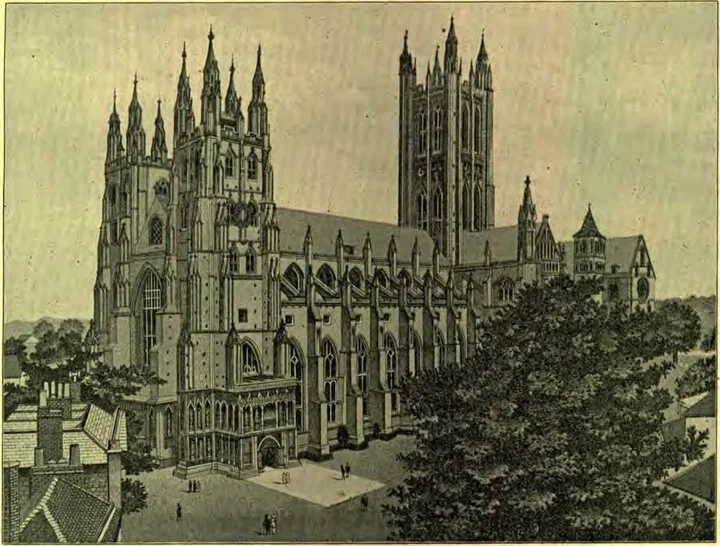
The ride to Dover lasted about two hours. The route lay through the ancient city of Canterbury, where is situated Canterbury Cathedral, the scene of Thomas à Becket’s murder; but the night was dark, and nothing much could be seen. These English cities are not so brilliantly lighted as are our American towns, or at least they were not at that time. The use of French continued to increase till Dover was reached, when it seemed that nearly every one was using the quick, soft speech of the smooth Latin tongue, in sharp contrast with the prevailing rougher Anglo-Saxon words heard two hours before. Here, after a half-hour’s delay, one of the Calais boats was boarded. The English Channel is rough,—very rough and choppy sometimes,—and these boats are not large, like the great “liners” of the Atlantic service; but a description of this feature of the trip will be omitted till the return journey, for fear that some might by its perusal miss the enjoyment that such a trip really affords.
By the time the shores of France were reached, not only was there much French to be heard in the commands of the custom-house officers, the orders of the railway foremen, and the shouting of the men under them; but English seemed to be a dead language. It will be remembered that only a short time before this date, the anarchist Vaillant had thrown a bomb in the Chamber of Deputies, in Paris, which resulted in the injury of many persons and damaged the auditorium to a considerable extent. This incident caused much excitement all through the nation; and on entering the country all foreigners were carefully scrutinized, and their baggage was subjected to a thorough examination . Although our travelers had only small hand baggage, even this caused considerable delay, especially as neither of them could speak French, and a French official who could speak English was, to their surprise, hard to find. At last the ordeal was over, and they were told to pass out to the train.
It was now two o’clock in the morning. On leaving the station a great railway yard was entered, where there were several trains, but which one to enter they could not tell. After searching some time, a coach was found on which was a card labeled “Paris;” but an attempt to enter it was quickly interrupted by a uniformed official who, up to this effort to help themselves, had seemingly paid no attention to the searchers. No reason was given for their not being allowed to take this train; but fromp. 282 the fact that it was finished better than others, and that it was the first to leave the station, the conclusion was reached that it was for regular passengers only, not for excursionists. After showing their tickets to the brass-buttoned official, the two Americans were turned over to a “guard,” or a “trainman,” as he would be called in England and America; but what appellation is given to him in Calais was not learned. With lantern in hand, he led the way across several tracks to the opposite side of the yard, opened a door, and motioned them to enter a dingy, ill-lighted, uncushioned compartment, in a black car, which can best be compared in outside appearance to a Lehigh Valley coal-car with a roof. For half an hour it had been dawning upon the Yankees that they were not receiving the courteous attention that a lavish use of francs and centimes would have secured, and now they had good reason to regret that the continental portion of their trip was to be as “excursionists.”
After a tedious delay, during which the first-mentioned train pulled out, this train was hauled out of the darkness, and backed up to the station platform. Then the other passengers entered the compartments of the cars, which are similar to those of England, except that they are much heavier, and evidently designed for longer journeys.
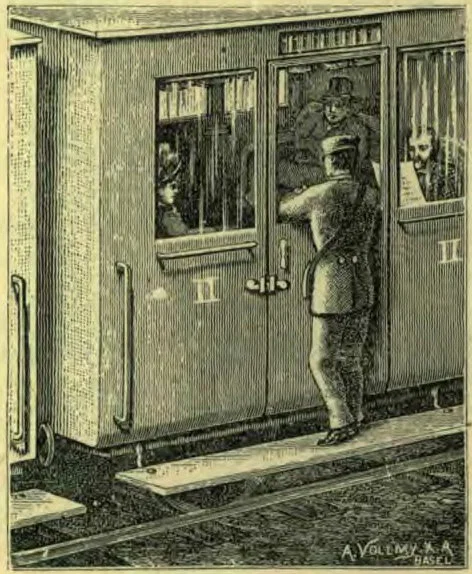
The section assigned to the two Americans received the addition of three Frenchmen and an Englishman who spoke French. The journey passed without incident worthy of mention till daylight, when other passengers, residents of the rural districts, took the places of some who had reached their journey’s end.
The Americans, now properly designated the foreigners, not being acquainted with the road, and not understanding the language, did not know the exact time they would arrive in Paris; so the younger one took out his timepiece, and pointing to it inquiringly, said to one of the latest occupants, “Paris”? He felt sure that the name would be recognized, and the man would understand that the time when the city would be reached was sought. But no; not a gleam of intelligence passed over the face of the Frenchman. The French-speaking Englishman came to the American’s assistance by informing him that Paris was not so pronounced in France. Said he, “You should say Paree.” On hearing that word the Frenchman became animated at once. Reaching for the watch, he pointed to seven and twelve, thus indicating that the train would reach the city at seven o’clock. He seemed quite pleased to be able to render this service. It was soon learned by the two Americans that what seemed to be a lack of courteousness on the part of the people with whom they were forming an acquaintance was due only to a failure to make themselves understood; and without doubt if those men at the station at Calais had been changing cars in Chicago or New York, the different manners and customs of American railways would have led them to think they were among a race of stupid, ignorant people. So much for a different point of view. That the newcomers in the car were considerate for others was soon proved by the act of a kind-hearted old man with an “Oom Paul” countenance, who made use of his snuff-box, and seeing the elder American eyeing it closely, passed it to him at once.
When the hands of the watch indicated 6:30, there began to be a bustle among the passengers in the little room of the car, especially among the ladies. Hats were adjusted, wraps fastened, children who had been eating were brushed up, and everything showed that the city was near. Soon the familiar outlines of the Eiffel Tower, so often pictured in modern literature, appeared to view through the right window, and the last possible fear that the wrong train might have been taken amid the confusion at Calais was dispelled. The great building in which the train stopped had over the door on the outside, facing the street, a sign reading, “Station du Nord.” By this it was learned that the train had entered and stopped in the north side of the city. A day or two later another station was entered, over the door of which was the word “Ouest,” associated with others now forgotten. The location was responsible for the conjecture that the word meant “West.” H. E. SIMKIN.
(To be continued.)