A TRIP TO PARIS

5%

Review and Herald Publishing Company · Battle Creek, Mich. · Sep 20, 1900

FromThe Youth’s Instructor, Vol. 48, No. 37.

Read the full edition

A TRIP TO PARIS

II

On leaving the train, our two travelers walked a considerable distance, mainly because there seemed nothing else to do. They did not know what to look for first, nor yet where to find it. Their walk led them to a tram-car, or street-car, station. Here, on paying a fare of thirty centimes (six cents) for inside seats, or fifteen centimes for outside seats, on the top of the car, a large brass check, with a number on it, was given to each prospective passenger. These checks were numbered in order, and the one purchasing first received the lowest number. When the car came, persons were admitted only on the presentation of the checks; and those holding the lowest numbers were admitted first. When all the seats were filled, no more were admitted till the next car came. By this ingenious system, which would work a revolution in the selfish, jostling, standing crowds of a Chicago street car, all were insured seats, and none could crowd in ahead of his turn.
The car taken runs on a slightly elevated street around the north side of the city. The visitors, seated on top of the car, facing the south, enjoyed a most delightful change from their tedious all-night ride and early morning walk. Having no objective point in view, they rode as far as the car would take them. By this means a good idea of the lay of the city was obtained. When nearing the end of the line, and while listening to the talk of their fellow passengers, a few words were sufficiently understood to convey to them the information that they were passing a Russian, or Greek, church. Its attractive exterior caused them both to decide upon a visit to it at the first opportunity. The next day this was accomplished; and in nothing during their whole visit were they more thoroughly repaid than in the investment of the small fee required to admit visitors to this church. Words would have to be combined very skillfully to convey any accurate idea of the grandeur of the place. Nothing in either Protestant or Catholic churches visited before or since will bear comparison with it.
The car stopped just before the Arc de Triomphe, the great pile that commemorates Napoleon’s triumphant campaigns. The top of the monument was reached by climbing two hundred stone steps in a winding stairway. From this position an excellent bird’s-eye view of the whole city was obtained. There were many visitors passing and repassing on the broad top; and among them our friends, fortunately for them, heard words in their own tongue from a lady and gentleman who were also visitors in the city, but who had mastered the language of the people. Being familiar with the place, this lady and gentleman kindly explained some confusing things about the points of the compass, pointed out several objects of interest, and told the best time to visit them,—information which was much appreciated.
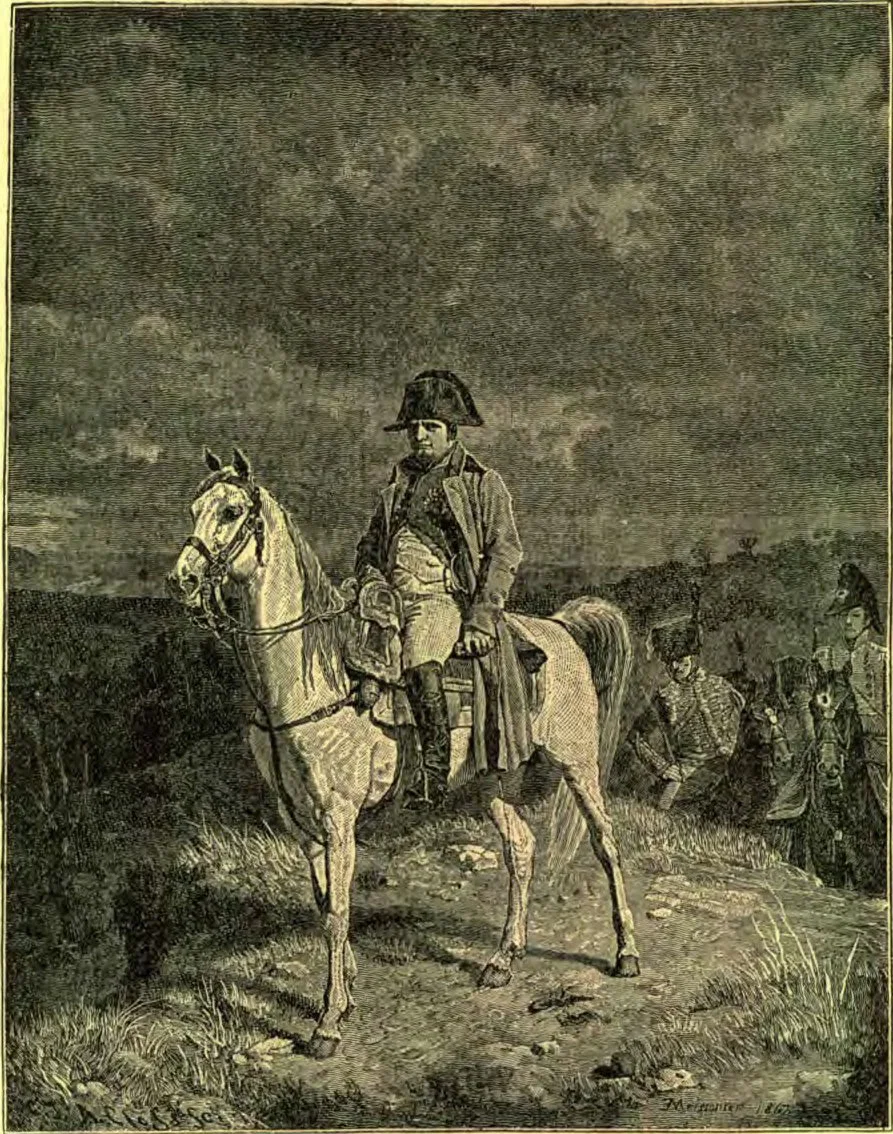
NAPOLEON ON HORSEBACK
The next place visited was the exposition site of 1889. Several of the buildings had been torn down, but some were still standing.
Beyond these is the Eiffel Tower, previously mentioned as the first prominent object seen on entering the city. Under one corner of its massive frame our tourists seated themselves to rest and study a map of the city and its surroundings. While busily discussing this map, a gentleman approached unobserved. He, too, was a stranger in the city, being a delegate from Toronto, Canada, to a Sunday-school convention in England. While there, he made the usual visit to Paris, and was attracted to the seat by hearing the familiar sound of his own tongue. This bond of union proved to be mutual, and the three were together till he left for home, two days later. The Canadian said he had found a pleasant English hotel, and invited his new friends to stay there. The landlady had a large sign over the door, reading, “English Hotel;” but on being asked what part of England she came from, she confessed she had never seen England. She was born in India, which of course is under British control.
The English hotel, however, was some distance from the tower, where this meeting took place. Soon after this incident some one suggested something to eat, as it was already noon. A restaurant was near at hand; and a guide, who had been secured for an after-dinner’s visit to the Hotel des Invalides, proposed the place for dinner, and volunteered to act as interpreter at the meal. After considerable delay, dinner was announced,—but what a dinner! Probably it would have tasted well enough to one who was used to it, but to the Americans it was nauseating. Our friends did not learn just what was set before them, but one dish was found to be fried string-beans, over which a bountiful supply of strong oil had been poured.
After dinner, when the bill was asked for, the greatest surprise was manifested. Two attendants sat down at a table, with paper, pens, and ink, and for fifteen or twenty minutes wrote vigorously. At last a sheet was perfected. The guide, who undoubtedly was to receive a percentage, interpreted its contents. Each item of the meal was mentioned, and a price stated for it in the right-hand column. After a list that seemed far to exceed what had been served, came an item for “service.” This was for the time of the waiters in preparing the meal, and making out the bill! Next followed an item for “tablecloth,” and lastly one for “napkins.” By the time the last item was read, the guests began to wonder if a charge would be made for chairs, knives, forks, etc., and for the air breathed.
The bill was exorbitant, and protests were freely made, the claim being entered that the charges were much higher than for similar service in London. The guide said he would see what could be done about it; and after a long conference with the proprietors, he returned, saying that no reduction could be made. Said he, “You see, gentlemen, Paris is not London. London is a commercial city, but Paris is a city of pleasures, and people expect to pay for them.” The bill was paid, and thus another lesson was learned.
The visit to the Hotel des Invalides was one never to be forgotten. The front portion of the building is square, surmounted by an immense gilded dome, underneath which is a basin of similar proportions. This excavation, the dome, and indeed this whole section of the building, are finished with dazzling splendor. In the center of the basin-like, inverted dome, which is several feet below the floor where visitors are allowed, is the last resting-place of Napoleon, the national hero of France. Born in a soldier’s camp; educated in a military school; and as a young man trained to endure hardship without a protest, and carnage without a conscience, he attained among men a position that many regard as the highest ideal of life. But what was really gained?—He died an exile on an isolated island, without even the common comforts of a peasant’s home. Looking at his career from the standpoint of this life only, his voyage on life’s ocean was a terrible shipwreck; but regarding the possibilities of a life beyond for such as he, nothing hopeful can be said.
A large portion of the building in which this tomb is situated is set apart as a home for the old soldiers of the republic, many of whom have been maimed for life, and were seen hobbling about on a wooden stump, or walking with an empty coat-sleeve. An interesting museum of old armor and other relics of different periods of the national life of France is also connected with the place. Beautiful gardens extending to the river, and filled with flowers alongside the well-kept gravel walks, form a fine promenade for the old veterans.
As the tourists left this place, they walked a short distance to a large building guarded by soldiers. They did not know what the place was; but being there to see all there was to see, they started up the walk toward the front doors. A soldier motioned them to stop, but they were persistent. An attempt was made to pass him, but two other soldiers near at hand presented bayonets at close quarters, so that no progress could be made. At this juncture a higher officer, who had been watching at a little distance, came up, and tried his best to make the tourists understand something, but they only indicated a desire to enter the building. After some parleying the officer indicated by signs that if the small satchel carried by the elder visitor was surrendered, they could proceed. This was at once agreed to, the men even offering umbrellas, jackknives, etc. The satchel was taken, and with a good-natured smile the other articles were refused.
A young soldier was assigned the duty of escorting the men through the building. At the door he again plied them with questions, but to no avail. He could not make them understand French. After passing through a hall, they were shown into a large auditorium, with seats arranged in a partial circle, those in the rear being elevated considerably higher than those in front. As they stood facing these seats, which nearly surrounded them, the guide tried to tell what the room was, but none of the party could understand at first. Finally he pointed to a large chair on the platform behind them, and said, “Président.” Then it dawned upon the mind of the younger visitor that they were in the Chamber of Deputies, which in France corresponds to the House of Commons in England, or the House of Representatives in Washington. On his speaking the words, “Chamber of Deputies,” the French soldier exclaimed, enthusiastically, “Oui, oui,” meaning, “Yes, yes.”
Much pleased that he had been able to convey this information, the guide made another effort to interest his visitors. Pointing to a section where several seats were torn out, and carpenter’s scaffolds were placed, he tried for some time to tell about it, but was unsuccessful in making himself understood. His audience tried their best to understand, but could not. At that another Frenchman in civilian dress, who had fallen in with the party, proposed to try an explanation. He put his hands together, as if expressing the shape of something round; then, motioning with his arms, as if throwing something toward the demolished seats, he exclaimed, with much force, “Whiz! Bang!” The effort was well planned, and entirely successful. The younger visitor said the word, “Anarchist,” and he said, “Oui, oui, anarchist,” pronouncing the word with the soft sound of ch. The word “dynamite” was also mutually understood.
The repairs going on were to restore the damage done by the bomb thrown but a short time before by Vaillant, as previously mentioned. This lesson had taught the French guards to be suspicious of strangers, and no one could blame them. By keeping the satchel outside, they were guarding against another bomb being carried into the building.
After seeing this room, the visitors were taken into adjoining rooms, where, although it was Sunday, several men were at their desks. They all regarded the visitors with great suspicion, and would not remove their eyes from them while in their presence. The young soldier was put to his wit’s end to understand the things spoken to him; but he thoroughly understood, before they left, that his guests were from America, the name of the country, and also the words, “Etats-Unis” (United States) being spoken by him. A mention of Lafayette also brought a pleased look to his face, showing that he was aware of the assistance rendered this country by one of his nation.
H. E. SIMKIN.
(Concluded next week.)