The text-books say that “zoology is that part of natural history which tells us how animals are formed, how they are classed, what they do, and all about their homes.”
Under this heading Windon found that the animal kingdom includes five subkingdoms,—Vertebrata, Articulata, Mollusca, Radiata, and Protozoa. He kept saying it over and over, until he knew it by heart.
He loved animals, and was learning all he could about them. He caught some hedgehogs, and tried to tame them. He had fox-squirrels gayly spinning in a wheel. He searched the ponds and streams, and came home with tiny red bugs, water-spiders, and beetles. Crabs and turtles interested him, and all wild birds.
But what were the Vertebrata?—“Animals that have brains and spinal cords, like men, horses, snakes, and fishes,” said his book.
It was very curious, Windon thought, if he were an animal. He could hardly believe it at first; but he became reconciled when his teacher told him that man is much higher in the scale of being than a cat, or a dog, or a horse.
He had seen wasps, with their heads and bodies joined together with a thread-like something, not thicker than a pin, and had noticed that bees and ants and crabs are jointed in much the same way. These he found were Articulates, and belonged in the division Articulata. “Articulate” means “having the body and members jointed.”
Snails, he supposed, were hard, and also oysters; but his book said they are soft, mushy animals, and are, therefore, to be classed with the Mollusca, or mollusks. The hard part, the shells, are only their houses.
Windon had never been to the ocean; but there were starfishes in his uncle’s collection of curiosities, and these, he was told, were Radiates, also that the pretty coral and the jellyfish belong to the same class, because their organs, inner and outer, are arranged like the petals of a flower, radiating from the center, their mouths being in or near the center.
Windon had used a sponge in cleaning his slate, and had seen his uncle wet sponges, and put them under his arms when he had a fever; but though he knew the curious things came from the sea, he had forgotten that they are animals.
Yet here they were classed with the Protozoa,—“animals with no proper mouths,” yet taking nutrition, trembling when touched, and smelling like scorched wool when burned.
He liked it all, and prized the book that told him about “four feet, wings, and fins,” more than any other in his library.
It was not long until he could tell that the Vertebrata are divided into five classes,—Mammals, Birds, Reptiles, Amphibians, and Fishes,—and that Mammals are subdivided into four subdivisions,—Archontia, referring to man alone; Megasthenia, the larger and more powerful mammals; Microsthenia, the smaller mammals; and Oöticoidea, mammals that carry their young in a pouch, or bag, like the opossum and the kangaroo.p. 294
Then he learned the orders of the Megasthenes, or larger mammals; that they are the Quadrumana, or four-handed, like the monkeys; the Carnivora, or flesh-eating, like the wolf and the lion; and the Herbivora, or herb-eating, like the ox and the horse; and the Cetacea, ocean mammals, having fins instead of feet, like the whale.
Windon then made a diagram of his lesson, much as you do of a sentence when studying grammar.
It looked something like this:—
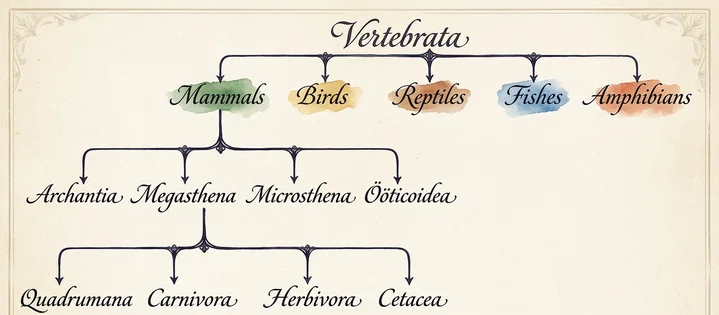
This helped him to remember.
AUNTIE WINCE.