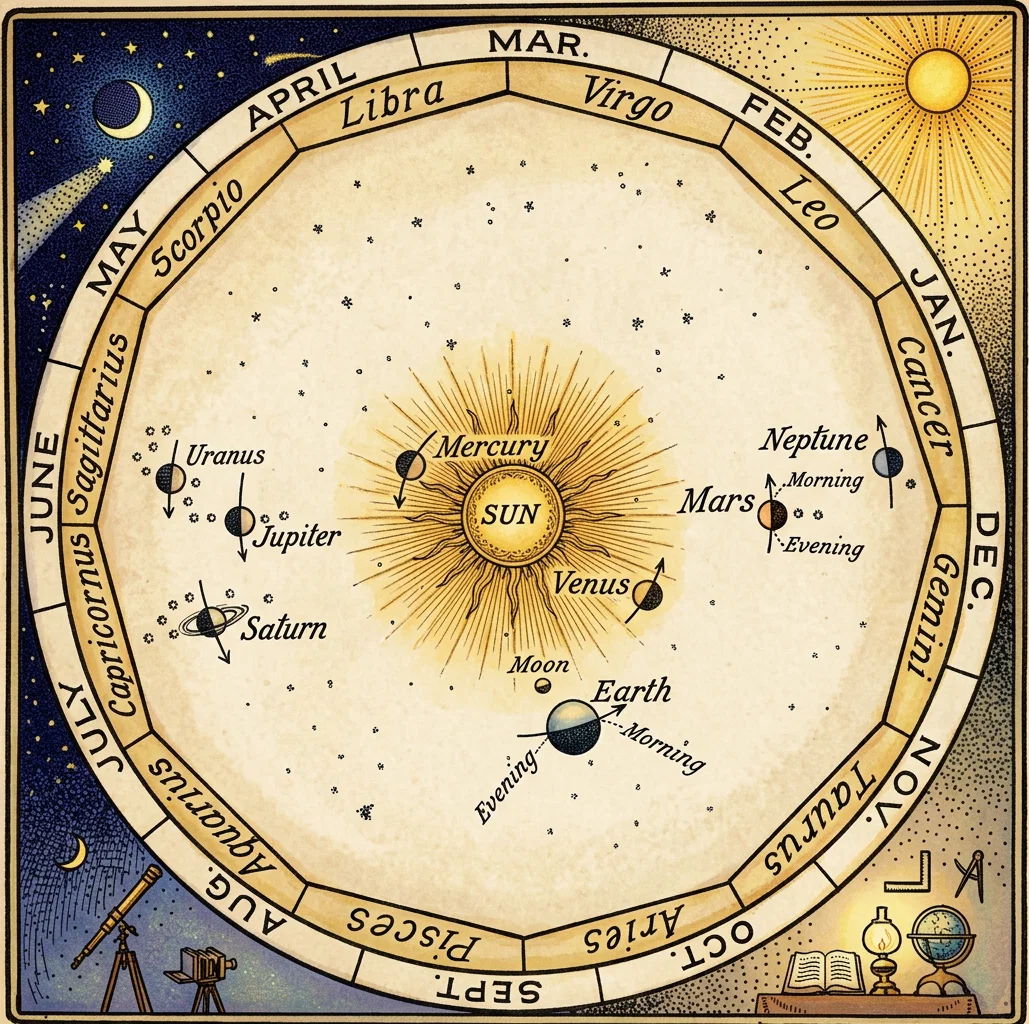
In the INSTRUCTOR bearing date of August 23, we presented a diagram of the solar system, showing the relative positions of the sun, earth, moon, and planets as they would be September 1, 1900. This week we are pleased to call the attention of our readers to the same subject, showing the position of the planets as they will be October 1, 1900. We are glad to learn that so many of the INSTRUCTOR family are making a real study of these subjects, and feel that they are being benefited thereby. We can scarcely see how any one can study the majestic workings of our Heavenly Father without having his soul drawn out to the Author and Giver of all our many blessings.
Now let us study, together, this present diagram, carefully comparing it with the one that appeared in the issue of August 23.
Restored with AI
First let us notice the planet Neptune—the one farthest from our sun, and the one requiring a longer time than any of the others to make its yearly revolution around the sun. So far as the diagrams are concerned, we can not see that Neptune has made any progress during the whole month of September. Why do you suppose this is? Think a moment, and see if you can not tell.
We will tell you: although it has been moving swiftly on in its course at the rate of about twelve thousand four hundred miles each hour, it is so very far away from the sun that it requires one hundred and sixty-six years of our time to make one year of its time; this will explain why it has apparently made no progress during one month of our time.
So far as appears on the diagrams, the planets Uranus and Saturn have made but little onward progress, owing to their great distance from the sun.
Next we come to Jupiter, which we see has made some visible progress, as we find it has gained somewhat on Saturn, and left Uranus somewhat in the rear. By the way, how many are watching the real planet Jupiter in its movements among the other stars of the evening291heavens? We know of several who are, with us, enjoying this study, and we wish all would. You remember that for a long time this planet appeared to be moving westward among the stars, then for some time it seemed to stand exactly still; but that ever since the middle of August, it has been moving again on toward the east. How carefully did we watch for the first visible shifting of its position toward the east! You remember we told you in an article about this planet some time ago that it would do this very thing, and we know many were pleased to see how faithfully it obeys the Father's commands. May we as faithfully walk in the pathway he has marked out for us.
The next planet that claims our attention in our journey toward the sun is Mars, which, as you will readily see, has made considerable progress, having gained quite perceptibly on Neptune. Now how many can tell, by looking at the diagram, whether Neptune is a morning or an evening star to the inhabitants of Mars? Notice carefully, and see who can tell. Yes; it is a morning star, and has been for some time. How can we tell? Notice again, and see from which place on Mars could you see Neptune the better,—at the point marked “Evening,” or at that marked “Morning.” From the “morning” side, of course. Now another question: By the middle of November, Mars will have so far passed Neptune as to leave it considerably in the rear: will Neptune then be a morning or an evening star to the people living on Mars, supposing that planet to be inhabited?
Our own earth has, of course, moved onward one twelfth of the circle during the last month, and the moon will be in nearly the same position. Venus has been speeding on so as to get considerably ahead of us; while Mercury, which was a morning star last month,—that is, it could be seen from the “morning” side of our earth,—has so sped its rapid flight that we see it peeping around on the “evening” side of the sun, and so it becomes an evening star. Although we speak of Mercury as being an evening star from September 13 to November 29, we shall be privileged to see it but a very few evenings during that time. You who wish to make the acquaintance of this planet may have the privilege of doing so, provided the weather is pleasant, on the evenings of October 28–30. You will see it hanging low in the southwestern sky immediately after sunset. Watch it, and see how rapidly it moves onward in its journey.
One word further as to how to apply the diagram to the heavens themselves. In the evening, stand facing the south, with the top of the diagram to your right. This will bring the sun to the west of you, and you will see Jupiter and Saturn low in the southwestern sky, just as illustrated in the diagram.
You are to imagine yourself as being on that part of the earth marked “Evening,” rolling away from the light of the sinking sun into the dark shadow of the earth. In the morning, stand facing the south; but with the top of the diagram to your left, which will bring the rising sun to your left, or the east; then imagine yourself upon that part of the earth that is just rolling out of its shadow into the light of day, and you will see Venus and Mars as morning stars, as illustrated in the diagram.
Fix these things in your mind, apply what you learn to the heavens themselves, and you will have within yourselves an understanding of the movement of these worlds in their courses that will be a source of wisdom, instruction, and satisfaction that can not be obtained from a superficial piling up of cold facts and figures. May the Lord bless our Instructor family as, together, we study the beauties of his heavens, which continually declare his goodness and glory.