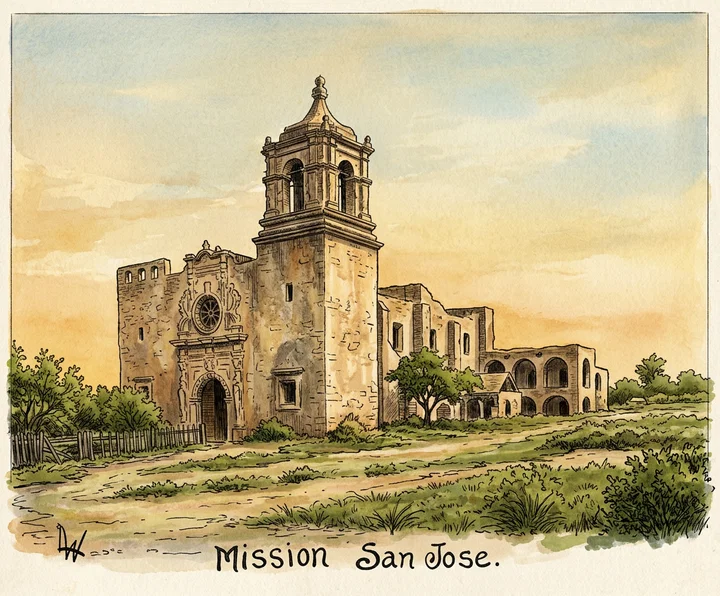
It was almost two hundred years ago that the Jesuits pushed inland from the Gulf of Mexico, and beheld in rapture the curling stream and the lovely valley where now is situated the city of San Antonio. Far enough from the Gulf to escape undue humidity, and at an elevation of about six hundred and fifty feet, it is practically free from malaria. For years this city has been a Mecca to those afflicted with throat and lung troubles. The soil is porous, and the rains therefore sink quickly. The winds are dry, and there are no fogs. Because of these advantages, and also because of the mild and delightful winter weather, San Antonio is fast becoming the popular health resort of the Southwest. Many make this place their home during the winter months, thus escaping the rigors of more northern latitudes during that season.
Founded by the Spanish, there yet remain some of the buildings that they erected, though by far the greater number are in ruins. The old ascequias missions have almost crumbled to the ground; a few, however, have been restored as relics of the old Spanish domination.
Historically, San Antonio is interesting for having been a fortress and a battle-field. More than a dozen times has it been besieged and captured. The most notable siege was that of the Alamo, March 6, 1836, in which David Crockett’s little band of Texans, under Colonel Travis, in defending the place against overwhelming numbers of Mexicans, were slain to a man. Upon the heavy stonework of the Alamo were carved many inscriptions, now almost obliterated by the effacing hand of time.
Much has been done in recent years to increase the attractiveness of the city. Parks, plazas, boulevards, asphalted streets, and many handsome public buildings are to be seen. The plazas, together with the large Mexican population, give to the city a Mexican likeness, as do also the crumbling adobe huts surrounded each with its clump of mesquite trees, in which, morning and evening, may be heard the mocking-bird.
The river itself is not without interest. Indeed, it is a wonderful river. Only a few miles farther up, in the foothills of the Guadalupe Mountains, the water bursts forth from beneath the rocks a full-fledged river. The water is exceptionally clear. Little is yet known of the subterranean origin of this stream.
One must not miss visiting the market on market morning. It is a motley throng that greets the eye,—negroes, Mexicans, Italians, Jews, Chinese, each busy making his purchases of poultry, eggs, vegetables, meats, fish, oysters, crabs, fruit, etc. Each vender calls out his wares; and the tumult occasioned by so many voices, mingled with the sound of numberless feet, the squawking of poultry, etc., combines to make the place a pandemonium. One is glad to escape, and make his way to the river’s cool and shady banks, where the results of the curse are less apparent.
Leslie J. Weese.